Glacier Rope Diameter Calculator
Estimate a practical glacier travel rope diameter from team size, carried load, rope certification, crevasse-fall severity, hauling system, strand count, knots, wet-rope condition, and device compatibility.
🏔Glacier Rope Presets
⚙Rope, Load, Team, and System Inputs
This calculator estimates rope sizing from simplified load models, common rope diameter ranges, approximate rope efficiency, and device limits. It is a planning aid only; always follow rope manufacturer instructions, current standards, local conditions, and trained glacier-rescue judgment.
🧵Rope Type and Spec Grid
Twin-rated glacier rope
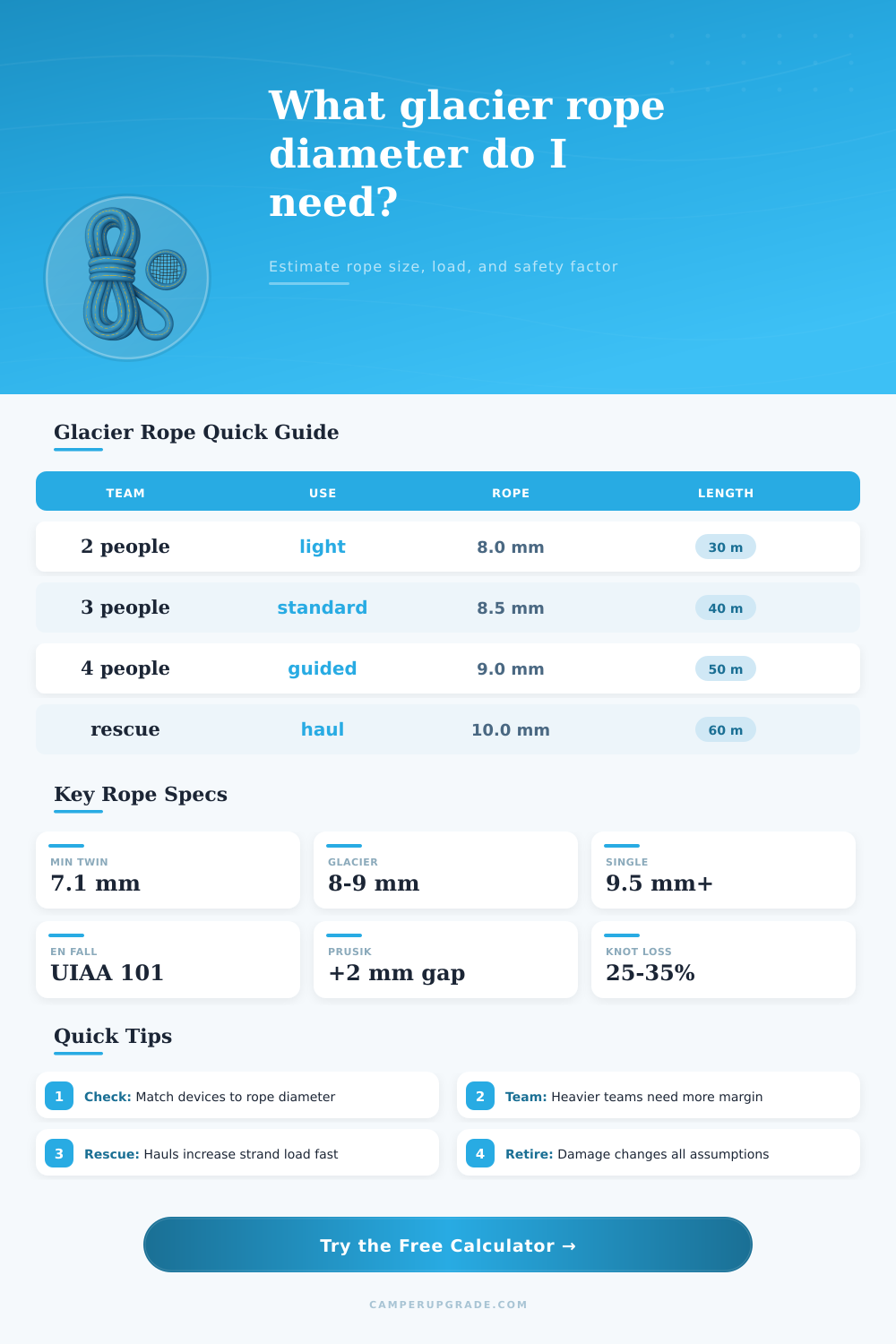
7.1-8.0 mmLight glacier travel; check device limits and pair rating.
Half rope used singly
8.0-8.9 mmCommon glacier compromise with better handling than ultralight cord.
Skinny single rope
8.9-9.5 mmMore margin for mixed glacier and alpine use.
Full single or rescue rope
9.6-10.5 mmDurable handling for training, hauling, and repeated systems.
📊Formula Reference Cards
📘Glacier Rope Diameter Reference Tables
| Diameter | Typical Class | Handling | Use Case |
|---|---|---|---|
| 7.1-7.8 mm | Twin or specialty | Very light | Expert light teams |
| 8.0-8.4 mm | Half or glacier | Light | 2-3 person travel |
| 8.5-8.9 mm | Half or skinny single | Balanced | Standard glacier rope |
| 9.0-9.5 mm | Skinny single | Durable | Guided or rescue mix |
| 9.6-10.5 mm | Single or rescue | High margin | Training and hauling |
| Team Setup | Spacing | Common Rope | Reserve |
|---|---|---|---|
| 2 people | 35-45 ft | 30-40 m | low |
| 3 people | 35-45 ft | 40-50 m | medium |
| 4 people | 30-40 ft | 50-60 m | medium |
| 5-6 people | 25-35 ft | 60 m | variable |
| rescue team | as needed | 60-70 m | high |
| System | Load Factor | Friction | Notes |
|---|---|---|---|
| travel arrest | 1.0x | low | single catch |
| 1:1 pull | 1.2x | medium | lip drag |
| 2:1 loop | 1.7x | medium | pulley loss |
| 3:1 Z-pulley | 2.4x | high | anchor load |
| 5:1 compound | 3.2x | high | rescue margin |
| Device Range | Rope Fit | Prusik Cord | Check |
|---|---|---|---|
| 7.1-8.0 mm | micro | 5-6 mm | manual |
| 8.0-8.5 mm | light device | 6 mm | common |
| 8.5-9.5 mm | guide device | 6-7 mm | smooth |
| 9.5-10.5 mm | rescue device | 7 mm | durable |
| 10.5+ mm | work line | 7-8 mm | bulky |
💡Rope Diameter Calculation Tips
When you travel on a glacier, you need to use a ropes to attach yourself to the other people in your group. A rope is used to prevent people from falling into a crevasse, as well as for performing rescue operation should someone fall into a crevasse. The diameters of the rope that you use must be appropriate for the situation.
A rope that is too heavy to carry for many miles can be difficult to transport, but a rope that is too thin may not have enough strength to safely prevent individual from falling into a crevasse or performing a rescue of an individual that has fallen into a crevasse. While many travel group may choose the diameter of the rope based off the recommendation of a guide for the area in which the group will travel, the individual group members should choose the diameter of the rope according to the specific need of that group. The diameter of the rope is just one of many variables to consider as part of the safety system that the individuals that will travel on the glacier will create.
How to Choose a Rope for Glacier Travel
Other variables to consider include the number of individual that are traveling on the glacier, the size of the group, and the spacing between each of the individuals that are traveling on the glacier. The larger the group size, the more effective each group member may be in slowing the fall of the individual that begins to fall into a crevasse. However, the larger the group, the more variables that may impact the rope and the safety system.
Additionally, the spacing between individuals on the glacier is another variable; the more space that is provided between each individual, the more likely that the individual that begins to fall will land on even ground rather than a drop into a crevasse. However, the more space provided to each individual also means more rope to manage during any rescue operations of an individual that falls into a crevasse. The circumstances of the individual that begins to fall into a crevasse may also impact the strength of the rope.
For instance, the weight of the individual, the momentum of the individual, and the friction of the rope against the snow will create a force that is placed upon the rope. Such friction is one variable that may increase the force that is applied to the rope. For instance, if the rope rubs against the lip of a crevasse, the ice may increase the tension upon the rope.
Therefore, another variable to consider is the type of snow and ice in which the group will travel. The type of snow and ice may impact the way in which the rope reacts to the individual that may fall into the crevasse. Another factor to consider is the compatibility of the climbing hardware with the diameter of the rope.
The diameter of the rope may be appropriate for preventing individuals from falling into a crevasse, but the rope may be too thin for the friction hitches or other climbing hardware that the group will utilize on the glacier. Friction hitches must be able to grip the rope to which the individual is attached; the rope may become wet or icy. If the rope is too thin for the friction hitch, the friction hitch will not be able to function apropriately, and the individual will not be able to be securing to the rope.
Therefore, each individual must ensure that there hardware will work with their rope. An additional factor to consider is the strength required to perform a rescue of an individual that has fallen into a crevasse. While the strength required for pulling an individual across the glacier is different than the strength required for performing a rescue, a mechanical advantage system, such as a Z-pulley system, will increase the load that is placed upon the rope.
Therefore, any rope that is sized for the travel portion of the travel on the glacier may not be of sufficient strength for the rescue portion of such a trip. Other factors to consider include the effect that the environment will have upon the rope. For instance, the rope may degrade with exposure to the water and grit in the environment.
The rope may wet, dirty, or change in some way due to the environment. Additionally, another factor to consider includes how knots will reduce the strength of the rope. Any knot may reduce the strength of the rope by a significant amount.
Therefore, any rope should be considered in regard to the effect that a knot will have upon the strength of that rope. Finally, another factor to consider is the diameter of the rope in regard to providing a sufficient safety factor for the individual and the activity that is to be performed. Any activity may require a certain safety factor for the rope in order to account for any potential error in the group.
For instance, the safety factor may account for the possibility of a poorly tied knot, a frayed rope end, or other error. Additionally, the rope is a tool that only becomes effective if the individuals that are using the rope are also trained to use that rope and its hardware.