3 Way Fridge Propane Usage Calculator
Estimate RV absorption fridge propane use from burner BTU rating, duty cycle, trip length, tank fill, reserve, ambient heat, and door-opening load.
Propane usage breakdown
| Propane measure | Energy value | Equivalent amount | Calculator use |
|---|---|---|---|
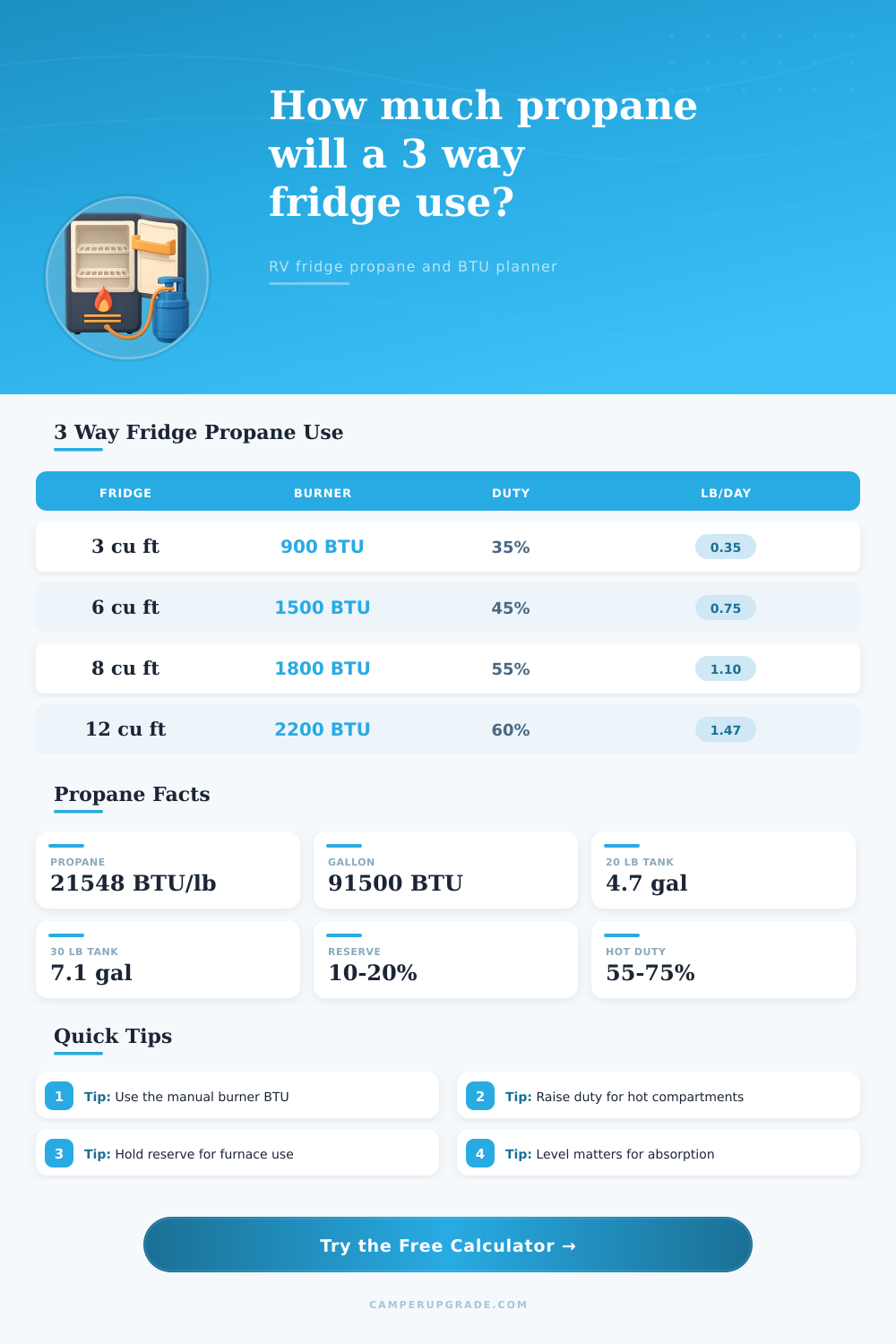
| 1 pound of propane | About 21,548 BTU | 0.236 gallons | Converts fridge BTU/day into pounds per day |
| 1 gallon of propane | About 91,500 BTU | About 4.24 pounds | Converts pounds into gallons for tank planning |
| 20 lb cylinder | About 430,960 BTU | About 4.7 gallons | Common portable RV and grill cylinder size |
| 30 lb RV cylinder | About 646,440 BTU | About 7.1 gallons | Common travel trailer and fifth-wheel cylinder |
| 40 lb RV cylinder | About 861,920 BTU | About 9.4 gallons | Larger towable RV propane storage |
| Fridge class | Typical LP burner | Typical burner duty | Propane estimate |
|---|---|---|---|
| Compact 3 cu ft absorption fridge | 800-1000 BTU/hr | 30-45% | 0.27-0.50 lb/day |
| Small 5 cu ft RV fridge | 1100-1300 BTU/hr | 35-50% | 0.43-0.72 lb/day |
| Common 6 cu ft RV fridge | 1400-1600 BTU/hr | 40-55% | 0.62-0.98 lb/day |
| Mid-size 8 cu ft RV fridge | 1700-1900 BTU/hr | 45-60% | 0.85-1.27 lb/day |
| Large 10-12 cu ft absorption fridge | 2000-2400 BTU/hr | 50-70% | 1.11-1.87 lb/day |
| Condition | Duty adjustment | Why it matters | Calculator choice |
|---|---|---|---|
| Cool shaded vents, 55-70°F | Subtract 5-10 points | Lower condenser temperature shortens burner cycles | Cool shaded vent stack |
| Normal campsite, 70-80°F | No change | Matches many manual and field estimates | Normal campsite |
| Warm compartment, 80-90°F | Add 5-10 points | Absorption systems reject heat less easily | Warm compartment |
| Hot sun, 90-105°F | Add 12-20 points | Long burner cycles and weak draft raise LP use | Hot compartment |
| Frequent door openings | Add 5-15 points | Warm air and unchilled food increase heat load | Opening load selector |
| Available propane | At 0.5 lb/day fridge | At 1.0 lb/day fridge | At 1.5 lb/day fridge |
|---|---|---|---|
| 5 lb cylinder with 10% reserve | 9.0 days | 4.5 days | 3.0 days |
| 11 lb cylinder with 10% reserve | 19.8 days | 9.9 days | 6.6 days |
| 20 lb cylinder with 10% reserve | 36.0 days | 18.0 days | 12.0 days |
| 30 lb cylinder with 10% reserve | 54.0 days | 27.0 days | 18.0 days |
| 40 lb cylinder with 10% reserve | 72.0 days | 36.0 days | 24.0 days |
| RV fridge style | LP mode behavior | Strength | Planning caution |
|---|---|---|---|
| 3 way absorption fridge | LP flame heats ammonia absorption boiler | Low battery draw while parked | Propane use rises sharply in heat |
| 2 way absorption fridge | LP or 120V electric heating source | Common in travel trailers | Still needs level operation and vent draft |
| 12V compressor fridge | No propane; electric compressor cycles | Efficient on battery systems | Requires battery and charging capacity |
| Residential 120V fridge | No propane; inverter powered | Large cold storage volume | Inverter and battery losses dominate |
| Portable propane cooler | Small absorption system on LP | Useful away from the RV | Often lower cooling capacity in hot weather |
A 3-way absorption fridge use a propane flame to maintain the internal temperature of the fridge. These refrigerators dont have their propane flame lit continuous. Instead, they utilize a burner duty cycle for the propane flame to maintain the temperature in the fridge.
The burner duty cycle are the percentage of time the propane flame is lit in a specific period. Since there are various variable at play in the operation of these refrigerators, these refrigerators will consume the amount of propane accordingly. Some of the variables that will impact the propane consumption of a 3-way absorption fridge include the environmental factor in which the refrigerator is located.
What Affects Propane Use in a 3-Way Absorption Fridge
If the refrigerator is located in an area that is shaded and feature a breeze, the refrigerator will be able to efficient reject the heat that is produced within the fridge. However, if the refrigerator is in an area that is constantly hot, such as a parking lot in the summer, the burner duty cycle will have to increase to reject the additional heat from the environment. As a result, the propane will empty more quick from the propane tank.
Another factor that will impact the amount of propane consumed by the fridge is the BTU rating of the fridge. The BTU rating tell the consumer how much heat the fridge is capable of producing in an hour. Additionally, by multiplying the BTU output of the fridge by the duty cycle of the fridge, a person can calculate the amount of propane that will be used in a 3-way absorption fridge.
For example, a 6 cubic foot fridge has a duty cycle of 45 percent. However, the duty cycle isnt a static number and can change. The duty cycle can change to more higher percentages in areas with higher ambient temperatures and fridges that are opened more frequent.
The third variable to consider that will impact the propane consumption of these refrigerators is the condition of the ambient compartment of the fridge. These refrigerators use condenser coil to reject the heat that is produced in the fridge. If the area around the fridge become a heat trap for other appliance, the condenser coils will not be able to effectively reject the heat that is produced in the fridge.
This will cause the fridge to become less efficient in maintaining the internal temperature. Consequently, the burner will have to remain lit for longer period of time to maintain the desired internal temperature of the fridge. This longer period that the burner is lit will consume more propane in the fridge.
Another human variable that will affect the propane consumption of the fridge is the number of times that the fridge door is opened. Each time the fridge is opened, warm air enter the fridge and cold air leaves the fridge. This cause the fridge to work harder to compensate for the warm air in the fridge.
If a person open the fridge a number of times, the duty cycle of the fridge will increase. An increase in the duty cycle will cause the fridge to use more propane to maintain the internal temperature of the fridge. The last variable to consider is the size of the propane tank for these refrigerators.
The propane tank will not be filled to 100% of its capacity, as many propane tanks are only filled to 80% of the tanks liquid volume. This is to avoid the dangerous risk of tank explosion due to excessive pressure create by the propane in the tank. Additionally, other appliance in the house may also use the same propane tank as the 3-way absorption fridge.
For example, other refrigerators, a furnace and water heater will use propane from the tank. The furnace will use a significant amount of propane to heat the house. Therefore, if a person maintains a 20% propane reserve for the furnace, they will ensure that the propane tank still has enough propane for other needs of the household.
The altitude at which these refrigerators is located will also impact their propane consumption. High altitude feature thinner air. As a result, the propane flame will not be as efficient in burning propane at high altitude compared to area at sea level.
Consequently, the 3-way absorption fridge will have to run the burner for longer period of time at high altitudes to produce the same amount of propane flame output as compared to the amount that it produce at sea level. Therefore, refrigerators will consume more propane at high altitudes then they will at sea level. By understanding each of these variable, a person can estimate the amount of propane that will be consumed in a 3-way absorption fridge.
Using the duty cycle of the fridge, a person can account for the amount of propane that will be used given the environmental condition, the number of times the fridge door is opened, and the altitude of the refrigerator. If a person accounts for these variable, they will understand how much propane is left in the propane tank and have confidence in the fridges ability to keep the food cold.