🌲 Black Locust Firewood BTU Calculator
Estimate usable heat from black locust stacks by moisture, split size, bark, and appliance efficiency.
📋Quick Presets
🧮Calculator Inputs
Enter the mass of the stack, tote, or sample you want to rate.
20% means 20 lb of water per 100 lb of oven-dry wood.
Represents how much of the fuel energy becomes useful heat.
📋Black Locust Heat Snapshot
🌳Black Locust Species Reference
| Species | Dry BTU/lb | Seasoned cord lb | Heat note |
|---|---|---|---|
| White oak | 8600 | 3800 | Long, steady heat |
| Red oak | 8550 | 3600 | Dense and reliable |
| Hickory | 8800 | 3900 | Very high output |
| Hard maple | 8500 | 3400 | Balanced burn |
| Ash | 8300 | 3000 | Easy startup |
| Beech | 8400 | 3700 | Dense stove fuel |
| Birch | 8400 | 3200 | Quick ignition hardwood |
| Pine | 7900 | 2200 | Fast-start softwood |
| Cedar | 7300 | 1900 | Quick kindling |
| Poplar | 7300 | 2100 | Low-density heat |
💧Moisture Impact Table
| Moisture | Dry frac. | Net BTU/lb | Use case |
|---|---|---|---|
| 0% MC | 1.00 | 8600 | Oven dry |
| 10% MC | 0.91 | ~7600 | Very dry |
| 20% MC | 0.83 | ~7000 | Good stove fuel |
| 30% MC | 0.77 | ~6300 | Still wet |
| 40% MC | 0.71 | ~5700 | Greenish stack |
| 60% MC | 0.63 | ~4700 | Fresh split |
| 80% MC | 0.56 | ~4000 | Recently cut |
| 100% MC | 0.50 | ~3400 | Very green |
🔧Split and Seasoning Factors
| Condition | Factor | Behavior | Best use |
|---|---|---|---|
| Rounds / unsplit | 0.94 | Slow drying | Outdoor stack |
| Chunky splits | 0.98 | Moderate airflow | Long burns |
| Standard splits | 1.00 | Balanced burn | General heat |
| Small splits | 1.03 | Faster ignition | Shoulder season |
| Kindling | 0.92 | Quick flash | Fire start |
| Fresh cut | 0.90 | High steam loss | Not ideal |
| One season | 0.96 | Mostly dry | Heat stack |
| Two seasons | 1.00 | Stable fuel | Best all-around |
📈Energy Benchmarks
| Benchmark | Typical value | Units | Note |
|---|---|---|---|
| Oven-dry wood | ~8600 | BTU/lb | Chemical basis |
| Seasoned oak cord | ~22-28 | MMBtu/cord | Species dependent |
| Seasoned softwood cord | ~15-20 | MMBtu/cord | Lower density |
| Water evaporation | 970 | BTU/lb water | Moisture loss |
| 1 BTU | 1.055 | kJ | Metric bridge |
| 1 MMBtu | 1.055 | GJ | Large heat load |
| 1 lb fuel | 0.45 | kg | Mass conversion |
| 1 cord | 128 | ft3 | Stack volume |
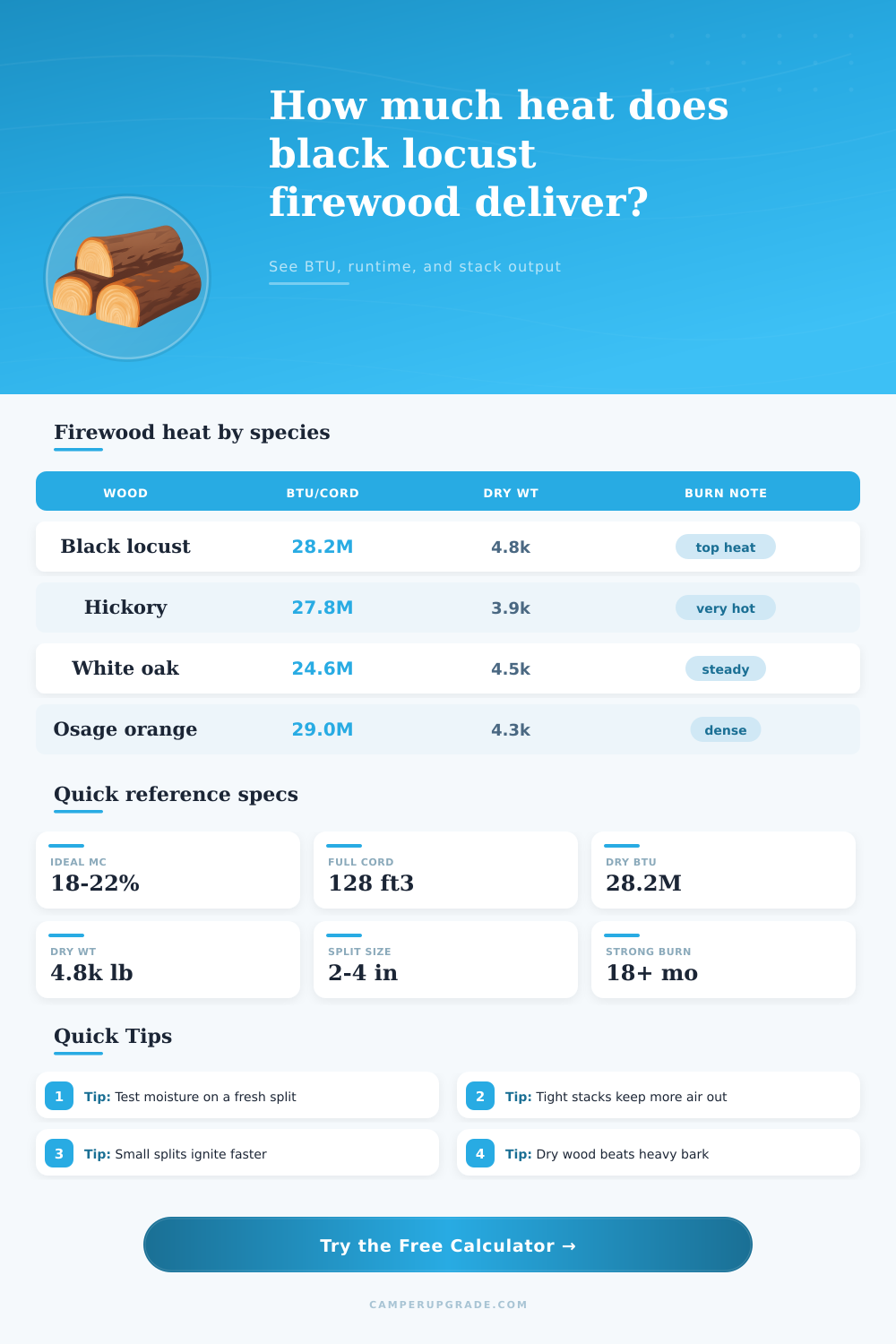
Black locust is a type of hardwood that can produce a significant amount of heat when burned in a stove. Black locust is a dense type of wood. The density of black locust allow black locust to produce a significant amount of heat when burned.
However, the amount of heat that black locust produces is dependent upon the moisture content of the black locust. If the black locust that you are going to burn are still green (or wet), the moisture within the black locust must first evaporate before the black locust can produce heat. The evaporation of this moisture consume some of the energy that would otherwise be provided to the room as British Thermal Units (BTU).
How to Burn Black Locust Wood for More Heat
To avoid losing energy to the evaporation of moisture, it is important to ensure that black locust to be burned is season (to remove moisture). Black locust should be seasoned to have a moisture content of around 20%. If the moisture content is above 20%, the black locust will produce more smoke and less heat.
Seasoning black locust will increase the efficiency of the fire. To season black locust, split the black locust into smaller piece and begin to stack the split black locust in a location with good airflow. Airflow will allow the moisture to leave the black locust more quick.
Many variable will impact the total amount of heat that a wood stack produces. Some of these variables include the weight of the wood that is to be burned, the moisture content of the wood, the size of the splits of the wood, and the efficiency of the stove in which the wood is burned. For instance, small splits of wood will ignite more easy than large splits of wood.
However, because of the large surface area of small splits of wood, the small splits of wood may burn out more quickly than large splits. Another variable is whether or not the wood contain bark. Because bark has the ability to trap moisture within the wood, wood that contains bark will have higher moisture content than wood that does not contain bark.
Wood with higher moisture content will contain less BTUs than wood with lower moisture content. A calculation tool is available that can help to determine how much heat the wood that is to be burned in the stove will produce. This calculation tool allow the user to input the weight, moisture content, and type of wood that is to be burned.
Based off these inputs, the calculation tool will output the net BTU per pound of the wood that is to be burned and the total amount of heat that the wood stack will provide. This calculation helps to provide an understanding of how much heat the wood that is to be burned will provide. For instance, if black locust with a moisture content of 20% is to be burned, the calculation tool will provide a higher output of BTU than if black locust with a moisture content of 40% was to be burned.
Another factor that will impact the amount of heat that is provided to the home is the type of stove that is used to burn the wood. Moddern stoves are typically more efficient than older model of stoves. Efficiency in relation to wood burning stove is achieved by the redirection of heat that would otherwise escape the stove through the chimney.
As a result of using an inefficient stove model, much of the energy that was stored in the black locust will be wasted. Another variable is the management of the draft within the stove. The draft will impact how efficiently the stove burns the black locust.
A draft that is too wide for the stove will result in the heat from the black locust burning out of the stove through the chimney. Conversely, if you adjust the draft proper, the stove will burn the black locust more effectively. Another variable to consider is the time that is required for seasoning the black locust.
Black locust typically requires 18 months of seasoning in areas that is humid. To ensure that the black locust is seasoned properly, a moisture meter can be used to determine the moisture content of the black locust. This meter will provide an accurate measurement of the water content of the black locust.
It is important to note the moisture content of the black locust as determined by the moisture meter. Rather than relying upon the appearance of the black locust to determine it’s moisture content, you must measure the moisture content of the interior of the black locust. If the moisture content of the interior of the black locust is high, then the black locust will not burn as efficient within the stove.
Additionally, high moisture content within the black locust will cause the black locust to produce creosote within the chimney of the stove. The amount of heat that black locust will produce is determined by the density of the black locust, the moisture content of the black locust, and the efficiency of the stove in which the black locust is burned. In order to increase the efficiency of the burning of the black locust, you should split it into smaller pieces to allow the black locust to dry and stacked in a location that allow airflow to the black locust.
By managing the moisture content and the draft within the stove, black locust will provide heat to the home consistently and effective.