Angle of Elevation Calculator
Work out rise, sightline, and required height from eye level, terrain change, and horizontal distance.
📋Scenario Presets
⚙Measurement Inputs
📊Geometry Spec Grid
📘Reference Tables
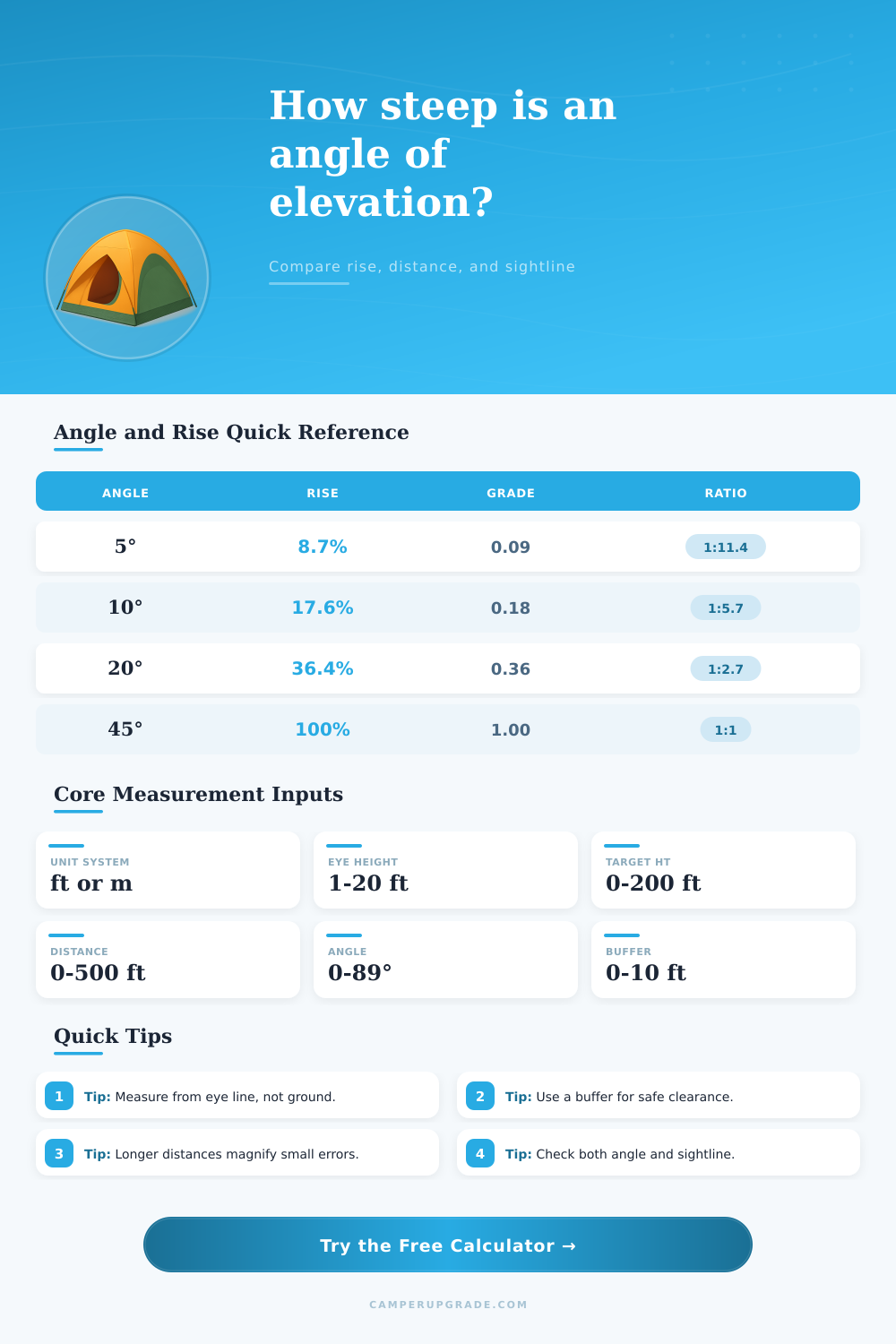
| Angle | Rise per 100 | Grade % | Slope ratio |
|---|---|---|---|
| 5° | 8.7 ft | 8.7% | 1:11.4 |
| 10° | 17.6 ft | 17.6% | 1:5.7 |
| 20° | 36.4 ft | 36.4% | 1:2.7 |
| 45° | 100.0 ft | 100% | 1:1 |
| Distance | 10° rise | 15° rise | 30° rise |
|---|---|---|---|
| 25 ft | 4.4 ft | 6.7 ft | 14.4 ft |
| 50 ft | 8.8 ft | 13.4 ft | 28.9 ft |
| 100 ft | 17.6 ft | 26.8 ft | 57.7 ft |
| 200 ft | 35.3 ft | 53.6 ft | 115.5 ft |
| Project | Eye line | Distance | Angle |
|---|---|---|---|
| Roof peak | 5.5 ft | 60 ft | 18° |
| Tree canopy | 1.7 m | 24 m | 27° |
| Flagpole | 5.0 ft | 80 ft | 11° |
| Hill marker | 1.6 m | 40 m | 15° |
| Measured LOS | Horiz. run | Vertical rise | Check |
|---|---|---|---|
| 61 ft | 60 ft | 18.0 ft | Close match |
| 26 m | 24 m | 12.3 m | Within range |
| 82 ft | 80 ft | 16.2 ft | Low angle |
| 44 m | 40 m | 10.7 m | Steady slope |
The angle of elevation are the measurement of the upward tilt of an object from the persons eye level to the object of interest. The angle of elevation is use to determine the vertical rise of an object. When measuring the angle of elevation, a person is working with a right triangle.
In a right triangle, the horizontal distances from the object is the base of the triangle, and the vertical rise is the opposite side of the triangle. To calculate the vertical rise of an object, a person can use the tangent function of the angle of elevation. The tangent function are equal to the vertical rise divided by the horizontal distance.
How to Find Height Using the Angle of Elevation
The horizontal distance from the object and the vertical rise of the object must remains separate in the calculation. If a person incorrectly uses the distance from the object along the slope line-of-sight to the object, which is the hypotenuse of the triangle, then the person will calculate the incorrect vertical rise of the object. The base of a triangle are shorter than the hypotenuse.
The height of a persons eyes above the ground must also be account for when calculating the angle of elevation. A person does not measure the angle of elevation from the ground. A person measure the angle of elevation from the level of the persons eyes.
If a person does not account for eye height, they will calculate an underestimated vertical rise of the object. The height of the object of interest above the ground, also known as the target height, must also be accounted for in the calculation of the vertical rise. If the object of interest is sitting on a base that is above the ground, the height of that base must also be included in the calculation.
The difference in ground between the person measuring the angle of elevation and the object of interest must also be accounted for in the calculation of the vertical rise. If the object of interest is on ground that is higher than the persons ground elevation, then the angle of elevation will be a positive elevation. However, if the object of interest is on ground that is lower than the persons ground elevation, then the angle of elevation will be a negative elevation.
Therefore, a person must account for the difference in ground elevation between themselves and the object of interest to calculate the angle of elevation correct. If a person makes any error in measuring the angle of elevation of an object, a person can make mistake in constructing the object of interest. For instance, if a person measures the distance from themselves to the object along the sloped line of sight instead of the horizontal distance between themselves and the object, then the angle of elevation will indicate that the slope of the objects vertical rise is more steeper than it is actualy constructed.
The impact of this error is even more significant on long distance. A small error in the measurement of the angle of elevation will have a large impact on the vertical rise of an object over long distances. Thus, a person should use a level or an application that calculate the angle of elevation to account for the horizontal distance from the object.
Additionally, a person should calculate a buffer distance to the vertical rise to account for the width of the object, wind, or other measurement inaccuracy. A person can refer to a table of grade percentages and ratios to help with calculating the angle of elevation of an object. These reference table show the grade percentage of the object and the ratio of the vertical rise to the horizontal distance.
For instance, a ratio of 1:11 is associated with an easy grade of the object, while a ratio of 1:1 is associated with a 45-degree angle of elevation. Thus, reference tables help a person to estimate the angle of elevation prior to calculate the vertical rise and horizontal distance of the object. The primary reason to use the angle of elevation correctly is for the safety of the individual measuring the angle of elevation.
In constructing an object or placing tools in specific locations, a person should incorporate a buffer into every calculation. A buffer allows a person to account for the swaying of an object, such as a ladder, or to account for measurement mistake. When measuring an object over a long distance, even a small mistake in the angle of elevation will result in a large error in the vertical rise that must be constructed.
This error in vertical rise can create a safety hazard. Thus, by calculating the angle of elevation of an object correct, by accounting for eye height and target height, and by incorporating a buffer to the vertical rise to account for errors in measurement or ladders swaying in the wind, a person can correctly place their tools or ladder at the appropriate height to reach the object of interest. It is alot of work to do it right.
If your dont take time, you might of missed something.