💧 72 Hour Kit Water Calculator
Estimate emergency drinking, cooking, and hygiene water for a full 3-day kit
| Use | Gallons / Day | Liters / Day | Notes |
|---|---|---|---|
| Adult drinking | 1.0-1.5 | 3.8-5.7 | Base survival range |
| Child drinking | 0.5-1.0 | 1.9-3.8 | Lower body mass |
| Infant drinking | 0.25-0.5 | 0.9-1.9 | Use age-appropriate supply |
| Cooking | 0.2-0.4 | 0.8-1.5 | Meals and rehydration |
| Hygiene | 0.2-0.5 | 0.8-1.9 | Wipe-down only |
| Pet water | 0.25-1.0 | 0.9-3.8 | Depends on size and heat |
| Container | Volume | Water Weight | Best Use |
|---|---|---|---|
| 1-gal jug | 3.8 L | 8.34 lb | Easy carry |
| 2-L bottle | 0.53 gal | 4.4 lb | Grab and go |
| 5-gal can | 18.9 L | 41.7 lb | Home cache |
| 10-L bladder | 2.64 gal | 22.0 lb | Vehicle kit |
| Case of 6 x 1L | 1.59 gal | 13.2 lb | Daily rotation |
| 12-oz bottle | 0.09 gal | 0.63 lb | Ration packs |
| Household | 3-Day Gallons | 3-Day Liters | Approx. Containers |
|---|---|---|---|
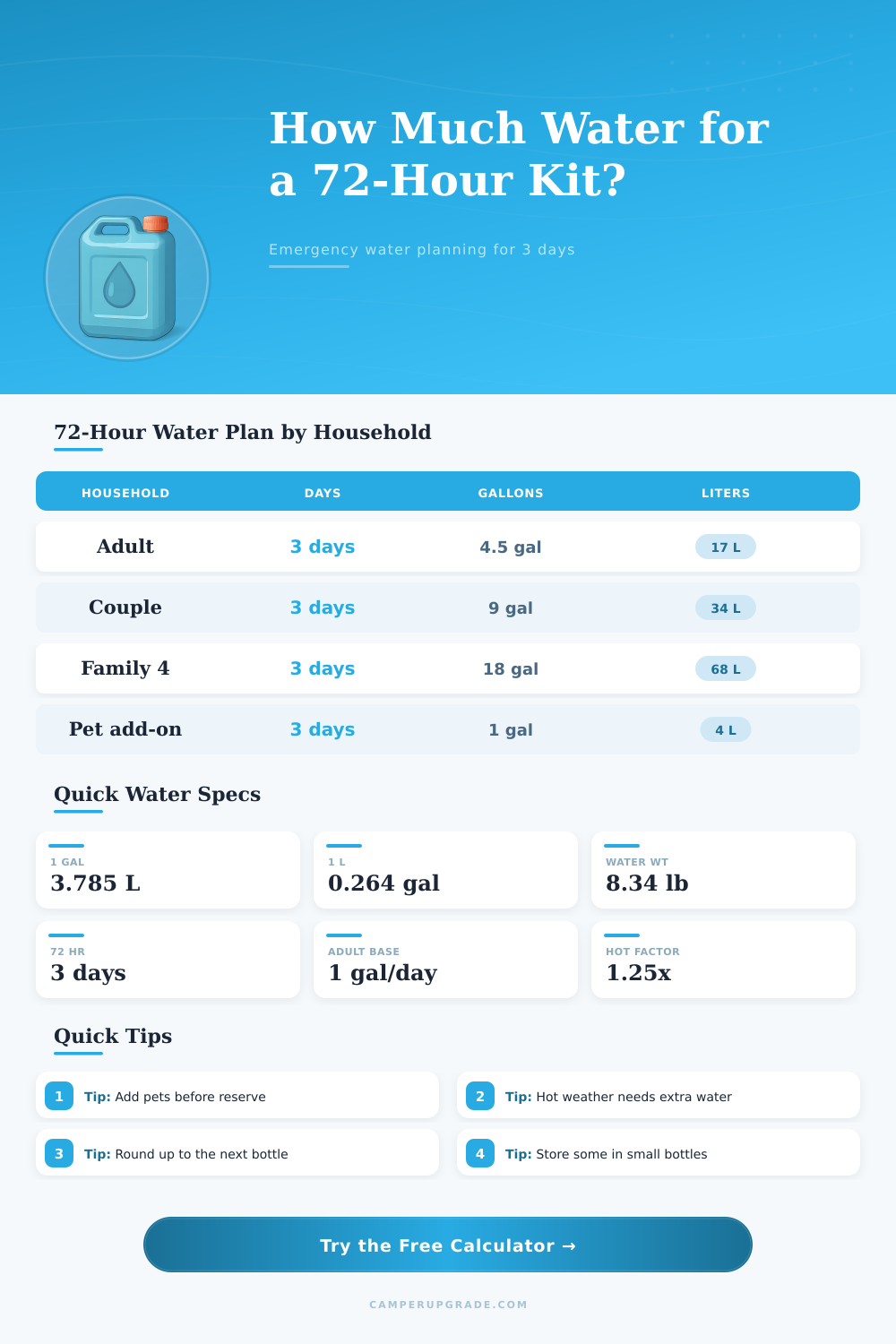
| 1 adult | 3-5 | 11-19 | 3-5 jugs |
| 2 adults | 6-10 | 23-38 | 6-10 jugs |
| Family of 4 | 12-18 | 45-68 | 12-18 jugs |
| Family + pet | 15-24 | 57-91 | 15-24 jugs |
| Heat adjusted | +10-25% | +10-25% | Add margin |
| Spill reserve | +5-20% | +5-20% | Round up |
| Item | Rotation | Method | Check |
|---|---|---|---|
| Sealed tap water | 6-12 mo | Cool, dark place | Look for leaks |
| Bottled water | 12 mo+ | Keep sealed | Inspect caps |
| Filtered water | Rotate often | Use clean containers | Smell and clarity |
| Treatment tabs | Replace by date | Store dry | Read label |
| Boiled water | Short term | Cool fully first | Re-seal container |
| Open containers | Use fast | Cover tightly | Discard if stale |
Water is one of the vital resource for humans to survive. Water is necessary to maintain an individuals health during a power outage or natural disaster. A 72-hour kit contain the supplies necessary to sustain one or more individual for three days.
Water should be included in a 72-hour kit because three days are the standard length of time that is required to survive a power outage or natural disaster. An adult require approximately one gallon of water per day for drinking purpose. One gallon of water per day is required for drinking purpose for the human body to properly regulate it’s body temperature and to flush waste.
Include Water in Your 72-Hour Kit
Infants and children require less water than adults due to their small bodies. However, infants and children are more vulnerable to dehydration. In addition to the water required for drinking, there is also water that is needed for cooking and hygiene.
Quarter-gallons of water per person is required for cooking tasks. Additionally, water is also required for hygiene task like sponge baths. Finally, water is required for pet, as well.
Including water for pets is necessary because pets require water to remain healthy. The amount of water that an individual require increases based off certain environmental and physical factors. For instance, the amount of water that an individual requires increases with hotter weather; hot weather cause individuals to sweat more.
Additionally, the amount of water that an individual requires increases with physical stress on the body; stress can cause individuals to drink water at a greater rate then they typically do. To account for these factors, an individual should include a buffer of approximately ten percent more water than the amount that is calculate for the supplies needed. Finally, the total amount of water needed should be rounded up to the nearest full container; rounding up ensures that there is enough water to last the individual for the three day period.
The container in which the water is stored can affect the way in which an individual use the water. For instance, while one gallon containers of water are easy to carry, they are also very heavy when full (over eight pounds); one gallon of water weigh over eight pounds. Additionally, smaller bottles of water are useful for individuals who require small amount of water; smaller bottles allow for the water to be doled out in small portions.
However, water should be rotated every six months to one year. Tap water that is stored in clean one gallon containers will last for six months to one year if stored in a cool and dark place. If the container of water is opened, bacteria can enter the water, and the water may become unsafe for drink.
While water treatment tablets can kill the pathogens in the water, they will not remove chemical contaminant from the water. Boiling the water will make it safe to drink, but require a fuel source. Many individuals make mistake when preparing their 72-hour kit.
For instance, many individuals dont think to include water for cooking. Additionally, many individuals also dont think to include water for hygiene, only a small amount of water is needed for hygiene task like taking sponge baths. Many individuals also dont think to include water for their pet.
Additionally, many individuals do not account for the fact that hot weather increases the amount of water that an individual need. Finally, many individuals do not consider the weight of the water; a large amount of water are very heavy to move. Despite these mistakes, there are ways to calculate how much water an individual need.
One person need three to five gallon of water per day. A family of four will need twelve to eighteen gallon of water per day. These amounts can be increased if the family have any pets.
Additionally, five gallon containers can be stored in the home. Furthermore, two liter bottle can be stored in a portable bag. Despite these general guideline for creating a 72-hour kit, it is also important to customize the kit to meet the specific need of the individual preparing the kit.
For instance, infants require water that is very pure because it is used to prepare their formula. Additionally, the elderly may require an extra supply of water to drink to take their medication. If the individual preparing the kit may need to move, lightweight container can be chosen for the water.
Finally, the kit should be test by filling each container and lifting each container to evaluate how much the water weigh. Additionally, the water in the container should be rotated; the stored water can be used for daily task in order to keep it fresh. Including water in a 72-hour kit ensures that there is a supply of water that will accompany individuals during a disruption.