12V Wire Gauge Calculator
Estimate camper, RV, van, boat, and solar circuit wire size from one-way length, amps, voltage drop target, conductor material, temperature, and bundled wires.
Formula Breakdown
| AWG | Area circular mils | Copper ohms per 1000 ft | Common 12V use | Baseline ampacity |
|---|---|---|---|---|
| 18 | 1620 | 6.385 | small signal, LEDs | 10A |
| 16 | 2580 | 4.016 | lights, fans | 15A |
| 14 | 4110 | 2.525 | pumps, outlets | 20A |
| 12 | 6530 | 1.588 | fridges, sockets | 25A |
| 10 | 10380 | 0.999 | chargers, panels | 35A |
| 8 | 16510 | 0.628 | DC-DC chargers | 50A |
| 6 | 26240 | 0.395 | large chargers | 65A |
| 4 | 41740 | 0.249 | small inverters | 85A |
| 2 | 66360 | 0.156 | battery links | 115A |
| 1/0 | 105600 | 0.098 | inverter feeds | 150A |
| 2/0 | 133100 | 0.078 | large inverters | 175A |
| 4/0 | 211600 | 0.049 | main battery runs | 230A |
| Load type | Suggested drop | 12V loss | Why it matters |
|---|---|---|---|
| Battery chargers, solar controllers, fridge electronics | 3% | 0.36V | Charging accuracy and low-voltage cutoffs are sensitive. |
| Water pumps, roof fans, USB outlets | 5% | 0.60V | Good balance of wire size and performance. |
| Incandescent lamps or short intermittent accessories | 10% | 1.20V | Only for tolerant loads where dimming or slower operation is acceptable. |
| Inverter battery cables | 2-3% | 0.24-0.36V | High current turns small resistance into large heat and shutdown risk. |
| Condition | Derating factor | Applies to | Calculator effect |
|---|---|---|---|
| 2-3 current-carrying conductors | 1.00 | typical duplex run | full baseline ampacity |
| 4-6 current-carrying conductors | 0.80 | shared loom | reduces allowable amps |
| 7-9 current-carrying conductors | 0.70 | crowded cabinet bundle | often upsizes one gauge |
| 10-20 current-carrying conductors | 0.50 | dense wire chase | requires major ampacity check |
| 50°C ambient with 75°C cable | 0.75 | hot compartment | lowers ampacity margin |
| 60°C ambient with 90°C cable | 0.71 | roof or engine-adjacent run | hot-run conservative sizing |
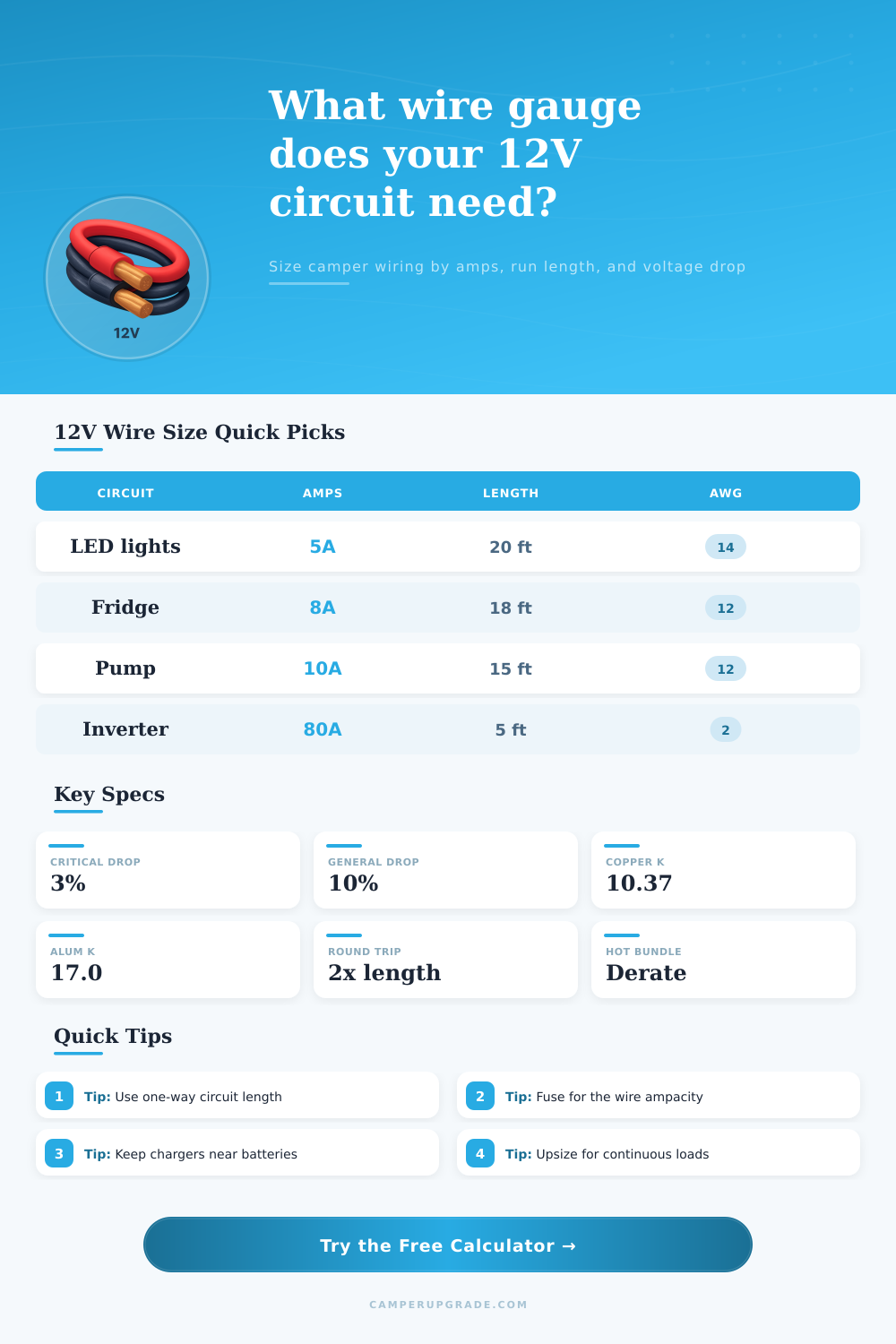
| Circuit | Typical current | One-way length | Drop target | Common copper size |
|---|---|---|---|---|
| LED cabin branch | 3-5A | 15-25 ft | 5% | 16-14 AWG |
| Compressor fridge | 6-10A | 12-20 ft | 3% | 12-10 AWG |
| Fresh water pump | 7-12A | 10-18 ft | 5% | 14-12 AWG |
| 30A solar controller to battery | 30A | 4-10 ft | 3% | 8-6 AWG |
| 40A DC-DC charger | 40A | 10-20 ft | 3% | 6-4 AWG |
| 1000W inverter at 12V | 90-110A | 3-6 ft | 3% | 2-1/0 AWG |
When choosing the correct wire size for a 12-volt camper system, it is essential to understands that the size of the wire will determine how the electrical components in the system will function. Using the wrong size wire can cause essential components of the electrical system to malfunction. For example, the refrigerator will not stay cold, the water pump will not maintain the proper system pressures, and the inverter will shut off while under a load.
Many people will choose the available wire instead of the correct wire size for there system, but this will cause the voltage to sag and the circuit breakers to trip. To find the correct wire size for a 12-volt camper system, it is essential to understand the relationship between the current, the length of the wire, and the voltage drop. Current is the amount of electricity flowing through the wire.
How to Choose Wire Size for a 12 Volt Camper
The length of the wire is the distance the electricity must travel to the device. Voltage drop occurs when there is a loss of electrical pressure as the electricity moves from one point of the wire to the next. Voltage drop occurs because every foot of wire add to the resistance in the circuit.
As electricity moves through the wire, the resistance of the wire converts some of the voltage to heat. This heat loss in the wire creates a drop in the voltage that reaches the end of the wire. If the voltage drop is too high, the device at the end of the wire will recieve too little voltage to perform at its desired rate.
For example, the compressor in a fridge may cycle on and off more frequent if the voltage drop is too high, and the inverter may cut out if the voltage drop is too high. Therefore, you must decide how much voltage drop you can have in each circuit in the camper system. The amount of voltage drop you can have in a circuit in your camper will ultimately depend on the type of device the circuit will power.
Devices like battery chargers or sensitive electronics will require a very low voltage drop. Devices like lights and fans does not require as low a voltage drop as the other types of devices. However, devices with motors will fall somewhere in the middle regarding how voltage drop affects the device.
Once you have determined the voltage drop you can have in each circuit, you can use a wire size calculator to determine the wire size you need for your system. A wire size calculator takes into account the length of the wire, the amps of the device, the voltage drop, the type of conductor in the wire, the temperature of the wire, and the number of wires in a bundles. The material used to make the wire will impact the resistance of the wire.
The most common material for electrical wires is copper. Copper is used because it has a low resistance and high ampacity. Another common material for camping wires is tinned copper.
Tinned copper is used because it provides some resistance to corrosion that can form in wet environments. Aluminum is another material used for camping wire, but copper and copper-clad aluminum have a higher ampacity and voltage drop than aluminum. The wire size calculator will adjust for the resistance of the wire material to provide you with a wire size estimate before you have to purchase the wire.
The temperature at which the wire will operate and the bundling of the wire is another factor that will impact the wire size. The ratings for wires are set for individual wires that are allowed to sit in the air at a moderate temperature. If you bundle several wires together, the safe current capacity of the wires will drop.
If the wires are run near the campers engine, the wires will be at a higher ambient temperature. A higher ambient temperature will cause the safe current capacity of the wire to drop. These factors are referred to as derating factors for the wire.
You must account for these factors when choosing the wire size for your 12-volt camper system. The wire size calculator will allow you to derate the wire for these factors so that you can see how the wire size will change once these derating factors are applied. Every camper build is going to be slightly different from the other campers builds.
The distance that the electricity from the battery must travel to the device will ultimately change based on how the camper builds there camper vans. For example, a 30-amp solar controller may require a six-foot wire in one campers van but might require a twenty-five-foot wire in a different campers van. The same 12-volt fridge might have a 3-percent voltage drop in one build but might have a 5-percent voltage drop in a different camper van layout.
Because of these varying distances and layouts, there is no one-size-fits-all chart for campers to use when determining the correct wire size. You must perform the calculations for your specific wire length and load. Many campers will make mistakes when determining the wire size for their 12-volt camper system.
One of the most common mistakes is measuring the round-trip distance of the wire instead of just the one-way distance. If they measure the round-trip distance of the wire, they will end up with a wire that is too large for the system. Another mistake that many people will make is sizing the wire for the peak amps but not providing a safety buffer for the continuous amp load of the device.
People will size the wire to have the proper voltage drop but then forget that after derating the wire for the length of the wire, the amps of the wire will be too low for the device. Others will forget to account for the impact of the temperature and bundling of the wire. If they dont account for these factors, their wire will overheat and the device will fail under the load that it has to perform on a warm day.
The goal of the wire size for your 12-volt camper system is to find the perfect match between the wire and the duty of the circuit. Electrical wires will heat up as they transmit the electricity from the battery to the devices. You want to make sure the wire does not become so hot that it could create a fire hazard for the camper.
Additionally, you also do not want the wire to overheat because it will cause the devices to malfunction. The fuse and the breaker for the system should be the weakest link in the circuit. This will allow the fuse or the breaker to trip when the wire overheats, preventing any fire hazards from the overheated wire.
If the wire and the load are matched properly, the circuit will run cooler and the devices will operate as they were intended to operate. When sizing the wire for your 12-volt camper system, you should start by determining the current (amps) and the one-way distance of the wire. Based off the device to be powered, you can determine the voltage drop you can allow in your circuit.
Once you have the amps, the distance, and the voltage drop, you can account for the material, the temperature, and the bundling of the wire. By doing so, you will find the wire size that will carry the current for your system without overheating or losing too much voltage along the way. Once you find the correct size of wire for your system, you should fuse the circuit at the source of the current (battery) and route the wire to ensure it is easy to inspect.