12V Load Amp Draw Calculator
Estimate running current, daily battery use, fuse size, surge demand, and voltage drop for camper lights, fans, fridges, pumps, sockets, and inverter-fed loads.
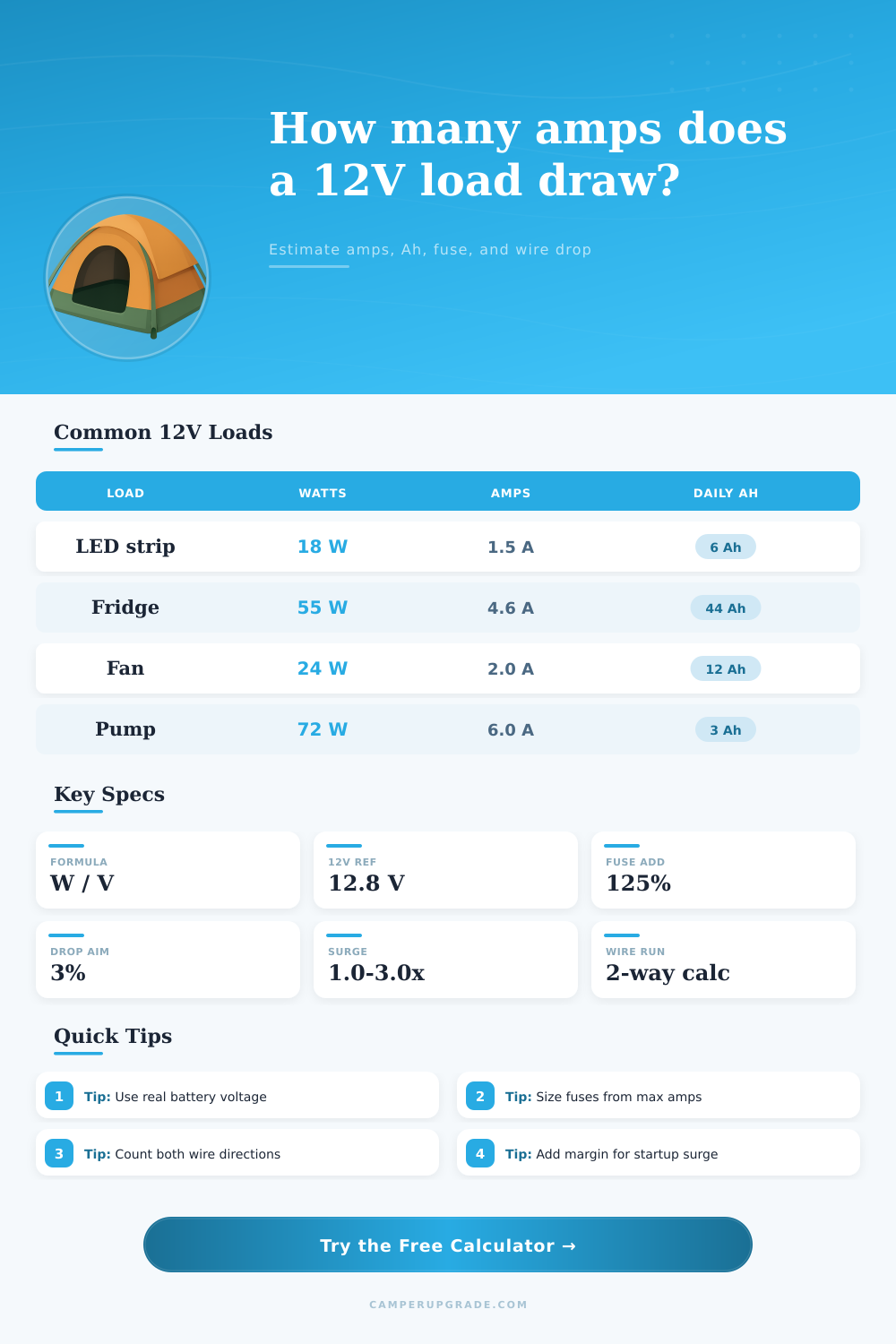
| Camper load | Typical rating | Running draw at 12.8V | Useful duty assumption |
|---|---|---|---|
| LED strip or light bar | 12-36 watts | 0.9-2.8 amps | 100% while switched on |
| Roof vent fan | 18-36 watts | 1.4-2.8 amps | 50-100% depending on speed |
| Compressor fridge | 40-70 watts | 3.1-5.5 amps | 25-55% across a full day |
| Fresh water pump | 60-96 watts | 4.7-7.5 amps | Short bursts, often under 1 hour/day |
| Diesel heater running | 10-36 watts | 0.8-2.8 amps | Fan draw after startup settles |
| USB-C charging hub | 30-120 watts | 2.3-9.4 amps | Depends on connected devices |
| 12V freezer | 45-80 watts | 3.5-6.3 amps | 35-60% in warm weather |
| Laptop through inverter | 60-100 watts AC | 5.2-8.7 amps DC at 90% | Use inverter efficiency |
| Gauge | Resistance ohms per 1000 ft | Example drop at 10A over 20 ft one-way | Typical camper use |
|---|---|---|---|
| 18 AWG | 6.385 | 1.00 V, 7.8% | Very small lights and controls |
| 16 AWG | 4.016 | 0.63 V, 4.9% | Short light branches |
| 14 AWG | 2.525 | 0.40 V, 3.1% | Fridge or fan branch when run is short |
| 12 AWG | 1.588 | 0.25 V, 2.0% | General 12V socket or pump runs |
| 10 AWG | 0.999 | 0.16 V, 1.2% | Longer sockets and small inverters |
| 8 AWG | 0.628 | 0.10 V, 1.0% | Higher-current DC branches |
| 6 AWG | 0.395 | 0.06 V, 0.5% | DC distribution feeds |
| 4 AWG | 0.249 | 0.04 V, 0.3% | Short inverter and battery feeds |
| Calculated demand | Common next fuse | Best suited load | Check before using |
|---|---|---|---|
| Up to 4 amps | 5 amps | Small lights, sensors, controls | Wire ampacity and device manual |
| 4.1 to 8 amps | 10 amps | Fans, pumps, USB hubs | Startup current for motors |
| 8.1 to 12 amps | 15 amps | Fridge, socket branch, small appliance | Socket rating and cable length |
| 12.1 to 16 amps | 20 amps | Multiple DC loads on one branch | Do not exceed wire protection |
| 16.1 to 24 amps | 30 amps | Heavy sockets, DC-DC accessory feed | Terminal and connector limits |
| 24.1 to 40 amps | 40 or 50 amps | Small inverter or distribution feed | Manual-rated fuse and cable size |
| Daily load | Usable 100Ah bank | Usable 200Ah bank | Planning note |
|---|---|---|---|
| 10 Ah/day | 8.0 days at 80% | 16.0 days at 80% | Small lights and charging only |
| 25 Ah/day | 3.2 days at 80% | 6.4 days at 80% | Fan plus device charging |
| 45 Ah/day | 1.8 days at 80% | 3.6 days at 80% | Typical 12V fridge day |
| 75 Ah/day | 1.1 days at 80% | 2.1 days at 80% | Fridge, fan, laptop, lights |
| 120 Ah/day | 0.7 days at 80% | 1.3 days at 80% | Heavy inverter or heating support |
| Result | Formula used | Where it matters | Example |
|---|---|---|---|
| Running amps | amps = watts / volts | Branch current and fuse math | 60W / 12V = 5A |
| Watts from amps | watts = amps x volts | Converting device labels | 4A x 12.8V = 51.2W |
| Daily amp-hours | amps x hours x duty x quantity | Battery sizing | 5A x 10h x 50% = 25Ah |
| Inverter DC amps | AC watts / volts / efficiency | Laptop and small AC gear | 80W / 12.8 / .90 = 6.9A |
| Voltage drop | 2 x feet x amps x ohms/1000 | Long wire runs | Round-trip copper resistance |
When you live in a camper or an van, your battery will provide power to all of the devices that you have on your rig. All of the devices that you use will draw power from that battery, and the battery will be the source of power for all of the devices. The battery is important in that it will determine for you how long you can operate all of your electrical devices before you have to charge your battery.
To determine how long your battery will last, you need to understand how many amp hour of power that it loses each day. These amp hours will allow you to determine whether or not you will be able to remain in one place with your camper trailer or if you will have to travel to a location that has shore power. Amp draw is a value that represents the amount of current that your electrical device will pull from your battery.
How to Calculate Battery Use for Your Camper Van
You can calculate amp draw by dividing the wattage of the device by the voltage of that device. The actual amp draw of a device may change while the device is in operation. Devices like compressor refrigerators will not be running all of the time, water pumps will have high amperage only when they are initially starting to move the water, and the use of an inverter will lose some of that energy as heat.
These changes in amperage can be accounted for through the use of a duty cycle. The daily amp hour total that the calculator provides will allow you to determine the size of your battery bank and the amount of solar power that you will need. Another two factor that should be considered before setting up your camper trailer are the length and gauge of the wires that will be used.
The length of the wire and the gauge will impact the voltage drop that can occur through the wire. Voltage drop occurs as the voltage of the power decreases as it passes through the wire. Voltage drop can lead to many different problems with your electrical devices, such as the device performing poorly, or the fuse for that device potentially blowing.
Longer wires with a smaller gauge will allow for more voltage drop than shorter wires of a larger gauge. The calculator allows for the input of the length of the wire run and the target percentage of voltage drop. Additionally, the calculator will also provide an estimation of the size of the fuse that you should use in your electrical setup.
You should protect your wire and device. The margin and surge fields are provided because many motors will draw more current when they are initially starting than when they are in operation. Battery capacity is another important consideration for your camper trailer.
The capacity of the battery will determine the amount of energy that can be provided to your devices. A 200 amp hour battery bank may not provide 20200 amp hours of energy to your devices because many types of batteries is not meant to be fully discharged. Batteries of the lithium type are most efficient when they are only being used for eighty percent of their capacity.
Batteries of the lead acid type are most efficient when they are only being used for a percent of their capacity lower than eighty percent. The input for the percentage of battery capacity that can be used will allow you to determine how many days the battery bank will be able to supply energy to your devices. One of the mistakes that many people make is to confuse the amp draw of the devices with the amps that will be required to plan for the operation of those devices.
When planning for your devices, you will have to include a safety margin into your calculations. Many devices will not pull the same amount of amps as they will when they are directly connected to an outlet in the house. As the voltage of the battery drops due to its discharge, the amps that are required by the device will increase.
Additionally, as the temperature of the circuit changes, the resistance of that circuit will change. These two factors are why a safety margin is essential to your electrical plan for your camper trailer. Another mistake that people often make is to assume that the devices that are to be used in your camper trailer will have a hundred percent duty cycle.
For instance, a roof fan may only be used for eight hours during the day, but it may only be drawing power during four of those eight hours. Similarly, the diesel heater fan may draw a great deal of amperage only during the initial start up of the heater, but draw less amperage once it is beginning to heat the interior of the camper trailer. The duty cycle field can be used to ensure that your daily amp hour total is accurate for your camper trailer.
The reference tables that the calculator provides are provided as many people dont know the exact wattage and amp ratings of the devices. The tables indicate the amps and watts of devices such as compressor refrigerators, USB hubs, and awning lights. The wire resistance table is also provided to help people understand the resistance of different gauges of wire and how that will affect the voltage drop in the wire over distance.
For example, the tables show that twelve gauge is the minimum size of wire for short distances, but eight or six gauge wires may be required for the distribution of power to outlets through an inverter. Calculating each of these factor will allow you to understand the components of the entire electrical system that will be established in your camper trailer. For instance, you will be able to determine if any new appliance will work with your existing battery bank.
For instance, adding another refrigerator will increase the number of amp hours that are used each day, but it may also increase the voltage drop in the electrical system. While the calculator will provide a baseline to your electrical system, the calculator cannot take into account your personal electrical habits. Some individuals may use the fan all night, others may use the fridge to store their food.
These habits will change the number of amp hours that are used each day. While the calculator will provide you with a baseline that you can use in planning for your camper trailer, you may have to add a margin to that baseline to account for your own personal habits. It is something you should of thought about before buying any new furnitures.
You might find it more comfortabley to have alot of extra power. Most people dont realize how much energy they use. The batterys capacity is vital.
You shouldnt forget that your electricity needs are different than what a book says. It is more complex than it looks.