🛻 Truck Camper Weight Calculator
Calculate total loaded weight, payload capacity, and cargo margins for your truck camper setup
| Truck Class | GVWR Range | Payload Range (lbs) | Payload Range (kg) |
|---|---|---|---|
| Half-Ton (1500) | 6,500–7,700 lbs | 1,500–2,300 | 680–1,043 |
| 3/4-Ton (2500) | 9,500–10,400 lbs | 2,500–3,800 | 1,134–1,724 |
| 1-Ton SRW (3500) | 11,500–14,000 lbs | 3,500–5,500 | 1,588–2,495 |
| 1-Ton DRW (3500) | 13,000–14,500 lbs | 4,500–7,500 | 2,041–3,402 |
| Fluid Type | Weight per Gallon | Weight per Liter | Common Tank Sizes |
|---|---|---|---|
| Fresh Water | 8.34 lbs | 1.0 kg | 20, 30, 40, 60 gal |
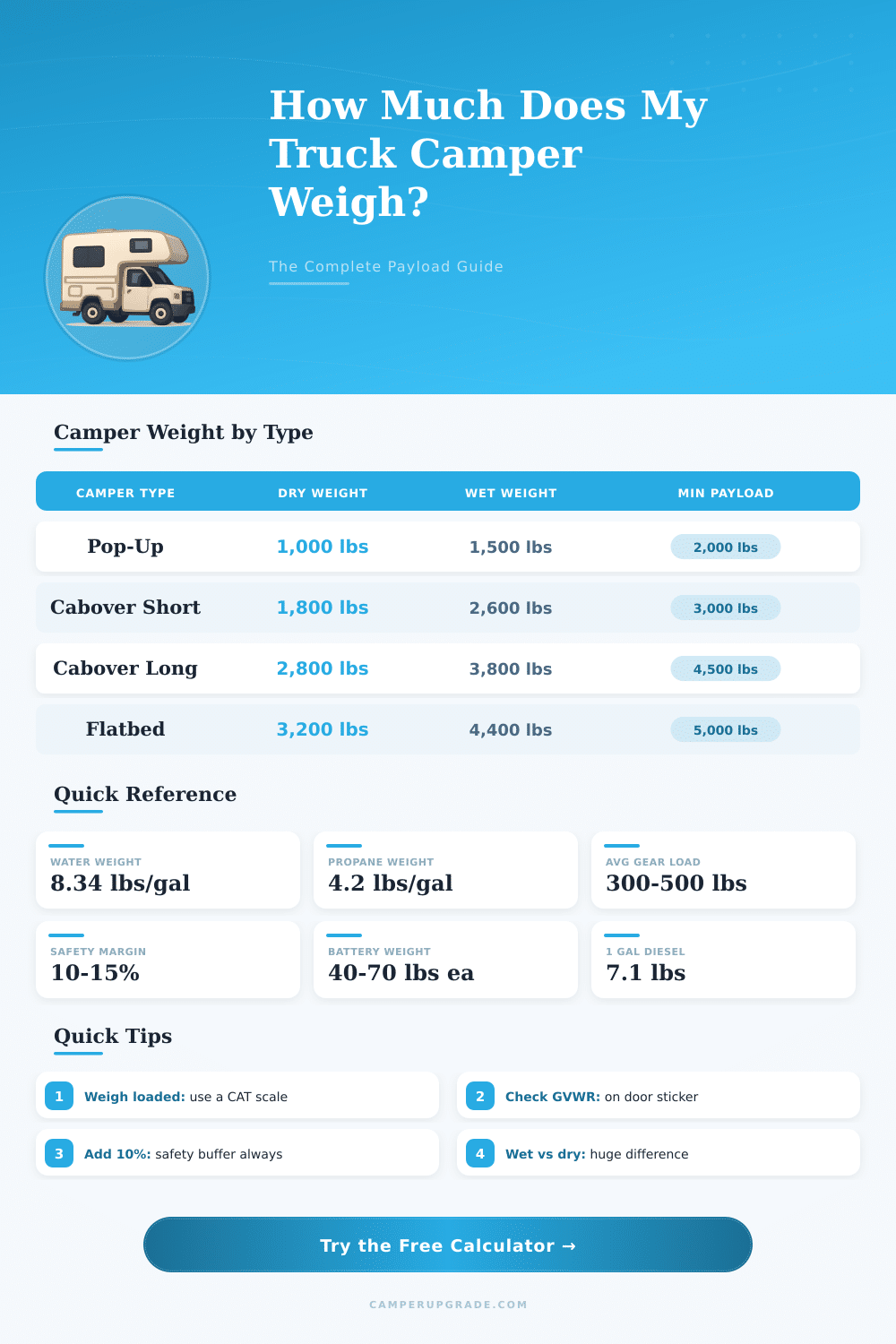
| Propane (liquid) | 4.2 lbs | 0.51 kg | 5, 7, 10 gal (20/30/40 lb tanks) |
| Diesel Fuel | 7.1 lbs | 0.85 kg | 26–38 gal truck tanks |
| Gasoline | 6.3 lbs | 0.76 kg | 23–36 gal truck tanks |
| Gray/Black Water | 8.34 lbs | 1.0 kg | 15–30 gal holding tanks |
| Accessory | Weight (lbs) | Weight (kg) | Notes |
|---|---|---|---|
| Lead-Acid / AGM Battery | 55–75 | 25–34 | Group 27/31 deep cycle |
| Lithium LiFePO4 Battery | 25–35 | 11–16 | 100Ah typical |
| Rooftop Solar (200W panel) | 25–40 | 11–18 | Per panel, varies by type |
| Portable Generator | 150–250 | 68–113 | 2000–3500W inverter type |
| Roof Rack / Cargo Rack | 50–100 | 23–45 | Aluminum vs steel |
| Bike Rack + 2 Bikes | 80–120 | 36–54 | Hitch-mounted |
| Awning | 30–60 | 14–27 | Manual or powered |
| 20 lb Propane Tank (full) | 37 | 16.8 | Tank + fuel combined |
| Tank Size (gal) | Water Weight (lbs) | Tank Size (L) | Water Weight (kg) |
|---|---|---|---|
| 10 gal | 83 lbs | 38 L | 38 kg |
| 20 gal | 167 lbs | 76 L | 76 kg |
| 30 gal | 250 lbs | 114 L | 114 kg |
| 40 gal | 334 lbs | 151 L | 151 kg |
| 60 gal | 500 lbs | 227 L | 227 kg |
| 80 gal | 667 lbs | 303 L | 303 kg |
Manufacturer dry weights often exclude options like AC units, roof racks, and jacks that were added at the dealer. Weigh your fully loaded truck and camper at a CAT scale (available at most truck stops for about $12) to get your real Gross Vehicle Weight. Subtract your trucks curb weight to find your actual payload being used.
Beyond total weight, how the weight is distributed affects handling and safety. Truck campers shift the center of gravity rearward and upward. Aim for 60–65% of camper weight on the rear axle and no more than 35–40% behind the rear axle. Airbags, helper springs, or sway bars can help but do not increase your payload — they only improve ride quality.
A 40 gallon fresh water tank adds about 334 pounds, and most people forget the hot water heater tacks on another 50. Propane surprised me at 37 lbs per full 20 lb tank (tank weight plus fuel). Two tanks and youre at 74 lbs before cooking a single meal.
Ive weighed my mid bed cabover at 2,700 lbs dry but wet it hit 3,480 on a CAT scale. Big difference. Switching from lead acid batteries around 65 lbs each to lithium at 30 saved me 70 lbs with two swapped out.
How to Choose the Right Truck Camper
Camper for truck is practically comfortable housing, that sits exactly in the bed of pickup, converting your car into ready for adventures lodging. Those versatile buildings come in all forms and sizes, since simple covers up until fully equipped sliding models with kitchens, beds and everything, what requires for nine yards of life. The advantage is clear: simply load it up and exit, without need to bother with tents or other tent stuff.
Campers for trucks cover broad range by size and mass. Models available from about 6 until 18 feet long and 4 until 8 feet high. About weight, oh, here starts the interest, it ranges somewhere from 700 until 4,000 pounds, by the actual features and extras, that one lays in the unit.
That broad range of masses is key part, because it directly decides, what truck one can safely drive with that particular camper.
Choosing the right truck for your camper, that is absolutely needed. The skill for burden, not the towing ability, is the main pattern, that one must check here. Know, many half-ton trucks, as the Ram 1500, simply do not fit to bear the weight, their maximum burden reaches around 1,650 until 1,700 pounds.
So, if your camper weighs easily 1,500 pounds itself, you risk overload. Usually one advises to go to 3500-series truck with 8-foot bed. And always well doubly check, that the mark of the truck confirms the load limit before doing purchases.
The market is full of variants currently. Lance Camper is famous mark, that receives prize after prize, with models as 855S and Arctic Fox 990, that attracts many customers. Four Wheel Campers bid strong, custom pop-up buildings, designed four adventure in nature.
There are even Alaska companies, that produce covers, campers and their variants since 1971. Bunkcamp, from Quebec, use ultra-lightweight materials to create all-season campers, that are more aerodynamic and adaptable. The Tribal Overland from Cap offer 1,600-pound unit with full sleep-area, battery, solar panel, heater, kitchen and others.
Even for mid-size Gladiator and Tacoma exist solid four-season options, as the Black Bear.
Prices also range a lot; more than 2,500 bids on RV Trader, with new units since around 13,000 dollars and fully equipped models until 76,000 dollars. Even so, for little trucks you find good base models between 18,000 and 28,000 dollars.
One good aspect of life in camper? You can turn it and leave at the campground, freely using the truck for important trips away from the way. Besides, the closed camper feels much more safe than tent in the middle of anywhere.
Stealing one is not fully simple, because they fit particular truck bed. Actually, many states do not require even separate registration or insurance except that of the truck.
Naturally, not everything is perfect. The fuel use fails because of the extra air resistance. Water and storage space become a bit tight because of the little area.
The internal layout, although practical, can feel less comfortable, if I say that. Load and unload the camper is big work. Drive with it can become a bit risky, because of the height and high center of weight, you certainly would want stronger brakes.
Cook in camper has its own challenges. Because of the little space for foods, easily end with road snacks as canned chili, ramen and other fast, easily born meals. The weather, wind, rain, cold, heat, can turn making of meal into real trouble.
But classics as sandwiches, broths and fresh fruits last well on the way. And reliableburrito with meat, corn, rice and cheese always pleases.