🚛 Trailer Tongue Weight Calculator
Check if your hitch tongue weight is safe & within your vehicle’s towing capacity
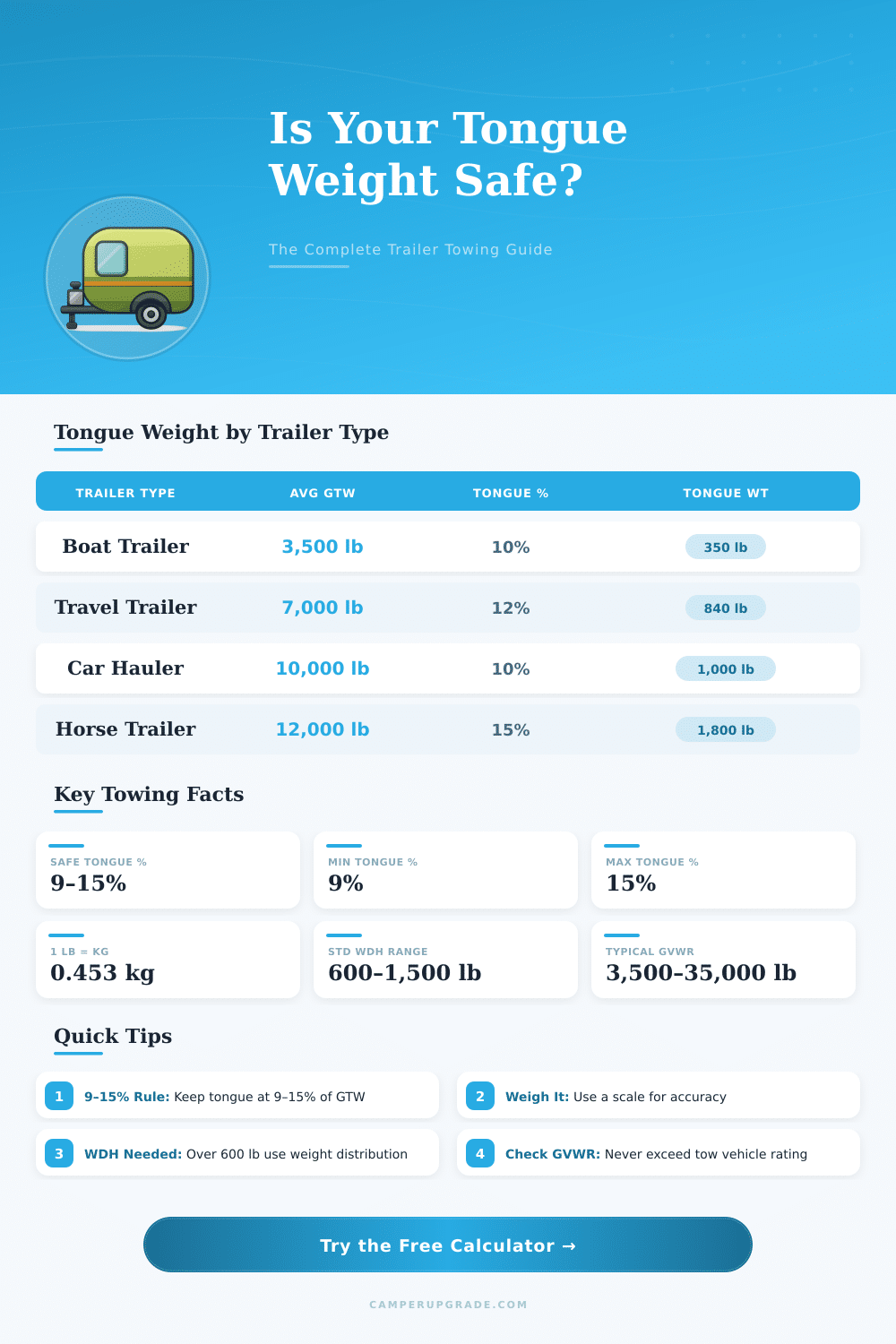
| Trailer Type | Typical GTW | Tongue % Rule | Typical Tongue Wt | Tongue Wt (kg) |
|---|---|---|---|---|
| Boat Trailer (small) | 2,000 lb | 10% | 200 lb | 91 kg |
| Boat Trailer (large) | 5,000 lb | 10% | 500 lb | 227 kg |
| Pop-up Camper | 2,500 lb | 10–12% | 250–300 lb | 113–136 kg |
| Travel Trailer (small) | 5,000 lb | 10–12% | 500–600 lb | 227–272 kg |
| Travel Trailer (large) | 10,000 lb | 10–15% | 1,000–1,500 lb | 454–680 kg |
| Car Hauler | 10,000 lb | 10% | 1,000 lb | 454 kg |
| Horse Trailer | 12,000 lb | 12–15% | 1,440–1,800 lb | 653–816 kg |
| Utility Trailer | 3,500 lb | 10–12% | 350–420 lb | 159–190 kg |
| Flatbed Trailer | 16,000 lb | 10–12% | 1,600–1,920 lb | 726–871 kg |
| Enclosed Trailer | 7,000 lb | 10–12% | 700–840 lb | 317–381 kg |
| Hitch Class | Max GTW | Max Tongue Wt | Ball Size | Common Vehicles |
|---|---|---|---|---|
| Class I | 2,000 lb | 200 lb | 1-7/8" | Small cars, sedans |
| Class II | 3,500 lb | 350 lb | 1-7/8" or 2" | Minivans, mid-size SUVs |
| Class III | 8,000 lb | 800 lb | 2" or 2-5/16" | Full-size SUVs, trucks |
| Class IV | 10,000 lb | 1,000 lb | 2-5/16" | HD trucks, large SUVs |
| Class V | 20,000 lb | 2,000 lb | 2-5/16" or 3" | Heavy-duty trucks |
| Axle Config | Tongue % of GTW | GTW 5,000 lb Tongue | GTW 10,000 lb Tongue | Notes |
|---|---|---|---|---|
| Single Axle | 10–15% | 500–750 lb | 1,000–1,500 lb | Wider range acceptable |
| Tandem Axle | 10–12% | 500–600 lb | 1,000–1,200 lb | More stable, tighter range |
| Triple Axle | 8–10% | 400–500 lb | 800–1,000 lb | Heavy trailers, lower % |
The tongue weight of a trailer is simply the pressure or force on the hitch, when the front part of the trailer rests on the vehicle for towing. Think of it this way: if you had to lift the front of that trailer off the ground the force needed would be the tongue weight. Getting the right values matters, because that affects your safety, the comfort of the trip and whether your tow vehicle truly fits to handle that, what you need of it.
Most folks follow a rule of thumb: the tongue weight should be around 10 to 15 percent of the total weight of the loaded trailer. An interesting fact is, that many vehicles limit their tongue weight to exactly 10 percent of their maximum tow rating. Take a sample vehicle, that can tow 3 500 pounds, it allows a maximum of 350 pounds for tongue weight.
What Trailer Tongue Weight Is and How to Check It
Here is that 10-percent limit. If you now add a fully loaded trailer weighing 3 650 pounds, you will find almost 547 puonds of tongue weight, if you aim for the 15-percent ideal spot.
Here is where things become tricky. If you put too much weight on the tongue, you press down the back of your tow vehicle, what hurts the steering and handling. If the tongue weight is too little…
Or, sky curse, if more weight rests behind the axles of the trailer than before them, then you risk swaying of the trailer, that worsens at higher speed. Finding the right balance truly depends on your particular vehicle and the setup of the trailer.
The specs from the maker about the wet tongue weight can fool you, honestly. They commonly ignore batteries, propane tanks and other gear, that adds real weight. I saw trailers advertised with wet tongue weights in the low 300s, but when you truly load them and add weight, you hit more than 700 pounds.
The place, wear you put your cargo in the trailer, makes a big difference. If you put the heavier items forward, you keep the tongue weight there, where it belongs.
You have some ways to measure. A bathroom scale works well for lighter setups, if you build a lever with a tube and do the math. Cat scales also are reliable…
They have three separate pads for weighing the front axle, back axle and the trailer. Another method is weigh the tow vehicle before and after the hookup of the trailer, then do the subtraction.
Weight distribution bars do not truly lower your tongue weight. What they do, is spread the load more evenly across all axles. Your total tongue weight includes everything, that rests on the tongue of the trailer, plus anything in the truck bed of your truck behind the back axle.
Real numbers almost always beat the claims of the makers, so knowingly leave margin in your calculations about the possible load. Before you even think to buy a trailer, weigh your fully loaded truck at a scale.
Even small changes move things around. Moving a spare tire or rearranging the cargo can alter your tongue weight a lot. A longer trailer also lowers thetongue weight through basic leverage.