⛺ Tent Waterproofing Lifespan Calculator
Estimate how long your tent's waterproofing will last based on fabric type, usage frequency, UV exposure, and storage habits.
📊 Your Results
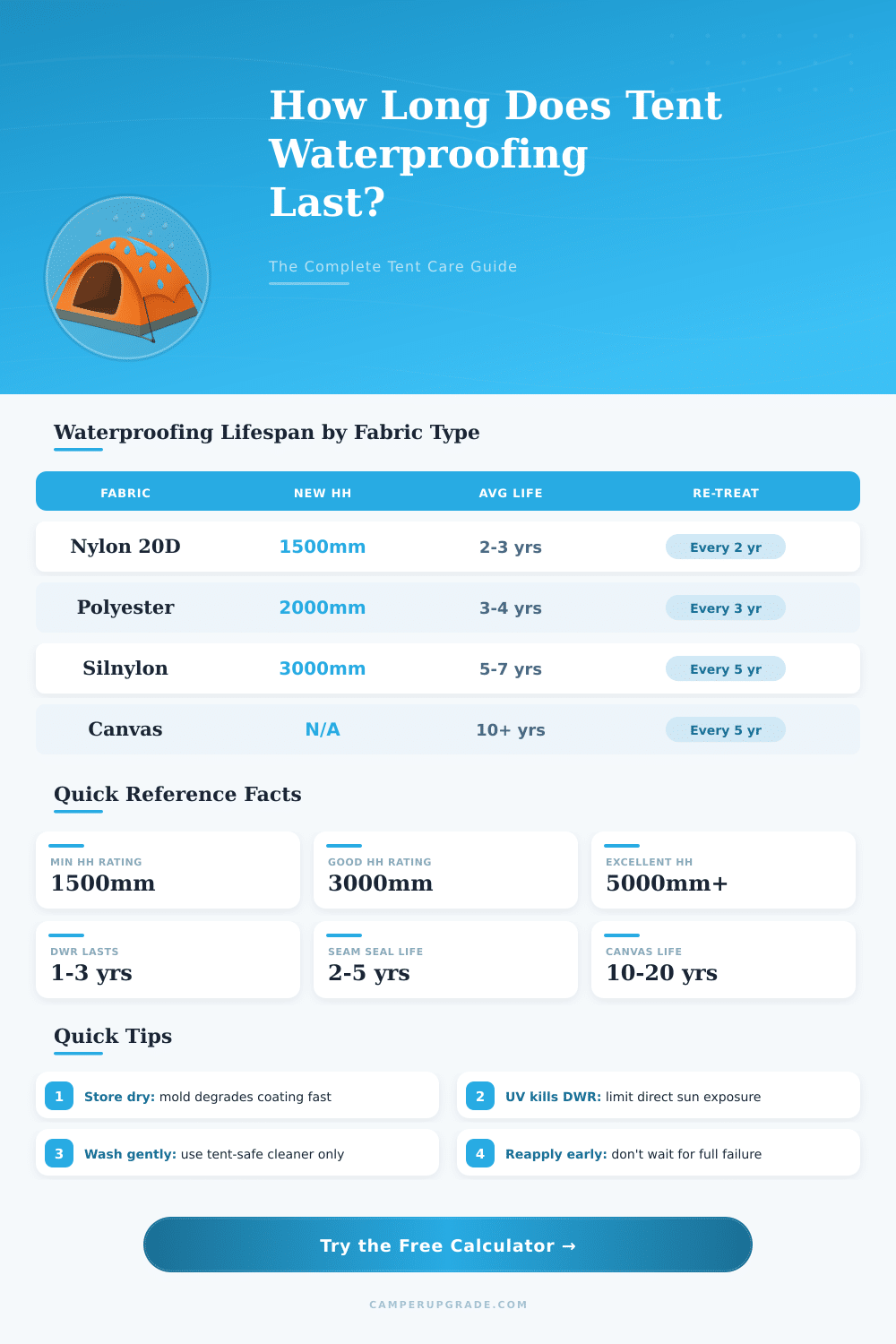
| Fabric Type | New Factory HH | Typical DWR Life | HH Decay Rate | Re-treat Interval |
|---|---|---|---|---|
| Nylon 20D–40D | 1500–2500mm | 1–3 years | ~20% per year | Every 1–2 years |
| Budget Polyester | 1000–2000mm | 1–2 years | ~25% per year | Every 1–2 years |
| Performance Polyester | 2000–4000mm | 2–4 years | ~15% per year | Every 2–3 years |
| Silpoly / Silnylon | 3000–6000mm | 5–7 years | ~10% per year | Every 4–6 years |
| Canvas / Cotton | N/A (wax-based) | 10–20 years | ~5% per year | Every 3–5 years |
| Dyneema / DCF | No coating needed | Lifetime inherent | Minimal | Seams only |
| Hybrid Cuben | 5000–8000mm | 7–12 years | ~8% per year | Every 5–7 years |
| TPU Laminate | 5000–10000mm | 4–8 years | ~12% per year | Every 3–5 years |
| Factor | Impact Level | HH Loss Per Year | Notes |
|---|---|---|---|
| UV Exposure (High) | High | +10% extra loss | Open alpine, desert, beach |
| Stored Wet / Damp | Very High | +15% extra loss | Promotes mold, PU delamination |
| Frequent Washing | Medium | +8% extra loss | Use gentle, tent-specific soap |
| Machine Washing | High | +12% extra loss | Agitation damages DWR layer |
| Heavy Foot Traffic | Low | +3% extra loss | Mainly affects floor only |
| Abrasion (packed tight) | Medium | +5% extra loss | Sharp stuff sack edges |
| Dry, cool storage | Positive | –5% loss (slows) | Ideal: loose, breathable bag |
| HH Rating (mm) | Protection Level | Rain Type Handled | Suitable For |
|---|---|---|---|
| Under 1000mm | Minimal | Light drizzle only | Sunny weather canopies |
| 1000–1500mm | Basic | Light rain | Fair weather camping |
| 1500–3000mm | Good | Moderate rain | 3-season backpacking |
| 3000–5000mm | Very Good | Heavy rain | 3-season / base camp |
| 5000–8000mm | Excellent | Heavy sustained rain | 4-season use |
| 8000–10000mm | Superior | Storm conditions | Alpine / expedition |
| 10000mm+ | Extreme | Extreme weather | Military / expedition grade |
| Product Type | Best For | Coverage Area | Reapplication Interval |
|---|---|---|---|
| DWR Spray (aerosol) | Nylon, polyester fly | ~3–5 sq meters/can | Every 1–2 seasons |
| DWR Wash-in liquid | Full tent re-treat | Full tent per 100ml | Every 1–2 seasons |
| Seam Sealer | All tent seams | ~5m of seam per oz | Every 2–3 seasons |
| PU Floor Coating | Bathtub floors | ~4 sq meters per kit | When peeling occurs |
| Canvas Wax / Oil | Canvas & cotton | ~3–4 sq meters/kg | Every 3–5 years |
| Silicone Spray | Silnylon only | ~5 sq meters/can | Every 4–6 seasons |
When the seams of tent start to leak, that does not mean that it must go in the trash. No tent stays fully waterproof forever not even the expensive models. Rather than replace it, you can renew the waterproofing, so the tent will last years.
My one backpacking tent served ten years, while another old Timberline model works well even after twenty-five years.
How to Make Your Tent Waterproof Again
The first step is check the seams. Usually the leak comes from them. You find seam seal in stores for camping, and it goes on all outer seams with a little brush.
Make sure first to learn what the material is, because different fabrics require separate kinds of seam seal. The wrong product might even destroy the tent fabric. Seal the seams first, leave evrything dry well, and later move to the waterproof spray.
There are some liked waterproof sprays. Nikwax Tent and Gear SolarProof are the only without-PFAS options, that also protect against UV damage while they renew the waterproofing of the materials. With Nikwax products the bottles with green head serve for cleaning, while those with purple head serve for waterproofing.
It works well, if you apply it every spring before the summer. Kiwi Camps Dry also helps well, some say that it beats Scotchguard on many fabrics. Fabsil is another option, that soaks in and you can brush it on.
For simple use, any waterproof spray from a camping store in a bottle tends to give one or too good years, before you need a new coat.
Waterproof sprays from places like Walmart work, but the tent must stay up some days to fully dry. Apply the spray to the bottom part of the tent and to places that still could get water from the rain fly, usually the bottom half or third.
Besides sprays, water-resistant sprays, tarps and seam tapes all work as homemade fixes. A tarp under the tent works well as a ground cover, but make sure that no footprint or ground sheet sticks past the edges of the tent. A bigger fly or even a second tarp above the tent gives extra cover during strong rain.
Tents with a bathtub floor, where the floor climbs the sides by some inches, also help to keep the water away. Seam tapes also stop water from sneaking through the holes of the stitches in the seams.
Keeping windows or vents a bit open, you help the airflow. Without airflow, moisture can build up inside and drip down in the morning, which sometimes causes leaks. Modern camping tents usually do not need extra waterproofing right from the box, but older models almostalways benefit from renewal.