☀️ Sunscreen Duration Calculator
Find out exactly how long your sunscreen lasts on your face based on SPF, activity & skin type
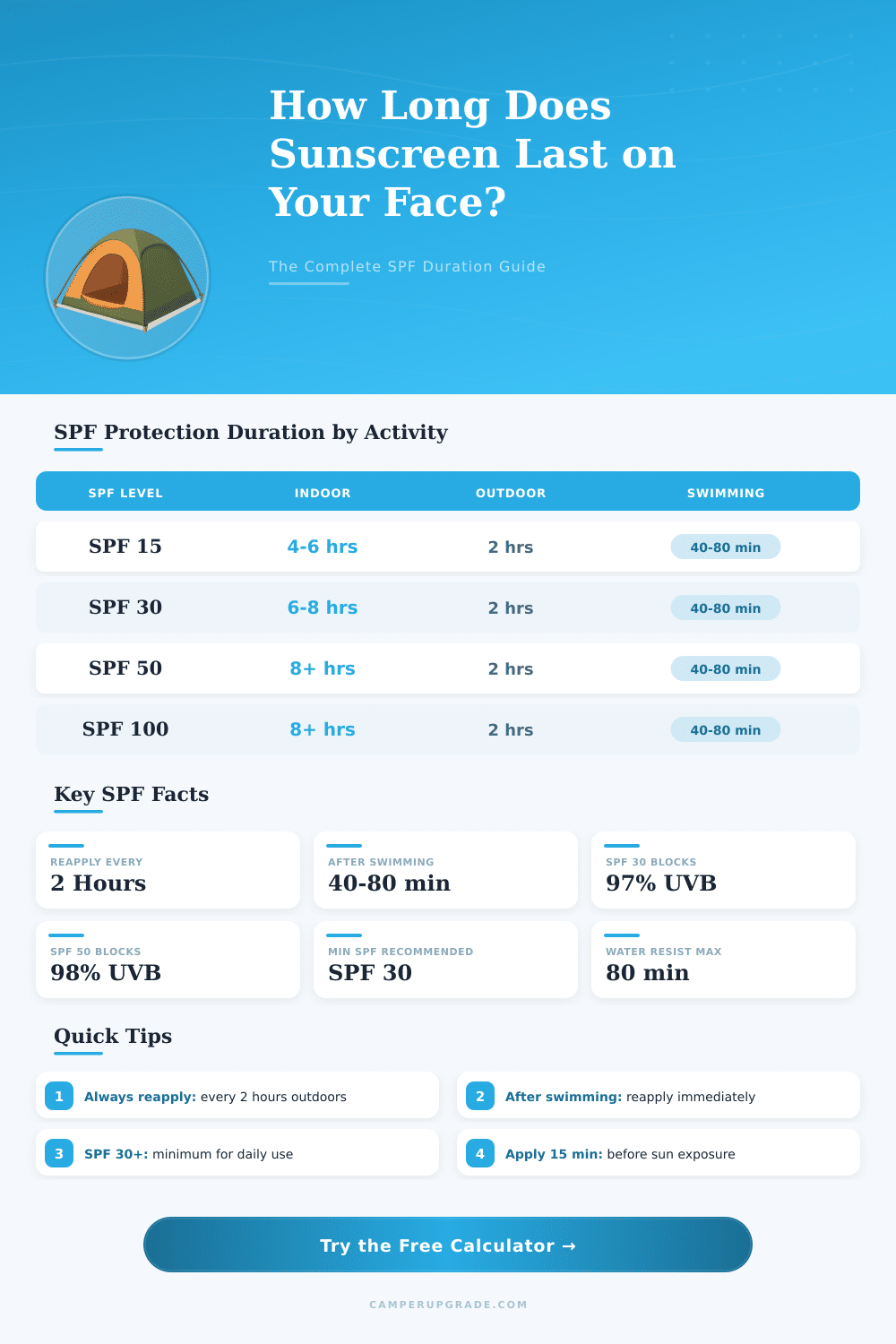
| SPF Level | Indoor Use | Low Activity | High Activity | Swimming |
|---|---|---|---|---|
| SPF 15 | 4–6 hrs | 2 hrs | 1–1.5 hrs | 40–80 min |
| SPF 30 | 6–8 hrs | 2 hrs | 1.5–2 hrs | 40–80 min |
| SPF 50 | 8+ hrs | 2 hrs | 2 hrs | 40–80 min |
| SPF 50+/100 | 8+ hrs | 2 hrs | 2 hrs | 40–80 min |
| UV Index | Risk Level | Reapply Every | Min SPF Needed |
|---|---|---|---|
| 1–2 | Low | Every 2 hrs (if outdoors) | SPF 15 |
| 3–5 | Moderate | Every 2 hrs | SPF 30 |
| 6–7 | High | Every 2 hrs | SPF 30–50 |
| 8–10 | Very High | Every 1.5–2 hrs | SPF 50 |
| 11+ | Extreme | Every 1 hr | SPF 50+ |
| Body Area | Amount (Imperial) | Amount (Metric) | Notes |
|---|---|---|---|
| Face only | 1/4 teaspoon | ~1.25 ml | Most commonly skipped |
| Face + neck | 1/2 teaspoon | ~2.5 ml | Neck often forgotten |
| Face + neck + ears | 1/2–3/4 tsp | ~2.5–3.7 ml | Ears = high-risk area |
| Full body (adult) | 1 oz / 2 tbsp | ~30 ml | Per FDA guideline |
Sunscreen is useful for the skin, that helps to protect against sunburns and also can help to prevent skin cancer. One calls it differently, for instance sunblock, solar lotion or solar cream. It appears in various forms, as lotions, sprays, gels and foams.
For choosing the right type matters more than many people imagine.
How to Choose and Use Sunscreen
Good Sunscreen must be broad-spectrum so it blocks both UVA and UVB rays. Resistance against water is another useful feature, together with SPF level of 30 or more. SPF shows the sun protection factor, that points how much more time one can stay under the sun before getting the same UVB damage.
Like this, with SPF 10, the rays require ten times more time to hurt the skin than without any protection.
Sunscreen forms a key part in a whole plan for sun protection. The way one uses it, together with other steps, strongly affects how well the skin stays protected against sunburns, skin cancer and early skin aging.
One big guide, that checked more than 2,200 Sunscreen products, showed that only around one from four met criteria for good sun protection while one avoids ingredients that create health risks. Here are quite a few cases. For your skin type, the choice of Sunscreen is also important.
Lightweight gel Sunscreen works well for oily or mixed skin. Creamy or thick mixes with hydrating parts better suit dry skin.
Mineral Sunscreen uses physical UV blockers and commonly is friendly too reefs. Zinc oxide is a common mineral part, and one considers that it a bit more well protects against the sun than titanium dioxide. The downside is that such physical Sunscreen sometimes feels chalky and leaves white cover, although new types spread easily and adapt to various skin colors.
Reapplying Sunscreen really matters. After two hours under the sun, one must replace it. Similarly after swimming or strong sweat.
Waterproof Sunscreen is not fully waterproof, so do not trust the label too much. Many folks also use too little amount. Around one ounce is enough to cover the whole body.
Easily forgotten places are the tops of ears, the back of the neck, the tops of feet and zones around clothing edges andsunglasses.
Spray Sunscreen brings safety issues. There were times when folks sprayed aerosol on the skin and later came near a grill or open flame, which caused burns on the skin. This is because sprays can hold flammable chemicals.
Australian Sunscreen tends to be thicker and heavier, commonly made resistant against water for swimming. Korean and Japanese Sunscreen is widely more lightweight, because they do not intend aquatic sports.