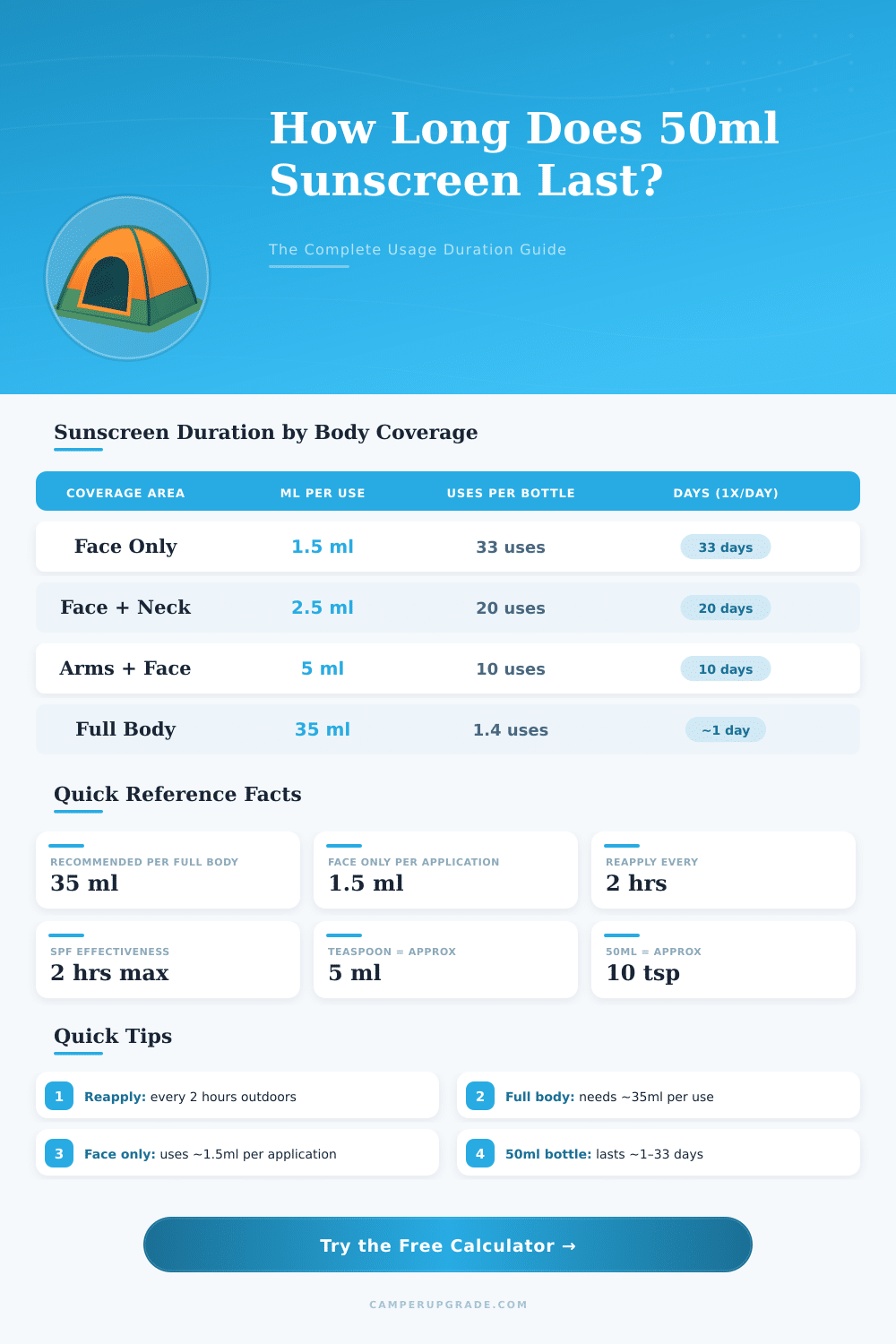
🧴 50ml Sunscreen Duration Calculator
Find out exactly how long your sunscreen bottle will last based on your coverage area, reapplication frequency, and skin type needs.
| Coverage Area | ml Per Use | Uses Per 50ml | Days (1x/day) | Days (2x/day) |
|---|---|---|---|---|
| Face Only | 1.5 ml | 33 | 33 days | 16–17 days |
| Face & Neck | 2.5 ml | 20 | 20 days | 10 days |
| Arms & Face | 5 ml | 10 | 10 days | 5 days |
| Upper Body | 12 ml | 4 | 4 days | 2 days |
| Full Body | 35 ml | 1.4 | ~1 day | <1 day |
| Bottle Size | fl oz | Face-Only Days | Full Body Uses |
|---|---|---|---|
| 50 ml | 1.69 oz | ~33 days | ~1.4 uses |
| 75 ml | 2.54 oz | ~50 days | ~2.1 uses |
| 100 ml | 3.38 oz | ~67 days | ~2.9 uses |
| 150 ml | 5.07 oz | ~100 days | ~4.3 uses |
| 200 ml | 6.76 oz | ~133 days | ~5.7 uses |
| Activity Type | Reapply Every | Apps/Day (8 hrs) | ml/Day (Face) |
|---|---|---|---|
| Indoor / Office | 4–6 hours | 1–2x | 1.5–3 ml |
| Daily Commute | 3–4 hours | 2x | 3 ml |
| Outdoor General | 2 hours | 3–4x | 4.5–6 ml |
| Beach / Pool | 80 min – 2 hrs | 4–5x | 6–7.5 ml |
| Sports / Sweat | 60–80 min | 5–6x | 7.5–9 ml |
sunscreen is a product that one puts on the skin to defend it against sunburn and to lower chances of skin cancer. It has various names, for instance sun block, sun lotion or sun cream. The product appears in different forms as creams, sprays, gels and foams.
Using sunscreen is a key part of a whole plan to protect the skin against sun damage.
How to Use Sunscreen Safely
SPF numbers show the level of sun protection factor. They show how much more time the skin can face sun rays before getting the usual UVB damage. Like this, using SPF 10 it requires tenfold more time for those rays to cause harm.
Sunscreen of broad spectrum blocks both kinds of rays, UVA and UVB. Choosing SPF 30 or higher is wise advice, although some prefer SPF 50 or even more. When one correctly applies it, SPF 30 ensures around 97 percent of sun protetcion.
Adding more sunscreen is an important habit. Here, after two hours under the sun, one must add a fresh layer. The same happens after sweating or swimming.
So called water-resistant sunscreen is not fully waterproof, so one still must reapply after water contact. Setting phone alarms helps, because under the sky one easily forgets the thyme.
Almost everyone uses too little amount. To cover the whole body, one needs around 30 milliliters. Missed areas commonly include the tops of ears, back of neck, tops of feet and parts around clothing and sunglasses.
The best kind of sunscreen depends on the skin type. Lightweight gel form works well for oily or mixed skin. For dry skin, cream or dense mix works more, and choosing gentle ingredients has value.
Mineral sunscreen uses physical barriers, like zinc oxide, that is a bit better than titanium oxide. Some of those mineral products leave a white cover, even so many blend easily without any chalkiness.
A safety problem with spray sunscreen is the risk of fire. There have been cases, when folks sprayed the product and later stood beside a grill or lit a cigar, which caused burns on their skin. Those sprays hold easily flammable stuff, and some of them were recalled because of serious wounds, that needed medical help.
Australian sunscreen usually is thicker and heavier, because it is made to resist water. Korean and Japanese ones commonly are thinner, because they do not intend for swimming really. European standard sunscreen is rated more strong than many American types.
Zinc-based, water-resistant sunscreen, that is friendly to reefs, seems safer for folks and creatures, when onepasses time beside rivers, pools or sea.
The amount of used sunscreen together with other safety steps really affects the health of skin.