☀️ SPF 50 Sunscreen Duration Calculator
Find out exactly how long your SPF 50 protection lasts based on UV index, skin type & activity level
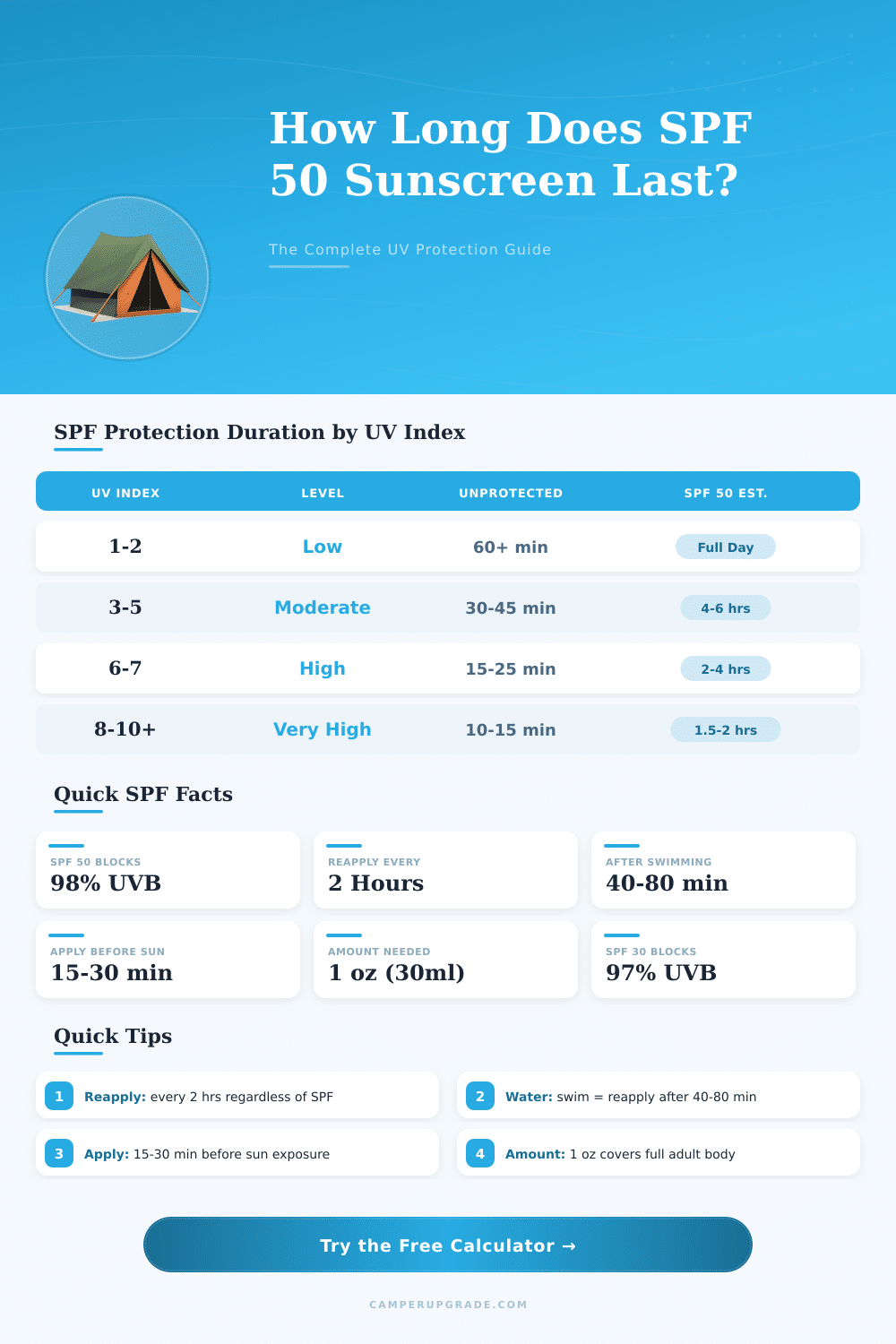
| UV Index | Level | Unprotected Skin | SPF 50 Est. Duration | Reapply Interval |
|---|---|---|---|---|
| 1–2 | Low | 60+ min to burn | Up to full day outdoors | Every 2–4 hours |
| 3–5 | Moderate | 30–45 min to burn | 4–6 hours | Every 2 hours |
| 6–7 | High | 15–25 min to burn | 2–4 hours | Every 90 min–2 hrs |
| 8–10 | Very High | 10–15 min to burn | 1.5–2.5 hours | Every 80–90 min |
| 11+ | Extreme | Under 10 min to burn | 1–1.5 hours | Every 60–80 min |
| Activity | Formula Needed | Effective Window | Reapply After |
|---|---|---|---|
| Casual / Shade | Standard | Up to 2 hours | 2 hours or earlier |
| Walking / Gardening | Standard | 1.5–2 hours | 2 hours |
| Hiking / Light Sweat | Water-resistant 40 min | 1–1.5 hours | Every 80 minutes |
| Sports / Heavy Sweat | Water-resistant 40–80 min | 40–80 minutes | After 40 min of sweating |
| Swimming / Surfing | Water-resistant 80 min | Up to 80 minutes in water | Immediately after toweling |
| Beach / Sunbathing | Water-resistant 80 min | 1–1.5 hours | Every 60–90 minutes |
| Skin Type | Description | Unprotected Burn Time | SPF 50 Estimated |
|---|---|---|---|
| Type I | Very fair, always burns | 5–10 min (UV 6) | 4–8 hours (UV 6) |
| Type II | Fair, usually burns | 10–15 min (UV 6) | 5–10 hours (UV 6) |
| Type III | Medium, sometimes burns | 15–25 min (UV 6) | Rarely burns w/ SPF 50 |
| Type IV | Olive, rarely burns | 25–40 min (UV 6) | Very unlikely to burn |
| Type V | Brown, very rarely burns | 40–60 min (UV 6) | Excellent protection |
| Type VI | Very dark, almost never burns | 60+ min (UV 6) | Maximum protection |
| Cloud Cover | UV Penetration | Effective UV Reduction | Protection Still Needed? |
|---|---|---|---|
| Clear Sky | 100% | None | Yes — full SPF needed |
| Partial Clouds | 75–90% | 10–25% | Yes — SPF required |
| Mostly Cloudy | 50–70% | 30–50% | Yes — SPF still recommended |
| Overcast / Full | 25–50% | 50–75% | Yes — UV still present |
sunscreen outline that the protective layer that you spread on your skin cuts sunburn in quarter and lowers the risk of skin cancer in the long run. One hears it called in various words… Sunblock, sunscreen, sun cream…
And it comes in many forms based on what works for you: creams, sprays gels, foams, whatever you want. It forms a key part of every good plan for defense against the sun, if you want to keep your skin healthy during years.
How to Use Sunscreen and Stay Safe in the Sun
Sun Protection Factor, or SPF, is that number that one commonly mentions everywhere. It shows how much more time your skin lasts sun exposure before getting the same amount of UV ray damage that it would suffer without any protection. For instance SPF 10 allows ten times longer time before the damage will happen, compared with bare exposure.
The ideal? sunscreen with broad spectrum, that blocks both UVA rays and UVB rays. Formulas that resist water and have SPF 30 or more, commonly show up as good choiecs.
Although many folks favor SPF 50 or even more, which makes sense, most of us use up the protection much more quickly than in the tests of scientists.
Reapplying is the spot where folks commonly fail. You should reapply every two hours, if you stay outside. Contact with water or start sweating?
Immediately spread more layers. But hear the key: that label “waterproof” does not have the meaning that you believe.
The average folk uses far too little. To cover your whole body well, you need around a shot glass amount. Pockets that one commonly forgets?
The tops of your ears, the nape, the tops of your feet and all places that stay hidden under clothing or sunglasses. Set phone alarms are useful, because it is surprisingly easy to lose the time when you have fun outside.
There is a difference between mineral and chemical sunscreen types. The mineral ones are based on zinc oxide, that some studies consider a bit more effective than titanium dioxide. The less good part?
Many such mineral creams leave a bothering white dust on the skin, although fresh versions settle that problem. Waterproof sunscreen based on zinc? They are widely rated between the safest for folks and nature, especially when you swim or such.
Your skin type also affects your decision. Greasy or mixed skin best matches with lightweight gel form. For dry skin works something thicker and richer, like thick creams work more well.
Search for ingredients that do not clog pores, hydrate and do not irritate, that truly helps. Sunscreen with zinc oxide that does not leave traces and does not stuff pores, deserves the effort.
Spray sunscreen types bring real safety risk. There have been cases when folks breathed in sunscreen and later stood beside a grill, candle or lit cigar, and their skinburned. Such sprays carry easily flammable chemicals, so be careful.
European standards for sunscreen sometimes give stronger protection than the usual in American products.