💧 Well & Septic System Calculator
Estimate tank capacity, drain field area, and well depth for your property
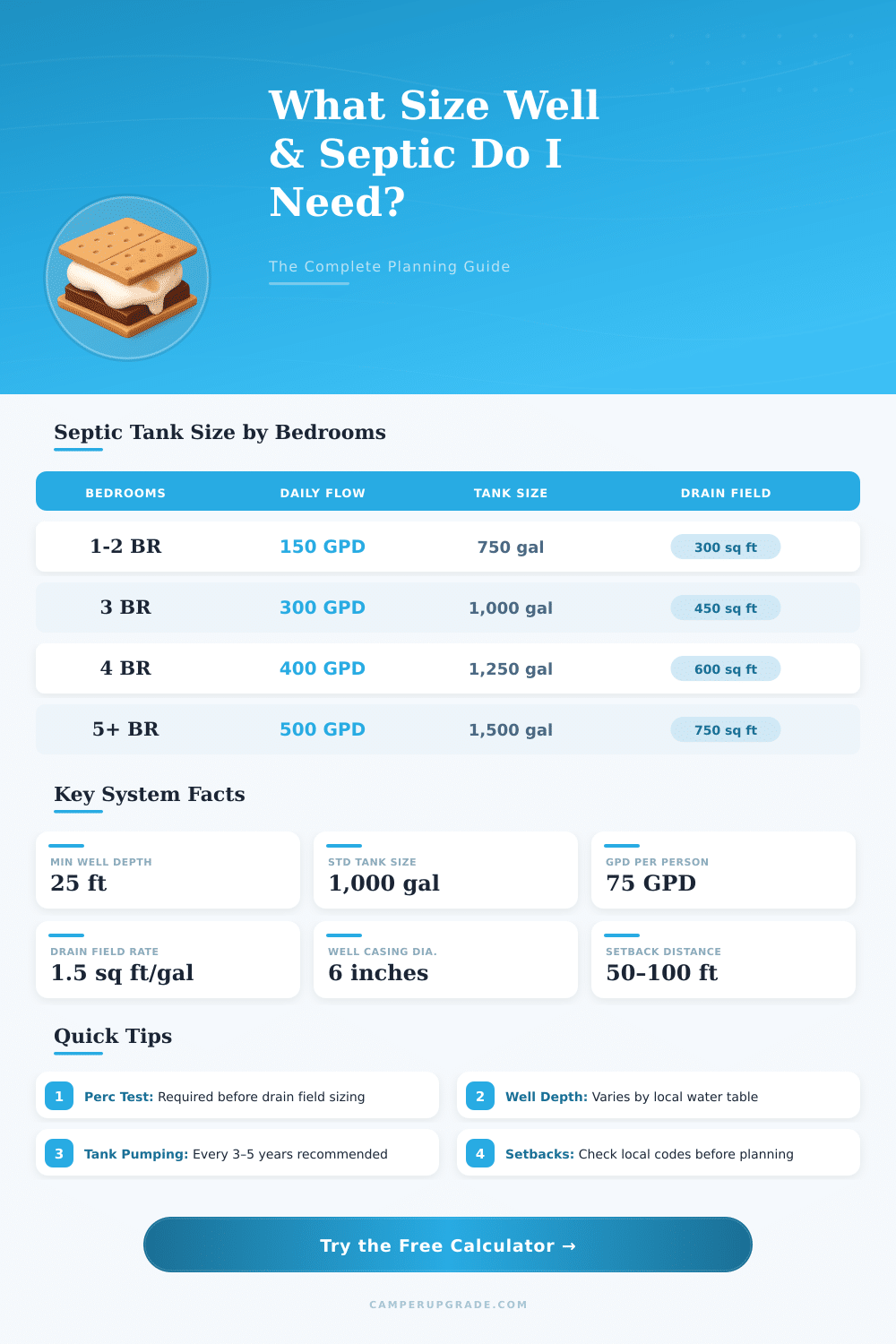
| Bedrooms | Occupants (est.) | Daily Flow (GPD) | Min Tank Size (gal) | Min Tank Size (L) |
|---|---|---|---|---|
| 1–2 | 1–4 | 150–200 | 750 | 2,839 |
| 3 | 4–6 | 300 | 1,000 | 3,785 |
| 4 | 6–8 | 400 | 1,250 | 4,731 |
| 5 | 8–10 | 500 | 1,500 | 5,678 |
| 6+ | 10+ | 600+ | 1,750+ | 6,624+ |
| Perc Rate (min/in) | Soil Type | Sq Ft per GPD | For 300 GPD (sq ft) | For 300 GPD (m²) |
|---|---|---|---|---|
| 1 | Gravel / Very Sandy | 0.83 | 249 | 23.1 |
| 5 | Sandy Loam | 1.50 | 450 | 41.8 |
| 10 | Loam | 2.12 | 636 | 59.1 |
| 20 | Clay Loam | 3.00 | 900 | 83.6 |
| 30 | Clay | 3.67 | 1,101 | 102.3 |
| 60 | Heavy Clay (marginal) | 5.19 | 1,557 | 144.6 |
| Region / Geology | Avg Depth (ft) | Avg Depth (m) |
|---|---|---|
| Coastal Plains | 25–75 | 8–23 |
| River Valleys | 50–100 | 15–30 |
| Midwest / Plains | 100–200 | 30–61 |
| Eastern US | 100–300 | 30–91 |
| Western / Arid | 200–500 | 61–152 |
| Rocky / Fractured | 300–600 | 91–183 |
| Casing (in) | Gal per ft | L per m | Typical Use |
|---|---|---|---|
| 4" | 0.65 | 8.0 | Residential (small) |
| 6" | 1.47 | 18.1 | Residential (std) |
| 8" | 2.61 | 32.2 | Residential / Light comm. |
| 10" | 4.08 | 50.3 | Commercial |
| 12" | 5.88 | 72.5 | Large commercial |
Install well and septic system cost, according to what real homeowners already experienced. Usually you look at somewhere between $6,600 and $21,500 for both together. One draft even passed $22,000 after everything was done.
The most stressful part? Drilling a well is very surprising because you count the price by foot, and you cannot know before how deep you will have to go. Septic systems, though, are much more easily budgeted.
Well and Septic System Costs, Rules, and Care
One time, from what I heard, the septic system cost around $5,000, and the well around $10,000. Although that quickly jumped if the drilling had to go more than 300 feet.
Getting permits for private wells and septic systems usually goes through your local health department. They will come walk through the property, will design your septic setup, will point where the well should be, and later will inspect after everything is complete. Here is the thing, in some areas homeowners can install their own septic system.
An engineer can find the right place for your tank and the drain field, and perk-tests will show you how quikcly water drains through your soil.
Wells and septic systems must be far enough apart from each other. Most places require at least 100 feet of separation to escape contamination. You also will want to lay the drain field downhill of the well when possible.
The whole setup is done to ensure that septic mess stays away from you’re drinking water source.
Septic tanks slowly fill with sludge and need pumping every three to five years. The liquid waste flows out into a drain field, basically a shallow, covered trench filled with soil. The soil acts as a filter, breaking down sewage and killing bacteria.
There are also limits about what you can do in the area of the drain field. Build on it, plant trees or move a garden here? Those are all off limits.
The money saved on water and sewer bills is truly one of the best parts of living with a well and septic system. Your water costs almost nothing. On the other hand, you handle every bit of care yourself.
Some folks find that well water tastes a bit strange compared to city supply. During dry times, the water pressure can drop. And when septic systems fail, everything gets very dirty quickly.
Water tests check how much water actually flows and whether bacterial levels are safe to drink. Septic checks deal with checking the tank itself and any visible parts for signs of damage. If you have an old well on the property, you will have to get permits to shut it down right.
Where city sewer lines are available, any existing septic system needs a check every three years and must have certification to stay. Some setups use three-chamber tanks. A newer well should have a label attached to the main pipe listing its depth andflow rate, and honestly, more flow is always welcome.