🚛 Camper Weight Calculator
Estimate dry weight, GVWR, cargo capacity, and tongue weight for any camper or RV type
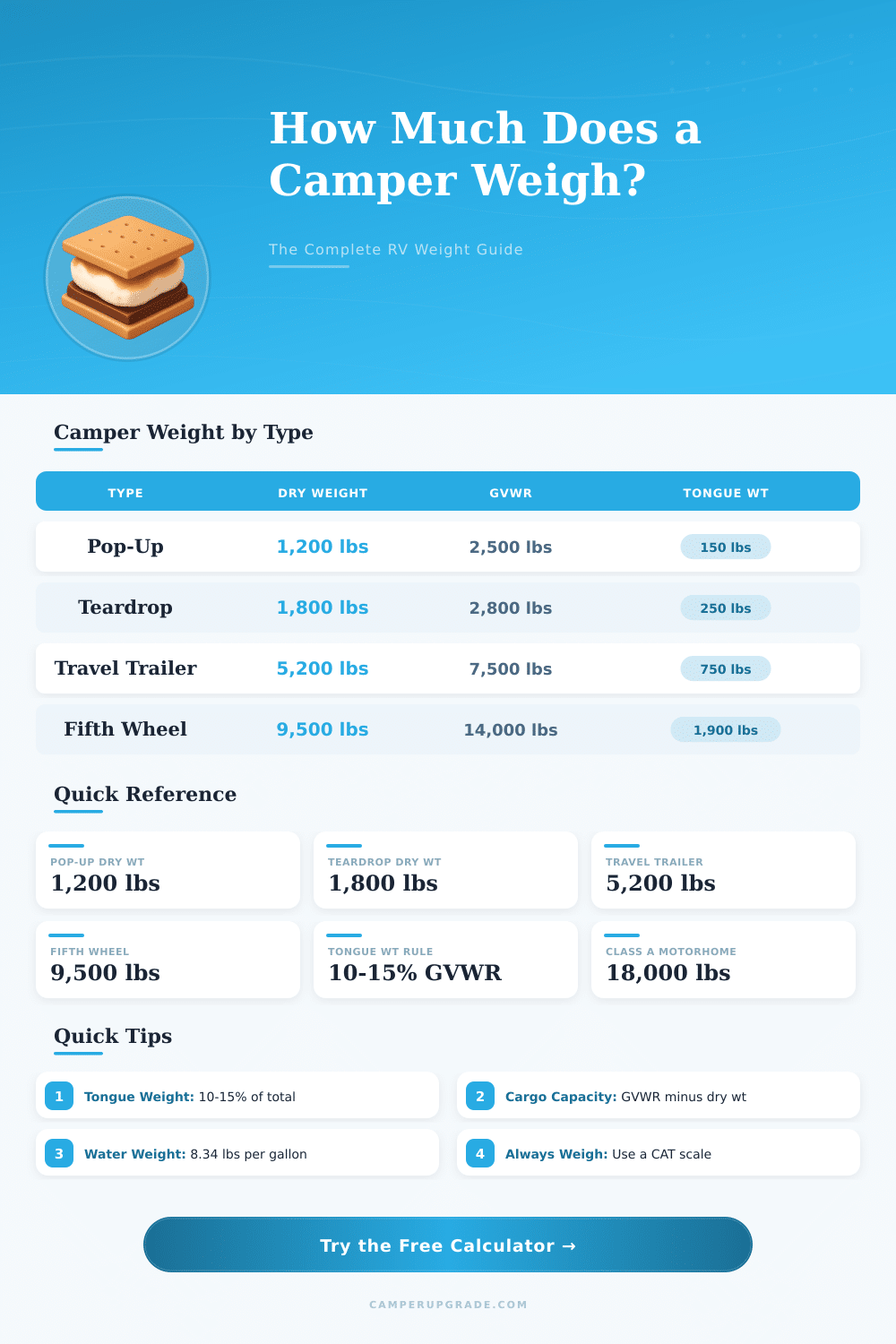
| Camper Type | Avg Dry Weight (lbs) | Avg GVWR (lbs) | Cargo Capacity (lbs) |
|---|---|---|---|
| Pop-Up Camper | 1,200 | 2,500 | 1,300 |
| Teardrop Trailer | 1,800 | 2,800 | 1,000 |
| Small Travel Trailer | 3,500 | 5,500 | 2,000 |
| Mid Travel Trailer | 5,200 | 7,500 | 2,300 |
| Large Travel Trailer | 7,200 | 9,500 | 2,300 |
| Fifth Wheel | 9,500 | 14,000 | 4,500 |
| Truck Camper | 2,500 | 3,800 | 1,300 |
| Toy Hauler | 7,800 | 11,500 | 3,700 |
| Class C Motorhome | 10,500 | 14,500 | 4,000 |
| Class A Motorhome | 18,000 | 24,000 | 6,000 |
| Item | Capacity | Weight When Full (lbs) | Weight (kg) |
|---|---|---|---|
| Fresh Water (per gallon) | 1 gal / 3.79 L | 8.34 | 3.78 |
| Small Fresh Tank | 20 gal / 76 L | 167 | 76 |
| Medium Fresh Tank | 40 gal / 151 L | 334 | 151 |
| Large Fresh Tank | 75 gal / 284 L | 626 | 284 |
| Propane (20 lb tank full) | 4.7 gal / 17.8 L | 37 | 16.8 |
| Propane (30 lb tank full) | 7.1 gal / 26.9 L | 54 | 24.5 |
| Gray Water Tank (40 gal) | 40 gal / 151 L | 334 | 151 |
| Black Water Tank (30 gal) | 30 gal / 114 L | 250 | 113 |
| Hitch Type | Tongue Wt % of GVWR | Example (7,500 lb GVWR) | Metric Equivalent |
|---|---|---|---|
| Bumper Pull / Receiver | 10–15% | 750–1,125 lbs | 340–510 kg |
| Fifth Wheel Hitch | 15–25% | 1,125–1,875 lbs | 510–851 kg |
| Gooseneck Hitch | 15–25% | 1,125–1,875 lbs | 510–851 kg |
| Weight Distribution | Redistributes tongue wt | Recommended >5,000 lbs GTW | >2,268 kg GTW |
| Item | Weight (lbs) | Weight (kg) | Notes |
|---|---|---|---|
| Passenger (average adult) | 155 | 70 | Industry standard est. |
| Camping gear (2 people) | 150–250 | 68–113 | Chairs, cookware, bedding |
| Generator (portable) | 45–120 | 20–54 | 2,000–3,500 watt |
| Bike rack + 2 bikes | 80–120 | 36–54 | Rack + adult bikes |
| Leveling blocks set | 15–40 | 7–18 | Plastic or rubber |
| Awning (power) | 75–150 | 34–68 | Included in dry weight |
| Solar panel setup | 40–80 | 18–36 | 200–400 watt system |
| Tool kit & supplies | 30–60 | 14–27 | Basic RV maintenance |
CCC = GVWR minus dry weight minus full LP gas weight minus full fresh water weight. This is the actual weight you can add in people and gear. Most manufacturers list this on the federal weight label near the entry door. Exceeding CCC is unsafe and may void your warranty.
CAT scales (found at most truck stops) can weigh each axle separately for about the same effort as filling up fuel. Weigh your camper fully loaded before a trip to make sure youre within GVWR and axle limits. Even 10–15% overloading can cause tire blowouts, brake failure, and frame damage.
A pop-up camper sits around 1,200 lbs dry, which is barely noticeable behind a midsize SUV. Teardrops land close to 1,800 lbs. Mid-size travel trailers jump to roughly 5,200 lbs dry but loaded with 40 gallons of water (thats 334 lbs just in water) youre pushing 6,000 easy.
Fifth wheels average 9,500 lbs empty and Ive seen them hit 14,000 at GVWR. Tongue weight runs 10 to 15 percent for bumper pulls, 15 to 25 for fifth wheels. Each propane tank adds 37 lbs full.
Types, Sizes and Weights of Campers
The information below is not done by any calculator or automatic converter on this page. It comes from real feedback, forum discussions and community experience found through the whole net.
The word “camper” can mean some different things. Sometimes it relates to folk that stays in tent or in fair camp. Sometimes it means big vehicle designed for living and driving.
A camper van sometimes called a small caravan, is vehicle that gives both transfer and living space like a tiny home. In it usually are basic services as kitchen, bathroom with shower and living space.
More exactly, camper commonly means sleeping module that seats in the back of truck. Such truck campers are the least vast, less equipped, less fancy and widely the most cheap choice. Fully equipped campers are heavy: they can easily pass 1500 pounds, what maxmizes the load limit of typical truck.
Most many trucks sold in United States are half-ton models as the Ford F-150, Chevy 1500 or Ram 1500. Those can bear camper, but that pushes their limits.
Truck campers also come with worse fuel efficiency because of wind drag. The water and sewage tanks usually are much more small, because space is tight.
RVs come in various sizes. The average length range from 20 until 40 feet. Heights go from 10 until 14 feet, and widths are around 8 feet.
Class A motor homes are the biggest, at 26 until 45 feet. Class B motor homes are the most small, at 17 until 23 feet. Choose the write size of camper is very important for comfort, towing skill and general enjoyment.
Travel trailers appear in great range of forms and sizes, with also vast range of weights.
Live in van sound fun, but it has its challenges. With two folks it becomes much more hard, because the other person always is here. Everything quickly feels crowded, even simple chatter.
Three folks would be truly very small. Good choice for group is van equipped with portable storage tins, hammocks or sleep pads. Like this the vehicle becomes the camping unit: no need to unpack or repack.
And if it does not look like camper, the chances for sudden stays or rest stops are almost endless.
Own camper can be great idea, but unless one earns money by means of travel, it always drops in value. Also it requires costly care and repairs. Live in one is not as cheap as it also could seem.
Drive cost fuel money, and even stay mostly in one place yet cost something. For those with tight budget, camping in tent is cheaper choice.
A camping van is usually van changed with basic comforts as house batteries, sun panels, bed platform, some toilet, sink and storage space. Some campers truly not have kitchen. In that case, portable stove that runs by means of gas is solid choice.
The fuel bottles are easily filled and portable.
Cook in little trailer can be messy. Things that splash end everywhere on the curtains, and fat mist covers everything in that tiny stuck space. Use a gas camp stove outside for breakfast help to reduce the flow of bacon and fat and also the smells.
Grill in most many evenings during outside camping is common.
About cook plates, propane is well known, but induction is other option. The main issue with induction is camp somewhere with weak sunshine because of weather or dense tree cover. Some folks prefer old Coleman boilers that use liquid fuel as crude.
Slow cook in electric pot during drive is other useful method for RV kitchens. Simple camp meals include chopped style dishes done with Polish stuffing and cubes of browned potatoes, that already has pepper and onions mixed in.
There are many kinds of campers for research, from teardrop trailers and collapsible campers until fifth wheels andmotor homes. Custom camping vans are bought or rented in places as Arizona for those, that want to try the freedom of van life and off grid living.