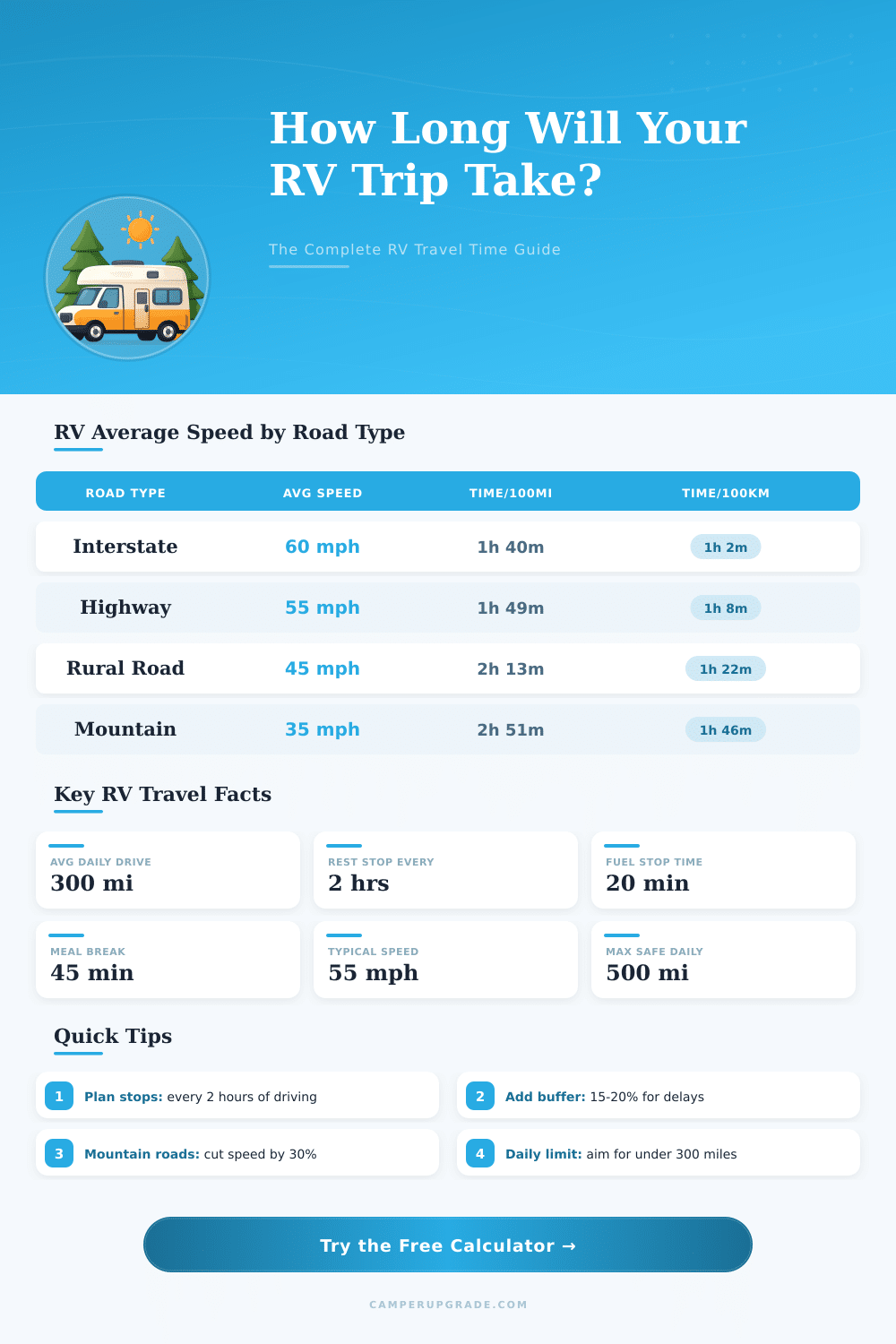
🚐 RV Travel Time Calculator
Estimate your total drive time including stops, speed adjustments, and rest breaks
| Distance | @ 55 mph / 88 kph | @ 60 mph / 97 kph | @ 45 mph / 72 kph |
|---|---|---|---|
| 100 mi / 161 km | 1h 49m | 1h 40m | 2h 13m |
| 200 mi / 322 km | 3h 38m | 3h 20m | 4h 27m |
| 300 mi / 483 km | 5h 27m | 5h 00m | 6h 40m |
| 400 mi / 644 km | 7h 16m | 6h 40m | 8h 53m |
| 500 mi / 805 km | 9h 05m | 8h 20m | 11h 07m |
| 750 mi / 1207 km | 13h 38m | 12h 30m | 16h 40m |
| 1000 mi / 1609 km | 18h 11m | 16h 40m | 22h 13m |
| Scenario | Drive Time | Stop Time | Total Time |
|---|---|---|---|
| No stops, 60 mph | 5h 00m | 0m | 5h 00m |
| 1 fuel + 1 meal, 60 mph | 5h 00m | 1h 05m | 6h 05m |
| 2 fuel + 2 meal, 55 mph | 5h 27m | 2h 10m | 7h 37m |
| Mountain roads, 40 mph | 7h 30m | 1h 05m | 8h 35m |
| With 10% traffic, 55 mph | 6h 00m | 1h 05m | 7h 05m |
| Rain + heavy traffic, 50 mph | 6h 00m | 1h 05m | 7h 05m |
| RV Type | Recommended Max | Comfortable Range | Driving Hours |
|---|---|---|---|
| Class A Motorhome | 400 mi / 644 km | 250–350 mi | 5–7 hrs |
| Class B Van | 500 mi / 805 km | 300–400 mi | 6–8 hrs |
| Class C Motorhome | 450 mi / 724 km | 250–350 mi | 5–7 hrs |
| 5th Wheel + Truck | 400 mi / 644 km | 200–300 mi | 5–6 hrs |
| Travel Trailer | 350 mi / 563 km | 200–300 mi | 4–6 hrs |
| Pop-Up Camper | 300 mi / 483 km | 150–250 mi | 4–5 hrs |
The time for Travel Time by RV is one of those spots that commonly surprises new owners of such vehicles. Driving an RV is different from driving an average car. It requires more attention, and the distances do not shrink as quickly.
So the majority of experienced RV drivers keep their days on the road to shorter periods usually less than six hours.
How to Plan RV Driving Time
The 330-rule is famous advice. It says that one should not drive more than 330 miles daily and arrive at the campground by 3:30 in the afternoon. Late arrival at an unknown campsite commonly causes tension and difficult setup.
The guideline helps to avoid such troubles, and it ranks among the most carelessly addressed parts of Travel Time planning.
Everyday distance is ideal between 250 and 300 miles, when one does not drag a trailer. Some fans of RV travel bid 700 miles in one day, what resulted in 13-hour work including the final setup. One does not want to repeat such extremes.
A more practical mode is to limit yourself to four to five hours of driving, with an occasional six-hour stage. Driving overnight extends the whole procedure and removes the delihgt.
Also the speed plays a role. Use the simple rule: plan on average no more than 50 miles per hour in your Travel Time. Many comfortable RVs only have modest engine power, so 60 miles per hour on flat road is right.
On roads with restrictions, 45 miles per hour is enough. Count with 55 to 60 miles per hour, unless the cost of fuel does not bother you. Also, book one hour to park, register and set up, as well as another hour in the morning too destroy camp and go.
Tools for planning journeys really are useful. For instance, the RV Life Travel Planner can estimate the drive time based on set speed limits, if one chooses the automatic calculation. Otherwise it uses custom average speeds.
It shows a more real picture of what happens in a typical Travel Time day.
It is not enough to think only about the hours of driving. Stops along the way consume time. Can you park RVs at the interesting places?
Moving a big machine in narrow spots is stressful. When towing a trailer, one must unhook it and hook it again at every stop, what steals part of the day. Also stops for gasoline happen more commonly.
Travel by RV should be enjoyable. Do not rush to the next station. No one finds their rhythm in the drive until one has spent a bit oftime on the way.
There is not only one right method for that.