🚜 RV Tank Volume & Dump Frequency Calculator
Calculate total tank volume, gallons per person per day, and how often you need to dump — for any RV type
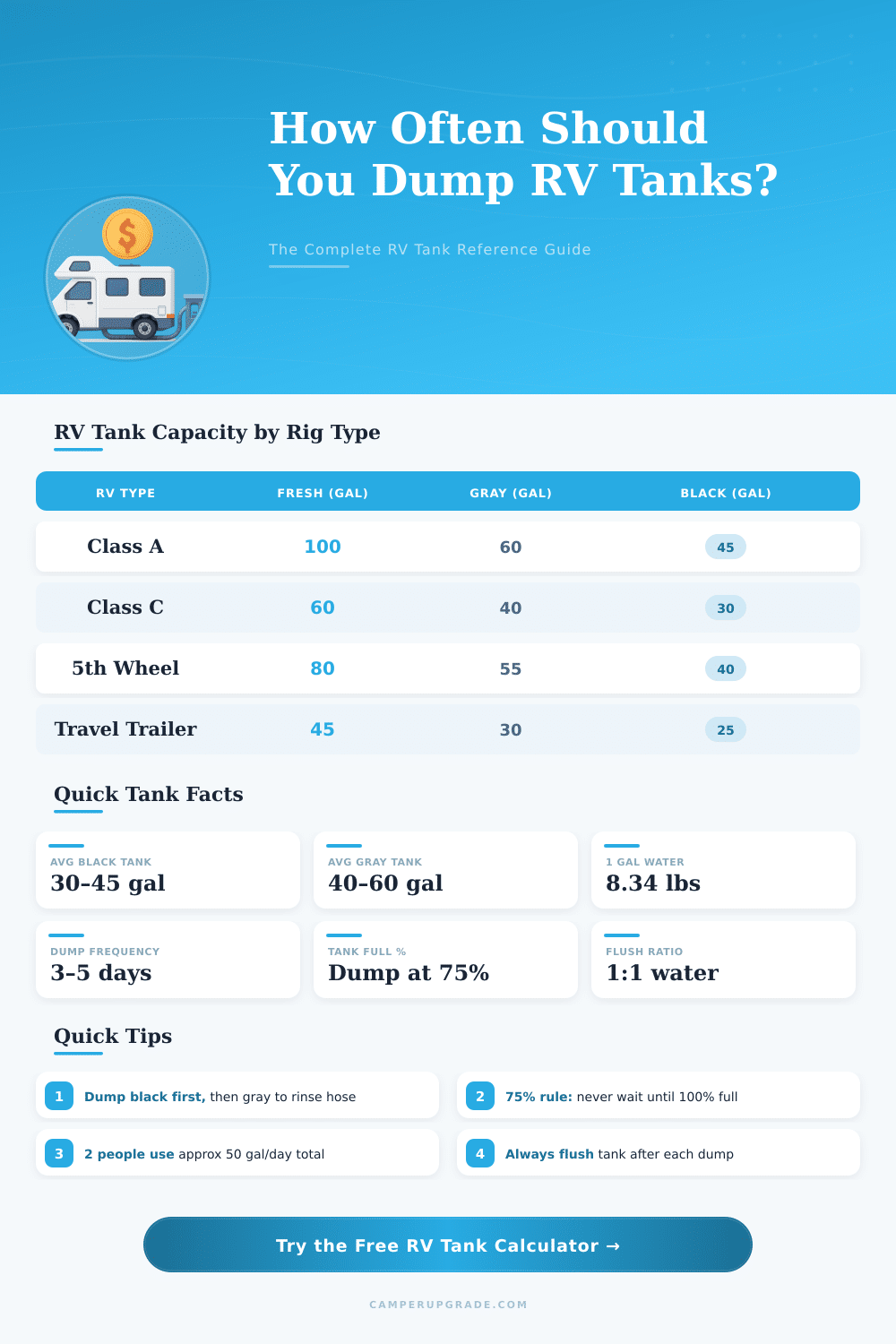
| RV Type | Fresh (gal) | Gray (gal) | Black (gal) | Total Waste (gal) |
|---|---|---|---|---|
| Class A Motorhome | 75–150 | 50–80 | 35–55 | 85–135 |
| Class B Van Camper | 20–40 | 15–30 | 10–25 | 25–55 |
| Class C Motorhome | 40–80 | 30–50 | 25–40 | 55–90 |
| 5th Wheel | 60–100 | 40–65 | 30–50 | 70–115 |
| Travel Trailer | 30–60 | 25–45 | 20–35 | 45–80 |
| Pop-Up Camper | 5–20 | 5–15 | 0–10 | 5–25 |
| Usage Style | Gallons/Day/Person | Liters/Day/Person | Black Tank % | Gray Tank % |
|---|---|---|---|---|
| Conservative (dry camping) | 10–15 | 38–57 | ~30% | ~70% |
| Moderate (mixed use) | 20–30 | 76–114 | ~30% | ~70% |
| Heavy (full hookups) | 35–50 | 132–189 | ~30% | ~70% |
| Full-Timer Average | 25–40 | 95–151 | ~30% | ~70% |
| Measurement | Imperial | Metric | Notes |
|---|---|---|---|
| 1 US Gallon | 1 gal | 3.785 L | Standard US liquid gallon |
| Weight of 1 gal water | 8.34 lbs | 3.78 kg | At 68°F / 20°C |
| 1 Cubic Foot | 7.48 gal | 28.32 L | Used in tank engineering |
| 100 Gallons | 100 gal | 378.5 L | Common large fresh tank |
| Full 40-gal Black Tank | 333 lbs | 151 kg | Full weight estimate |
| Full 50-gal Gray Tank | 417 lbs | 189 kg | Full weight estimate |
| Tank Size (gal) | 2 People Conservative | 2 People Moderate | 4 People Moderate |
|---|---|---|---|
| 20 gal black | 4–5 days | 2–3 days | 1–2 days |
| 30 gal black | 6–8 days | 3–4 days | 1–2 days |
| 40 gal black | 8–10 days | 4–5 days | 2–3 days |
| 50 gal black | 10–13 days | 5–7 days | 3–4 days |
| 55 gal gray | 8–11 days | 4–6 days | 2–3 days |
RV Tanks are quite important when dealing with life on the way. Most RV have three main kinds of Tanks. The fresh water tank stores drinking water.
The gray tank gathers water from sinks and showers. The black tank keeps the needed mess. Some smaller and lighter RV combine the gray and black in one tank, but that usually is not very good idea, because the activity in each is different.
RV Tanks and How to Care for Them
The sizes of Tanks really range. Fresh water Tanks come in scope of small 10-gallon boxes until 100-gallon rectangles. Some RV have truly tiny Tanks.
A fresh water tank of 15 gallons can feel very restrictive especially for family. Rather, a gray tank of 35 gallons can last for three or four days, if one daily does short showers and washes plates. One also can find holding Tanks of 3 gallons until 250 gallons, depending on what you need.
Where the Tanks sit depends on the layout of the vehicle. The fresh water tank sometimes is installed above the floor, for instance in a cabinet or under a bed. The other Tanks commonly sit under the floor, between the frame rails.
The placement also helps to keep good balance and proper weight spread for the RV.
Most RV Tanks are made from rotation moulded plastic. That means they have no seams and thick walls, what makes them almost unbreakable. Fresh water Tanks are made form FDA-approved plastic resin, so they are safe for carrying drinking water.
Custom Tanks also come in many sizes to suit various RV models.
It matters to well take care of the Tanks. No one wants a damaged waste tank during a long journey. Regular care and checks keep everything running smooth.
While draining, it is useful too wait until the Tanks are full or almost full. Full Tanks wash away the most stubborn content, and that helps to remove solid stuff. Adding water after draining stops buildup.
Special treatments, as powder product, help to break down mess and keep smells under control. In warm weather the smell becomes much more stressful, if the Tanks stay untreated.
Portable rolling Tanks is another option. A portable tank of 36 gallons means you must not detach the caravan only to go empty. Some folks search portable Tanks of 25 gallons or more.
Moving them to the dump station usually happens by rolling the tank or by putting it in a vehicle.
Cold weather is a real issue. Bare Tanks below easily will freeze during cool temperatures. Even with insulation and heating, tubes yet can jam and pop.
Some makers provide heated parts as standard gear. RV antifreeze in the gray and black Tanks can help during drive through cold regions. Gauges of tank level exist to show fresh, gray and black levels, but they are famously unreliable.
Experience teaches how long theTanks truly last between refills and dumps.