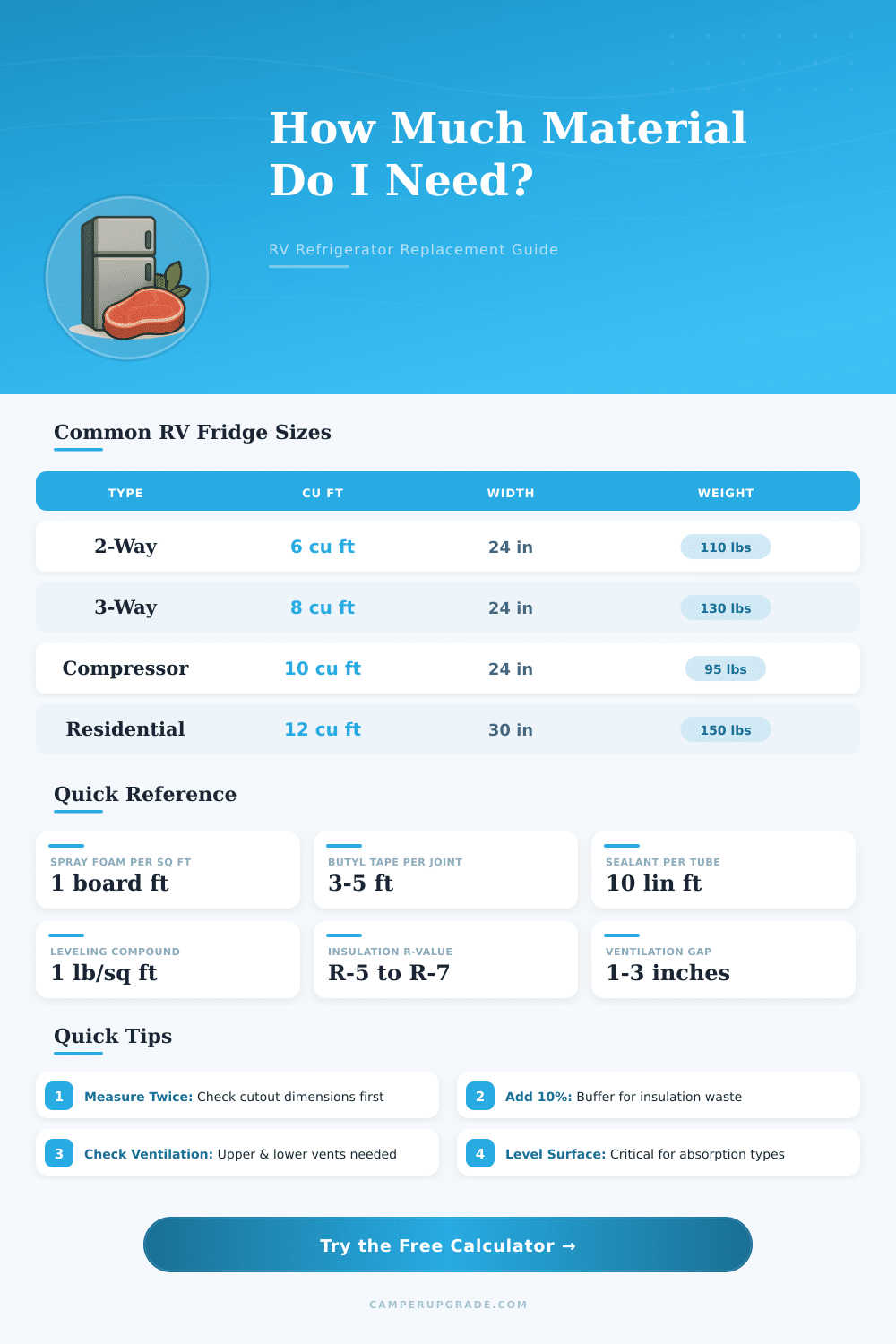
❄ RV Refrigerator Replacement Material Calculator
Calculate insulation, sealant, and leveling materials needed for your RV fridge replacement project
(lbs/cu ft)
(lbs/cu ft)
(lbs/cu ft)
(lbs/cu ft)
(lbs/cu ft)
(lbs/cu ft)
(lbs/cu ft)
(lbs/cu ft)
| Depth | Sq Ft / Cu Yd | Metric Depth | Sq M / Cu M |
|---|---|---|---|
| 1 inch | 324 sq ft | 2.54 cm | 30.1 m² |
| 2 inches | 162 sq ft | 5.08 cm | 15.1 m² |
| 3 inches | 108 sq ft | 7.62 cm | 10.0 m² |
| 4 inches | 81 sq ft | 10.16 cm | 7.5 m² |
| 6 inches | 54 sq ft | 15.24 cm | 5.0 m² |
| Package Size | Volume Per Unit | Units Per Cu Yd | Coverage at 3″ |
|---|---|---|---|
| Small Bag (0.5 cu ft) | 0.5 cu ft | 54 bags | 2.0 sq ft |
| Standard Bag (2 cu ft) | 2.0 cu ft | 13.5 bags | 8.0 sq ft |
| Large Bag (3 cu ft) | 3.0 cu ft | 9 bags | 12.0 sq ft |
| Spray Can (12 oz) | ~1.0 board ft | Varies | 1.0 sq ft at 1″ |
| Sheet (4″×8’) | 32 sq ft face | N/A | 32 sq ft face |
| Project Area | Dimensions | Area (sq ft) | Cu Ft at 2″ |
|---|---|---|---|
| Compact Fridge Cavity | 20″ × 20″ | 2.78 | 0.46 |
| Standard 2-Way Opening | 24″ × 24″ | 4.00 | 0.67 |
| Large 3-Way Bay | 24″ × 30″ | 5.00 | 0.83 |
| Residential Style Bay | 30″ × 36″ | 7.50 | 1.25 |
| Full Bay Floor | 48″ × 24″ | 8.00 | 1.33 |
| Side Wall Panel | 24″ × 60″ | 10.00 | 1.67 |
| Back Wall + Floor | 30″ × 48″ | 10.00 | 1.67 |
RV Refrigerators are built specially for life on the road. They combine small size with enough space for storing stuff, so they work well for campers, trailers and motorhomes. Such Refrigerators are designed for keeping food fresh, wherever the way leads.
A big advantage of RV Refrigerators is how they work. Many use an absorption system, which avoids mechanical parts. Because the RV moves always, such parts as in normal home Refrigerators could create troubles.
RV Refrigerators: How They Work and Why They Are Good for Camping
The absorption cools by means of little heat from gas, electricity or fuel. Propane models are popular, because they operate well without power and require only a bit of current for the control panel and the light, which helps the battery last more long.
RV Refrigerators operate on various power sources. In campers commonly present both 110V and 12V. The 110V arrives from shore electricity when one parks, while the 12V from the internal battery. Some are three-way, so they can use 110V, 12V or propane.
This flexibility really eases thnigs according to the camping needs.
New campers now commonly choose 12V compressor Refrigerators instead of the old absorption ones, that dated from the 60s and 70s. Those 12V types cool more quickly and do not require perfect level. Compressor Refrigerators can be also much more big than absorption, which helps in big motorhomes and fifth-wheels. Many fancy RVs have now large home-style Refrigerators, that work by means of AC power through an internal inverter.
Some RV Refrigerators come only as a fridge or with a freezer. They can have swing doors or sliding doors, even a separate cooling part sum distance away. Little energy use is a key feature, that separates good camping Refrigerators.
There is always discussion about usage of a propane Refrigerator during travel. The propane stays switched on unless 110V is available. Some tunnels require to close the propane at the tank.
New propane Refrigerators have several heat sensors for more safety. There are also electronic tools, that can turn off the Refrigerator, if it gets too hot.
Home Refrigerators placed in RVs weigh more, push heat into the living space and do not handle the stress of constant motion like purpose-built RV Refrigerators. If a home Refrigerator breaks, finding a fit replacement through the RV door can be very hard. Energy labels are required forhome units, but not for RV ones, which matters to recall during comparison of efficiency.