🔥 RV Propane Usage Calculator
Calculate exactly how much propane your RV appliances will use per trip
| Tank Size | Weight (lbs) | Gallons | Liters | BTU Total |
|---|---|---|---|---|
| 20 lb portable | 20 | 4.7 | 17.8 | 430,060 |
| 30 lb portable | 30 | 7.1 | 26.9 | 649,664 |
| 40 lb portable | 40 | 9.4 | 35.6 | 860,119 |
| Dual 20 lb | 40 | 9.4 | 35.6 | 860,119 |
| Dual 30 lb | 60 | 14.2 | 53.8 | 1,299,328 |
| ASME 18 gal | 76 | 18.0 | 68.1 | 1,647,036 |
| ASME 25 gal | 106 | 25.0 | 94.6 | 2,287,550 |
| ASME 40 gal | 170 | 40.0 | 151.4 | 3,660,080 |
| Scenario | Gallons/Day | Liters/Day | 20lb Tank Lasts | 30lb Tank Lasts |
|---|---|---|---|---|
| Summer, minimal (fridge + cooking) | 0.35 | 1.3 | 13.4 days | 20.3 days |
| Warm weather, moderate use | 0.65 | 2.5 | 7.2 days | 10.9 days |
| Mild weather, all appliances | 1.1 | 4.2 | 4.3 days | 6.5 days |
| Cold weather, heavy furnace | 2.0 | 7.6 | 2.4 days | 3.6 days |
| Freezing, full-time heating | 3.2 | 12.1 | 1.5 days | 2.2 days |
| Boondocking, conservative | 0.50 | 1.9 | 9.4 days | 14.2 days |
| Full-time living, 4 season | 1.8 | 6.8 | 2.6 days | 3.9 days |
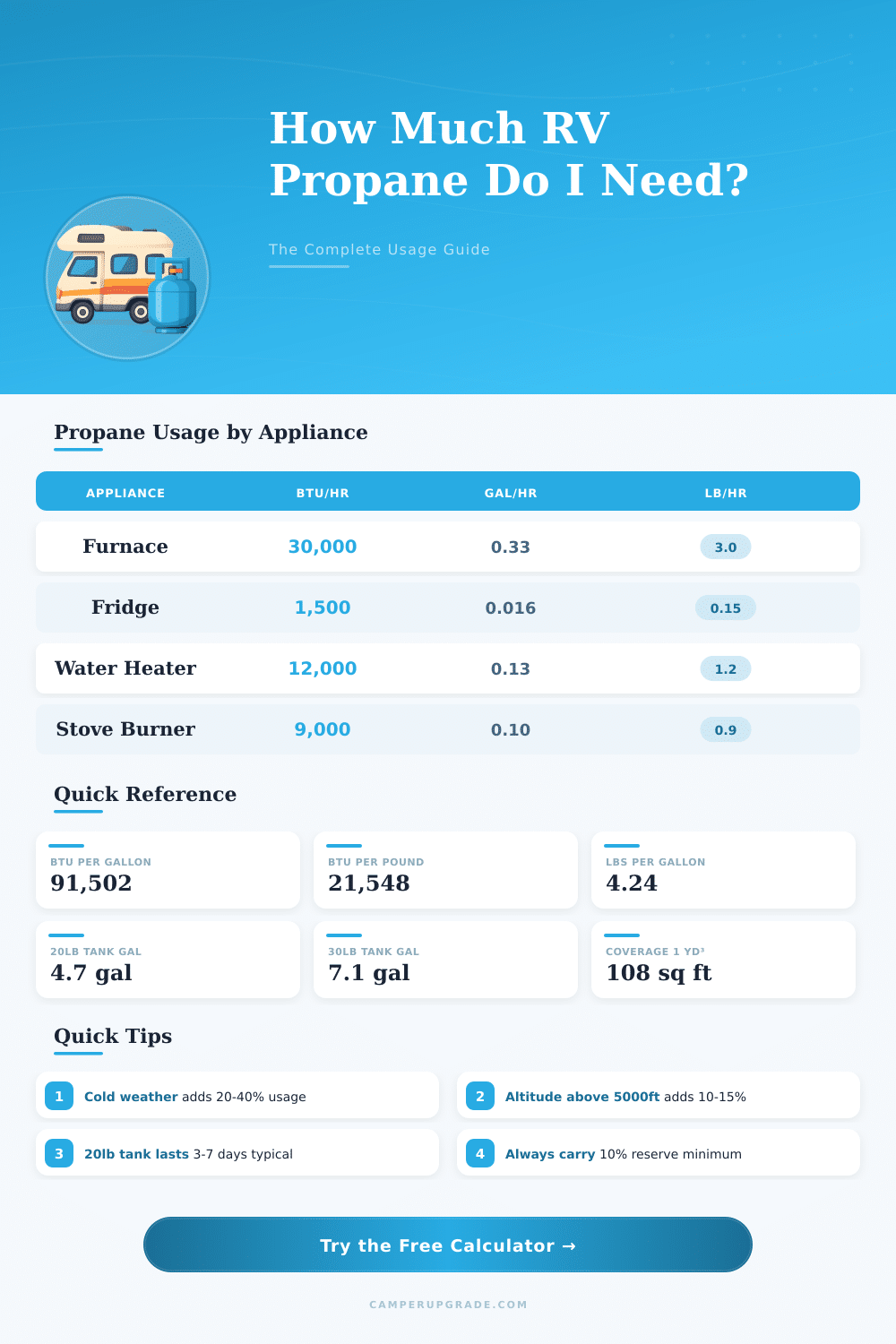
| Appliance | BTU/hr | Gal/hr | Lbs/hr | L/hr |
|---|---|---|---|---|
| RV Furnace | 30,000 | 0.328 | 1.39 | 1.24 |
| Stove (1 burner) | 9,000 | 0.098 | 0.42 | 0.37 |
| Stove (2 burners) | 18,000 | 0.197 | 0.84 | 0.75 |
| RV Oven | 7,000 | 0.077 | 0.32 | 0.29 |
| RV Fridge (LP mode) | 1,500 | 0.016 | 0.07 | 0.06 |
| Water Heater (6 gal) | 12,000 | 0.131 | 0.56 | 0.50 |
| Water Heater (10 gal) | 16,000 | 0.175 | 0.74 | 0.66 |
| Outdoor Grill | 20,000 | 0.219 | 0.93 | 0.83 |
| Propane Fireplace | 25,000 | 0.273 | 1.16 | 1.03 |
| Propane Generator | 73,500 | 0.803 | 3.41 | 3.04 |
| Trip Type | Days | Est. Gallons | Est. Liters | Min. Tank Needed |
|---|---|---|---|---|
| Summer weekend | 3 | 1.1 | 4.2 | 20 lb |
| Week camping (warm) | 7 | 4.6 | 17.4 | 20 lb |
| Week camping (mild) | 7 | 7.7 | 29.1 | Dual 20 lb |
| 2-week full-time | 14 | 15.4 | 58.3 | Dual 30 lb |
| 1 month snowbird | 30 | 33.0 | 124.9 | ASME 40 gal |
| Boondocking 5 days | 5 | 2.5 | 9.5 | 20 lb |
| Winter week | 7 | 14.0 | 53.0 | Dual 30 lb |
A single gallon of propane packs 91,502 BTU which sounds massive but an RV furnace chewing through 30,000 BTU per hour burns that in about 3 hours flat. Ive run through a 30 lb tank (7.1 gallons) in under 4 days during a cold snap below 25°F. The fridge barely sips at 1,500 BTU hourly, roughly 0.016 gallons per hour, so thats almost nothing compared to heating.
Altitude above 5,000 feet killed my efficiency by around 12%. Cold weather added another 30 to 40% on top of that. For a 7 day mild weather trip I kept landing on about 7 and a half gallons total, give or take.
Propane Basics: Uses, Tanks, and Safety
The information below does not come from some computer tool on this page. It is based on real scientific studies, talks in forums and experiences of communities, that one finds through the net.
Propane is a gas with three carbon atoms and has the chemical formula C3H8. It stays gaseous at usual temperature and pressure even so becomes liquid under high pressure. Like this one can store and transport it easily.
In the tank it exists as colorless and odorless liquid under pressure. If one opens the pressure, the liquid turns to steam, and exactly that steam one burns as fuel.
Because of the absence of own smell, one adds a chemical called ethyl mercaptan so that one can detect possible leaks. Itself is nontoxic. Propane is received as a side product during the preparation of natural gas or the refining of crude.
It comes from crude, produced in refineries. Chemically seen, it belongs to the alkanes, so simple chains of carbon atoms, that hydrogen atoms surround.
If Propane burns fully with enough oxygen, it gives water steam, carbon dioxide and much heat. Compared to coal, natural gas, diesel or gasoline, it less pollutes the surroundings. It burns more strongly than butane, but for basic works as caramelizing sugar, butane works well also.
Propane does not go bad quickly as gasoline. That makes it good for uses as back-up generators, where the fuel can sit unused during long time. One family, that uses Propane for boiler and gas fire, found, that a 120-gallon tank requires refill only every six months, even with daily cooking, common fireplace burning and summer grilling.
The sizes of tanks vary a lot. The most used are portable 20-pound cans, that work for standard barbecues, fryers for turkeys, bug devices and little heaters. Next come 200-gallon big tanks, that are 94 inches long and 30 inches wide.
They serve for extra heating or to move some home machines as generators, pool heaters or water heaters. A 320-gallon tank sits between 250- and 500-gallon sizes and works for homeowners, that want to berry his tank without choosing the whole 500-gallon version. Most tanks, included 500- and 1,000-gallon, one can bury underground.
A 1,000-gallon tank helps big businesses, while a 100-pound unit works for little business or vacation home. In the big end, there are tanks for 24,000 gallons, that are 70 feet long and 10 feet tall, used for big commercial places or stations for refueling autos.
A key safety spot is the rule about 80-percent filling. One fills Propane tanks only until 80% of capacity. So a 500-gallon tank indeed stores 400 gallons when it is full.
Bigger tanks give better steam during cold days and require fewer deliveries.
Refilling a Propane tank usually costs less than exchanging it. The cost for refill is around seven dollars, while exchange reaches about twenty dollars. Propane tanks have also a limit date, usually marked beside the handle.
If the tank nears its limit date, one does best exchange it at a store for a new full unit.
Propane costs more than natural gas on a monthly base. But installing a natural gas line to a distant place can be really dear at first. Hence many rural homes depend on Propane.
If natural gas would be available, some owners say, that they would choose it, because it costs at least half per heat unit compared to Propane. From home on heating oil to Propane-based, even so, Propane can cause lower costs than oil.
As car fuel, Propane gives fewer miles per gallon than gasoline, so one requires a bigtank for fuel. It makes also less power for same engine size. In the practical side, it commonly is cheaper than gasoline, although the prices do range.