🚐 RV Land Living Duration Calculator
Estimate how long you can legally live in an RV on your own land — based on lot size, zoning, and RV dimensions
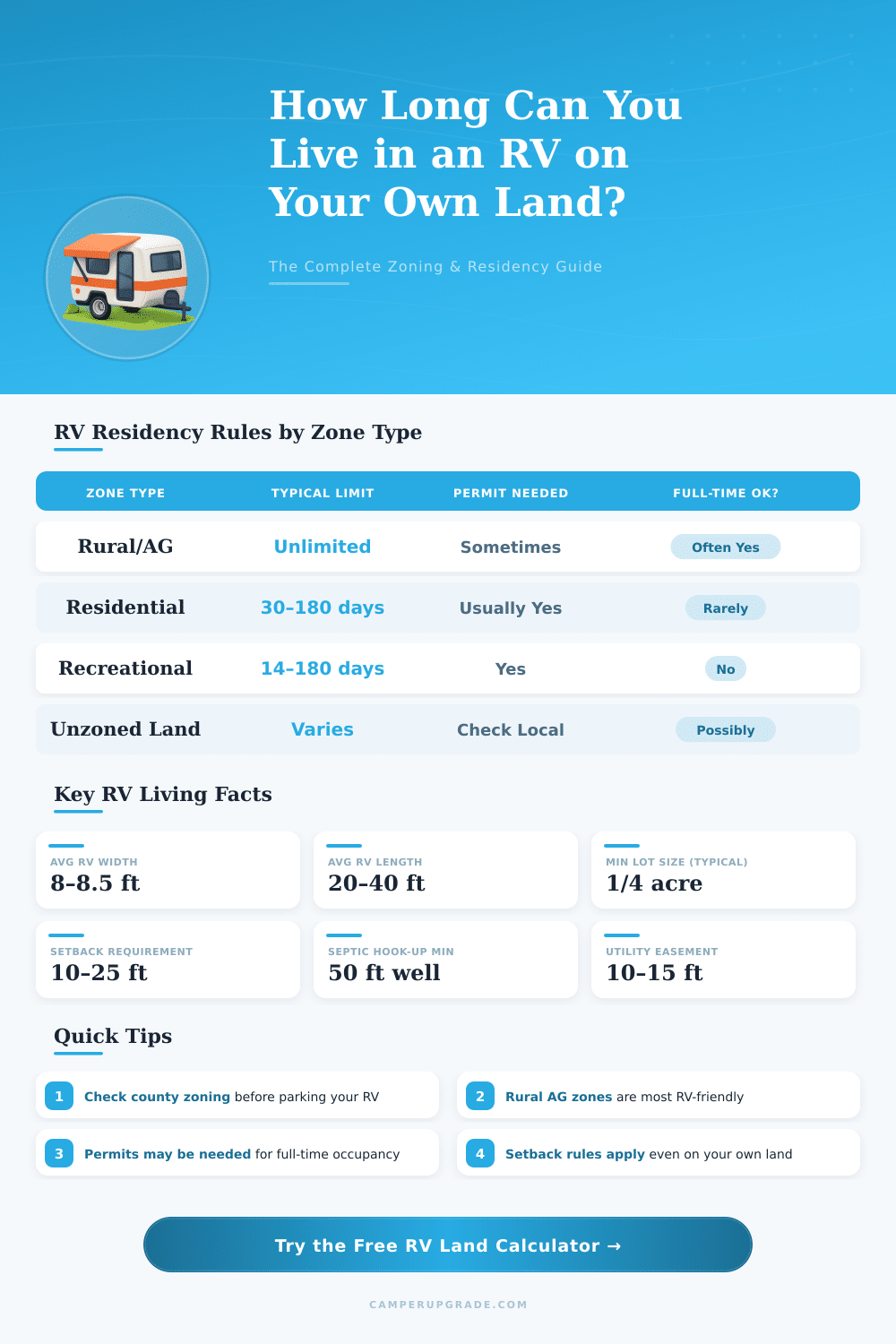
| Zone Type | Typical Stay Limit | Full-Time Allowed? | Permit Required? | Min Lot Size |
|---|---|---|---|---|
| Rural / Agricultural (AG) | Unlimited (varies) | Often Yes | Sometimes | 1–5 acres |
| Residential R1 | 30–180 days/yr | Rarely | Usually Yes | 6,000 sq ft |
| Residential R2 | 60–180 days/yr | Rarely | Usually Yes | 8,000 sq ft |
| Recreational / RV Zone | 14–180 days | No | Yes | Park rules |
| Unzoned County Land | Varies widely | Possibly | Check locally | No minimum |
| Mixed Use | 90–365 days | Case-by-case | Yes | Varies |
| Depth (in) | Depth (cm) | Sq Ft / Cu Yd | Sq M / Cu M |
|---|---|---|---|
| 1 in | 2.5 cm | 324 sq ft | 30.1 m² |
| 2 in | 5.1 cm | 162 sq ft | 15.1 m² |
| 3 in | 7.6 cm | 108 sq ft | 10.0 m² |
| 4 in | 10.2 cm | 81 sq ft | 7.5 m² |
| 6 in | 15.2 cm | 54 sq ft | 5.0 m² |
| Bag Size | Volume per Bag | Bags per Cu Yd | Coverage at 3 in |
|---|---|---|---|
| 0.5 cu ft | 0.5 cu ft / 14.2 L | 54 bags | 2 sq ft |
| 1 cu ft | 1 cu ft / 28.3 L | 27 bags | 4 sq ft |
| 2 cu ft | 2 cu ft / 56.6 L | 13.5 bags | 8 sq ft |
| 3 cu ft | 3 cu ft / 85 L | 9 bags | 12 sq ft |
| Bulk (1 cu yd) | 27 cu ft / 765 L | 1 load | 108 sq ft |
| Project | Area (sq ft) | Cu Yards Needed | 2 cu ft Bags |
|---|---|---|---|
| Small RV Pad (20×10) | 200 sq ft | 1.9 cu yd | 26 bags |
| Standard RV Pad (40×12) | 480 sq ft | 4.4 cu yd | 60 bags |
| Large RV Pad (60×14) | 840 sq ft | 7.8 cu yd | 105 bags |
| Campsite (20×20) | 400 sq ft | 3.7 cu yd | 50 bags |
| Fire Pit Zone (10×10) | 100 sq ft | 0.9 cu yd | 13 bags |
| Awning Zone (20×8) | 160 sq ft | 1.5 cu yd | 20 bags |
| Full Homestead Pad (40×40) | 1,600 sq ft | 14.8 cu yd | 200 bags |
RV life is a mode of living that many folks find attractive. It works for those that want the freedom to travel at their own pace. It also suits those that prefer simple life with fewer things.
Even so, it is not as simple or cheap as it could seem at first.
The Truth About Living in an RV
One of the biggest surprises for newcomers deals with the costs. Full-time life in an RV does not always cost less than living in a home. One must consider the purchase price, repair costs and gasoline.
RVs use much more fuel than average cars to move from place to place. A good RV park can cost around seventy-five dollars each night. Some parks are more costly, but the really cheap ones usually are unpleasant.
Long-term stay in an RV park is not expensive and mostly deals with limits on time, how many days one can stay.
Even so it depends on the place where one lives. In expensive cities like Austin or California, the price to live there can pass what many folks can spend. In such cases full-time RV life with monthly payments, site fees, insurance and repairs for the vehicle can still turn out chepaer than living in an apartment.
Some people in Austin chose RV life because the local prices far passed their incomes.
Staying in one place with a cheap used RV is a better weigh for saving money. The trade-off is giving up the travel lifestyle. Parking on private farm or own Land helps also.
In a mobile park one does not own the Land, but one owns the building and does not share walls with neighbors, so that noise matters less.
Every RV requires repairs, even new ones. Strong storms can destroy them. The materials do not have such high quality as in a house.
If one plans to use a warranty, one must stay somewhere while the RV gets repairs. Having a washer and dryer in the RV is needed for full-time living.
Place matters a lot also. Big cities in New York do not allow using an RV as regular housing outside of legal campgrounds. Florida enjoys popularity because there are no problems with bad cold, since most RVs are not built for winter.
Wyoming, on the other hand, raises doubts whether it is too cold for year-roundRV living.
When one starts, the desire is to travel without stopping and visit everything soon. But such thinking is not healthy or fun. The RV lifestyle requires slowing the pace.
Going everywhere all the time takes the pleasure from it.