⚡ RV Generator Size Calculator
Calculate the right generator wattage for your RV, camper, or travel trailer based on your actual appliances
Add each appliance you plan to run. Starting (surge) watts are what matters most for sizing.
| Appliance | Running Watts | Starting (Surge) Watts | Typical Use |
|---|---|---|---|
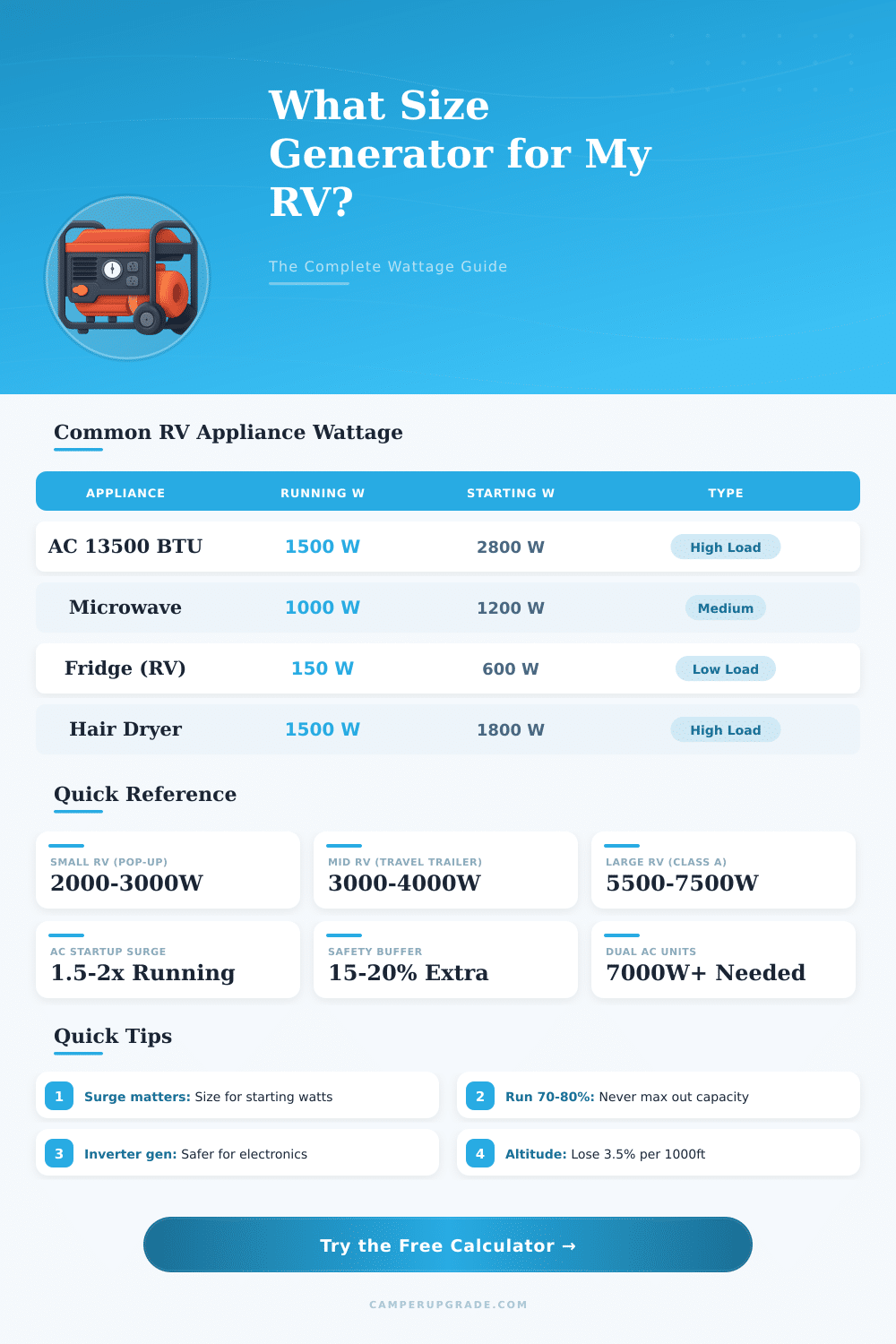
| AC — 13,500 BTU | 1,500 W | 2,800 W | Main cooling |
| AC — 15,000 BTU | 2,000 W | 3,300 W | Large RV cooling |
| AC — 9,000 BTU | 1,000 W | 1,800 W | Small / rooftop |
| Microwave (1000W) | 1,000 W | 1,200 W | Cooking |
| RV Refrigerator | 150 W | 600 W | 24/7 cycling |
| RV Furnace Fan | 300 W | 500 W | LP furnace blower |
| Electric Water Heater | 1,200 W | 1,200 W | Resistive load |
| TV (LED 32–42") | 80 W | 80 W | Entertainment |
| Laptop Charger | 65 W | 65 W | Work / browsing |
| Phone / Tablet Charger | 15 W | 15 W | Charging |
| Interior LED Lights | 100 W | 100 W | All fixtures |
| Coffee Maker | 600 W | 600 W | Morning brew |
| Toaster | 850 W | 850 W | Cooking |
| Hair Dryer | 1,500 W | 1,800 W | Personal care |
| Space Heater | 1,500 W | 1,500 W | Supplemental heat |
| Water Pump | 100 W | 350 W | Water system |
| Battery Converter | 350 W | 350 W | 12V charging |
| CPAP Machine | 65 W | 65 W | Medical / sleep |
| Electric Skillet | 1,200 W | 1,200 W | Cooking |
| Instant Pot | 700 W | 1,000 W | Pressure cooking |
| Altitude | Feet | Meters | Power Loss |
|---|---|---|---|
| Sea Level | 0 ft | 0 m | 0% |
| Low | 1,000 ft | 305 m | 3.5% |
| Moderate | 3,000 ft | 914 m | 10.5% |
| High | 5,000 ft | 1,524 m | 17.5% |
| Very High | 7,000 ft | 2,134 m | 24.5% |
| Extreme | 10,000 ft | 3,048 m | 35% |
| RV Type | Running W Needed | Starting W Needed | Suggested Gen Size |
|---|---|---|---|
| Pop-Up Camper | 1,000–1,500 W | 1,500–2,500 W | 2,000–2,200 W |
| Teardrop Trailer | 500–1,000 W | 800–1,500 W | 1,000–2,000 W |
| Travel Trailer (1 AC) | 2,500–3,500 W | 3,500–5,000 W | 3,500–4,000 W |
| 5th Wheel (2 AC) | 4,000–5,500 W | 6,000–8,000 W | 5,500–7,500 W |
| Class A Motorhome | 4,500–6,000 W | 6,500–9,000 W | 5,500–8,000 W |
| Class B Van | 800–2,000 W | 1,200–3,000 W | 2,000–3,000 W |
| Class C Motorhome | 3,000–4,500 W | 4,500–6,500 W | 4,000–5,500 W |
| Boondocking (Minimal) | 300–800 W | 500–1,200 W | 1,000–2,000 W |
| Scenario | Appliances Running | Running W Total | Peak Surge W |
|---|---|---|---|
| Morning Routine | Coffee + Lights + Fridge + Pump | 965 W | 1,565 W |
| Cooking Dinner | Microwave + Fridge + Lights + Converter | 1,600 W | 2,150 W |
| Summer Cooling | 1 AC + Fridge + Lights + TV | 1,830 W | 3,480 W |
| Dual AC Peak | 2 AC + Fridge + Lights | 3,250 W | 5,850 W |
| Work Camper | AC + Laptop + Lights + Fridge + Charger | 1,910 W | 3,280 W |
| Full Load (no heat) | AC + Micro + Fridge + Lights + TV + Pump | 2,930 W | 4,930 W |
A 13,500 BTU rooftop AC pulls around 1500 watts running but surges to 2800 at startup, which is the number that actually sizes your generator. Ive seen people buy a 2000W unit thinking itll handle one AC and it just wont. Most travel trailers with a single AC, fridge, and a few gadgets land somewhere around 3500 to 4000 watts once you factor in that surge spike plus a 15% buffer.
Altitude kills output fast. Roughly 3.5% lost per thousand feet with conventional generators, closer to 2.5% with inverter models. Camp at 5000 feet and that 4000W genset drops to about 3300 effective watts.
How to Choose the Right Generator for Your RV
Dual AC fifth wheels need 5500W minimum at sea level, and honestly closer to 7500 if youre above 3000 feet elevation.
Have a Generator for your RV changes everything when you do not have access to electrical outlets. In distant camping places without any energy, you still can enjoy all home comforts, if you carry a reliable Generator in the storage. Because of that, for fans of free camping and trips outside of the grid, such gear almost must be.
Naturally, when your camping place does have electrical outlets, the Generator is not strictly needed. Even so during long journeys, where you truly live simple, it creates all the difference, it powers your computers and the air conditioner, so that you always feel at home.
The secret when buying a Generator for an RV is to choose one from those inverter models. They receive the power of the AC and change it to DC, before restoring it as pure, smooth AC. That marks big progress compared to average built-in generators, that commonly give a bit rough flow.
For your RV, you need a model with 12 V DC and 120 V AC outputs, so that it serves all your electrical needs.
Picking the right size of the Generator is key. For a standard 30-amp RV on 120 volts, a 4,000-watt unit should be enough, although many prefer a 2,000 to 2,500-watt model as ideal. Smaller Class B vehicles commonly manage with a 2,000 to 3,600-watt Generator.
Simply make sure that it has enough power for the big air conditioning unit… Those machines alone use 1,500 to 1,800 watts, plus a starting spike of 2,800 to 3,500 watts.
For actual giants like 50-amp RVs with double 120 V branches, you must go up to a 12,000-watt Generator, to cover the maximum 12,000 watts. Such big vehicles truly can drain the Generator, so extra capacity is needed.
One good idea, so that a small Generator can start the air conditioner, is to install a soft-start kit. It greatly lowers the starting amps, making it possible to use the AC with a simpler unit. When quiet and being friendly to the surroundings is a priority, maybe think about a solar Generator, those are the most silent options available.
The amount of watts that all your devices and energy-hungry tools require ultimately decides the write size of the Generator. It is wise to count everything together, so that you choose a model that handles the whole load.
The Predator 3500 from Harbor Freight seems to be a great deal. People say that it runs a 13,500 BTU AC unit as if nothing, together with a microwave and charging of batteries, but I would not advise to use the AC and microwave at the same time. The main advantage is its quiet and fuel savings, with hundreds of hours of proven reliability.
Another strong offer is the Cummins P4500i. It has a separate starter, so you can start it from inside during bad weather. Cummins knows well about generators for RVs, designing them for easy hookup with the built-in devices.
And in a motorhome, the unit even can take fuel directly from the main tank.
Some RVs indeed arrive pre-wired for a Generator, with a built-in unit that fits directly into the electrical system. For the rest, you can choose a portable Generator, that sits outside or lies in the storage. Towable models even allow you to lay the Generator in the bed of the trailer.
Because of the many electrical options in this field, lightweightunits ease the portable solutions.
And if the noise truly bothers you, there are also silent diesel generators, made specially for use in an RV. The calm feel of a camping place matters, so the low decibel level of those units is a big extra.