🚙 RV MPG Calculator
Calculate fuel efficiency, consumption rates, and trip fuel needs for any RV type
MPG
MPG
MPG
MPG
MPG
Tow MPG
Tow MPG
Tow MPG
| Distance | 6 MPG | 10 MPG | 15 MPG | 20 MPG |
|---|---|---|---|---|
| 100 mi (161 km) | 16.7 gal | 10.0 gal | 6.7 gal | 5.0 gal |
| 250 mi (402 km) | 41.7 gal | 25.0 gal | 16.7 gal | 12.5 gal |
| 500 mi (805 km) | 83.3 gal | 50.0 gal | 33.3 gal | 25.0 gal |
| 1,000 mi (1,609 km) | 166.7 gal | 100.0 gal | 66.7 gal | 50.0 gal |
| 2,500 mi (4,023 km) | 416.7 gal | 250.0 gal | 166.7 gal | 125.0 gal |
| 5,000 mi (8,047 km) | 833.3 gal | 500.0 gal | 333.3 gal | 250.0 gal |
| Condition | MPG Impact | Example (10 MPG base) | L/100km Equiv. |
|---|---|---|---|
| Highway / Flat (55–60 mph) | Best (baseline) | 10.0 MPG | 23.5 L/100km |
| Mixed Driving | −10% to −15% | 8.5–9.0 MPG | 26.1–27.7 L/100km |
| City / Stop-and-Go | −20% to −30% | 7.0–8.0 MPG | 29.4–33.6 L/100km |
| Mountain / Hilly | −25% to −40% | 6.0–7.5 MPG | 31.4–39.2 L/100km |
| Strong Headwinds | −10% to −15% | 8.5–9.0 MPG | 26.1–27.7 L/100km |
| Towing (added trailer) | −25% to −40% | 6.0–7.5 MPG | 31.4–39.2 L/100km |
| RV Type | Typical Tank (gal) | Tank (liters) | Range at Avg MPG |
|---|---|---|---|
| Class A Gas | 80–150 gal | 303–568 L | 480–1,200 mi |
| Class A Diesel | 100–150 gal | 379–568 L | 800–1,800 mi |
| Class B Van | 25–30 gal | 95–114 L | 450–750 mi |
| Class C Gas | 40–80 gal | 151–303 L | 400–1,000 mi |
| Class C Diesel | 40–60 gal | 151–227 L | 480–960 mi |
| Tow Vehicle (1/2 ton) | 26–36 gal | 98–136 L | 208–504 mi |
| Tow Vehicle (3/4–1 ton) | 30–48 gal | 114–182 L | 210–576 mi |
| Conversion | Factor | Example | Result |
|---|---|---|---|
| MPG to L/100km | 235.215 ÷ MPG | 10 MPG | 23.5 L/100km |
| L/100km to MPG | 235.215 ÷ L/100km | 15 L/100km | 15.7 MPG |
| US Gallon to Liters | × 3.78541 | 50 gal | 189.3 L |
| Miles to Kilometers | × 1.60934 | 500 mi | 804.7 km |
| MPG (US) to MPG (UK) | × 1.20095 | 10 MPG (US) | 12.0 MPG (UK) |
| km/L to MPG (US) | × 2.35215 | 5 km/L | 11.8 MPG |
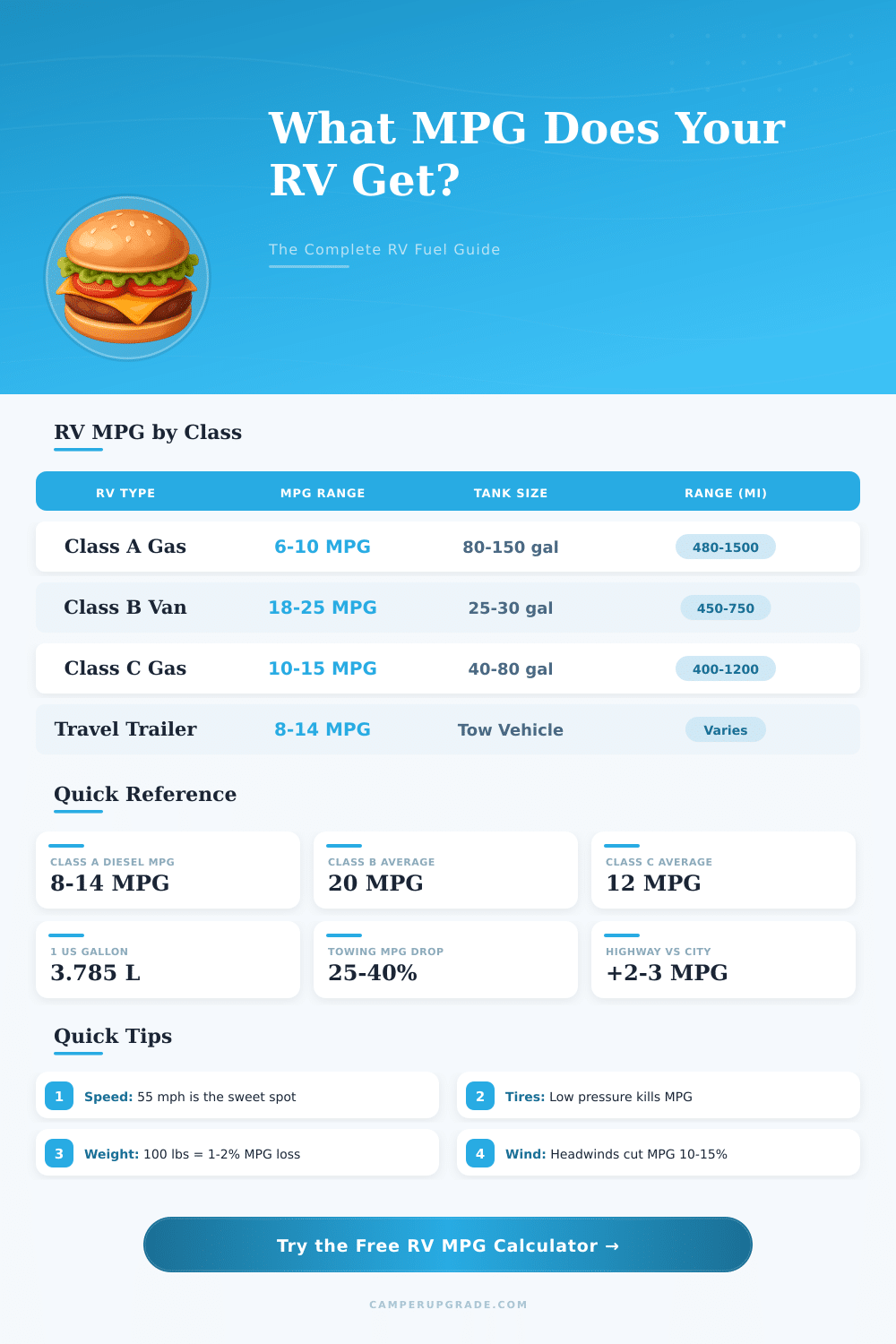
Every 5 mph you drive over 55 mph can reduce fuel economy by 7–14%. Keeping tires at the correct PSI (check your placard, not the tire sidewall) improves MPG by up to 3%. Reducing weight by 100 lbs can gain 1–2% in fuel efficiency. Use cruise control on flat highways to maintain a steady burn rate.
Fill your tank completely, reset your trip odometer, then fill completely again at the next stop. Divide miles driven by gallons added for the most accurate MPG reading. Single fillup calculations can vary by 10–15%, so average at least 3 fillups for a reliable number. GPS-based distance is more accurate than odometer readings, which can be off by 2–5%.
Class A gas rigs average about 8 MPG, which works out to roughly 29 L/100km. Thats 125 gallons for a 1,000 mile trip. Class B vans though?
Around 20 MPG. Huge difference. Ive tracked mine over 6 fillups and landed at 7.9 consistently.
RV Fuel Use, Tank Sizes, Costs and Simple Tips
Mountain driving crushed that number by 30 to 40 percent, dropping me to 5.2 on one particularly gnarly stretch through Colorado. Every 100 pounds of extra cargo shaves 1 to 2 percent off your efficiency.
The information below does not come from some computer calculator or automatic translator. It is based on actual user experiences, discussions in forums and shared knowledge from various websites.
Fuel for RV deal about one of those causes, that affects almost every part of life in an RV. One must think about everything from the size of tanks to the consumption and even where to actually fuel up. A typical RV with a gas engine reaches around 8 mpg.
That counts for Class A, Class C or even towed models with a gas vehicle. The basics work quite similarly for all those kinds.
The size of tanks varies according to the type of RV. Class A motorhomes have average around 100-gallon tanks. For Class B one finds around 24 gallons.
Models of Class C store about 25 gallons, although some sources point to Class C of 40 to 60 gallons according to the brand and maker. A range of 25 to 50 gallons maybe seem small compared to bigger motorhomes, even so Class C reach better mpg. For instance, compact rentals from Cruise America have a 40-gallon tank for gas.
RV with diesel is an entirely other matter. One such motorhome reached average 8 mpg during a six-month journey, including usage of the internal diesel generator during four to six hours a day in summer. Another big diesel rig holds 225 gallons of diesel fuel.
With seven pounds per gallon, that weighs 1 575 pounds only because of the fule. It reaches around 5 to 7 mpg.
Filling a Class A motorhome in the United States costs average around 312 dollars, according to fuel prices at average 1.03 dollars per liter. At 4 dollars per gallon, the expense for a full tank comes to about 1 dollar per mile. Like this, camping 50 miles away costs 50 dollars of gas, while a journey of 800 miles spends 800 dollars only for fuel.
Trailers for travel and towed models do not own their own tanks for fuel. They trust in the vehicle that tows them. Most trucks have between 15 and 30 gallons.
A minivan indeed ranks among the most efficient way to travel with maximum space, because it does not rely on a truck frame like a van or pickup.
Lowering speed helps to improve the consumption. One setup for truck use reaches 17 mpg at 55 mph, but it drops to 14 mpg at 65 mph. Keeping RPM low and avoiding too much pressure on the engine stays the best way for better fuel economy.
It also matters two find a good station for fuel. Going into a too small pump could cause expensive repairs for an RV. Travel centers beat average gas stations, because they serve big vehicles with wide fuel pumps and good turning space.
Places like Pilot and Flying J are very friendly to RV owners, offering easily reached entrances, showers, propane and even parking for night. Some stops at Flying J have separate entrances for fuel only for RV owners.
There are apps that help to plan for fuel. The app RV Life allows drivers to arrange fuel stops along the way. RV FuelSaver shows participating American stations for gas and suggests savings up to 1.50 dollars per gallon.
Other programs like Open Roads, Mudflap and DinoPay also help to find discounts for fuel. The card RV Frequent Fueler Advantage offers 2 cents per gallon of discount at certain places.
Generators in RV models consume roughly half a gallon per hour. Five gallons of diesel in the main tank last for eight hours of running the generator. Fuel additives help keep the system cleaner and protect it during long journeys.
Engines on diesel can last up to 1 000 000 miles, but that does not really matter for RV use, because the total mileage rarely passes even 100 000 miles. Engines on gas have usually easy to find parts and simpler care. RV models probably will be among the last vehicles that will switch to other fuels or batteries, not because of market need, but because suppliers of fuel willfinally stop supporting gasoline.
Mixes with ethanol like E10 stay here to last, so replacing fuel lines with modern parts made for E10 is a wise step.