⚡ RV Electrical Load Calculator
Calculate your total power needs — amps, watts, and battery capacity for any RV setup
| Battery Type | Capacity (Ah) | Usable Wh @12V | Usable Wh @24V |
|---|---|---|---|
| Lead-Acid (50% DOD) | 100 Ah | 600 Wh | 1,200 Wh |
| AGM (50% DOD) | 100 Ah | 600 Wh | 1,200 Wh |
| Lithium LiFePO4 (100%) | 100 Ah | 1,200 Wh | 2,400 Wh |
| Lead-Acid (50% DOD) | 200 Ah | 1,200 Wh | 2,400 Wh |
| AGM (50% DOD) | 200 Ah | 1,200 Wh | 2,400 Wh |
| Lithium LiFePO4 (100%) | 200 Ah | 2,400 Wh | 4,800 Wh |
| Lithium LiFePO4 (100%) | 300 Ah | 3,600 Wh | 7,200 Wh |
| Specification | 30 Amp Service | 50 Amp Service |
|---|---|---|
| Plug Type | TT-30 (3-prong) | 14-50 (4-prong) |
| Voltage | 120V single | 120V/240V split |
| Max Continuous Amps | 30A (24A safe) | 50A per leg (40A safe) |
| Max Wattage | 3,600W | 12,000W |
| Safe Load (80%) | 2,880W | 9,600W |
| Run 2 AC Units? | No | Yes |
| Typical RV Size | Under 32 ft | 32 ft and above |
| Daily Wh Needed | Panel Watts (5 sun hrs) | Panel Watts (4 sun hrs) | Panel Watts (3 sun hrs) |
|---|---|---|---|
| 1,000 Wh | 200W | 250W | 334W |
| 2,000 Wh | 400W | 500W | 667W |
| 3,000 Wh | 600W | 750W | 1,000W |
| 5,000 Wh | 1,000W | 1,250W | 1,667W |
| 8,000 Wh | 1,600W | 2,000W | 2,667W |
| Current (Amps) | 10 ft Run | 15 ft Run | 20 ft Run | 25 ft Run |
|---|---|---|---|---|
| 5A | 16 AWG | 14 AWG | 14 AWG | 12 AWG |
| 10A | 14 AWG | 12 AWG | 12 AWG | 10 AWG |
| 20A | 12 AWG | 10 AWG | 10 AWG | 8 AWG |
| 30A | 10 AWG | 8 AWG | 8 AWG | 6 AWG |
| 50A | 8 AWG | 6 AWG | 6 AWG | 4 AWG |
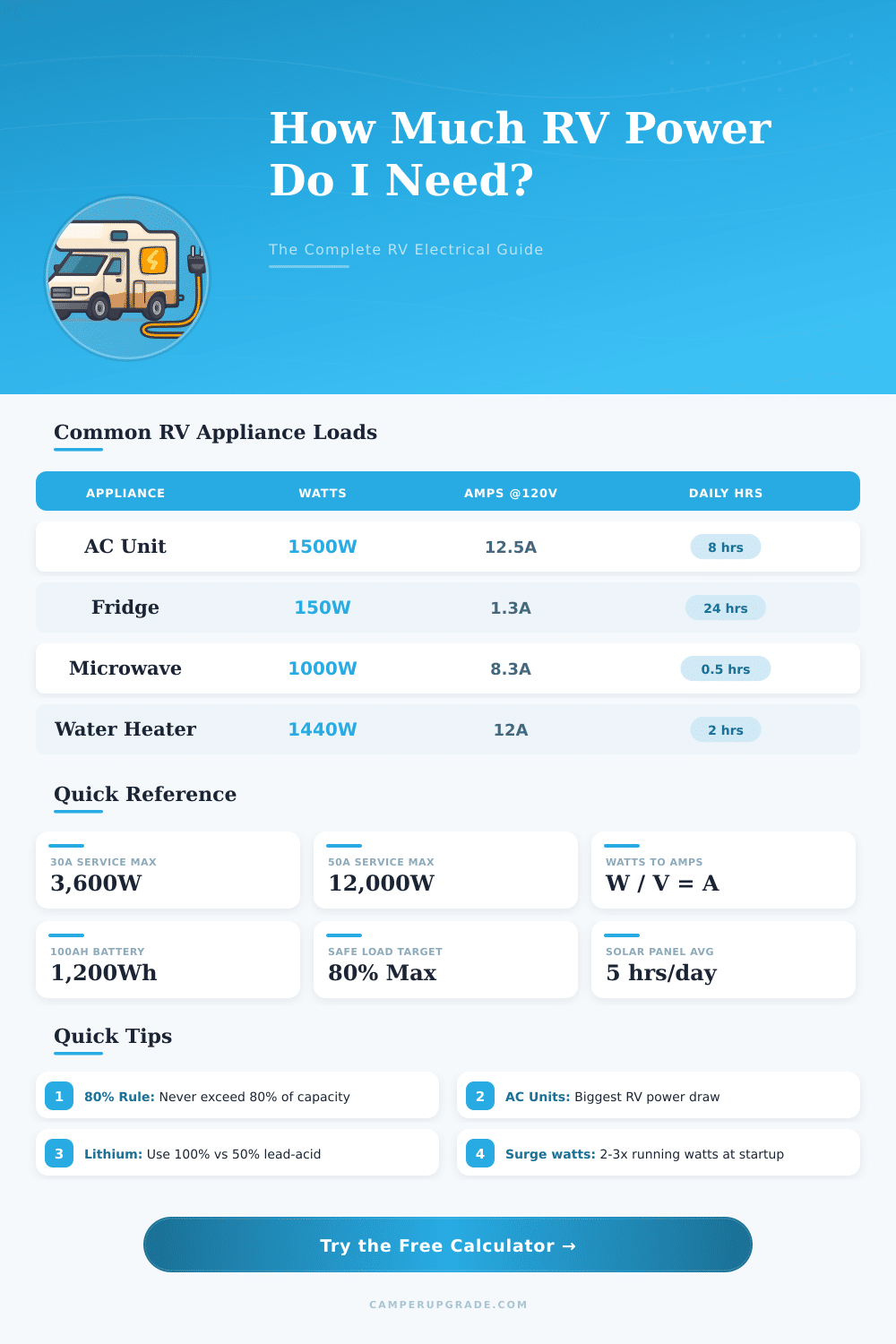
A 30 amp RV service maxes out at 3,600 watts and the 80% rule drops that to 2,880 usable. Ive tripped breakers running an AC at 1,500 watts alongside a microwave at 1,000 watts and a water heater pulling 1,440. Thats 3,940 watts on a 3,600 watt hookup.
Not gonna work. 50 amp service gives you 12,000 watts which changes everything. Off grid with lithium batteries you get 100% of the rated amp hours versus only 50% from lead acid.
RV Power Basics: 30 Amp, 50 Amp and Batteries
A 200Ah lithium bank at 12 volts delivers 2,400 usable watt hours per day. That same capacity in AGM? Half that, 1,200 watt hours.
The information shared here are not done by some calculator or tool. It bases on actual feedback of users, discussions in forums and experiences of the rv community found through the net.
Understand the electrical load of rv are between the most important things to detect before sailing. The electrical system of rv in 30 amps operate by means of 120 volts and give a maximum of 3 600 watts of power. That comes from a simple formula: 30 amps multiplied by 120 volts match 3 600 watts.
By comparison that is much less than the 200-amp system in most homes, that can deliver up to 24 000 watts.
The basic equation for counting electrical load are: watts = amps × volts. Knowing that formula, one more easily determines how many different electrical devices can operate at the same time in an rv.
50-amp rv service does not mean only 50 amps entirely. Actually it has two separate 50-amp, 120-volt “legs”, and because of that it can provide up to 12 000 watts. In actual usage, the vehicle operates many 120-volt loads, scattered between both legs.
That chance to share teh electrical load between two poles mean, that every pole can bear 50 amps. If all circuits would be on one alone phase as at 30-amp service, then 100-amp service should deliver the same amount of power. Sharing the electrical load also removes the need for very thick wire, that would be needed for something like a 10 kW generator.
rv connections come in different sizes: 15 or 20 amps, 30 amps or 50 amps. If one connects at home, the home electrical panel must have enough power and enough space for the switches to handle the extra circuit. A 200-amp home panel usually is quite good for backing this.
Devices really differ according to how much power they draw. Electrical motors commonly have an initial peak, that is much higher than their normal running load; a good example is the air conditioner. Its starting peak can be three times the usual running load.
The three big power users in an rv are the air conditioner, the refrigerator and the microwave. A system of 3 600 watts in 30 amps can cover operation of all three of those.
Some newer rv units have installed 50-amp supply in 120/240 volts. At least 20 percent of rv park places must have 50-amp outlets in 125/250 volts to handle the bigger electrical systems in some rv units. The electrical load counted for an outlet of a 20-amp rv place is 2 400 volt-amps.
Every separate tent with 20-amp supply counts as 600 volt-amps.
The standard 12-volt system in an rv operates the lights and the water pump. Sometimes also the television operates by means of 12 volts. That system receives energy from one or several deep-cycle 12-volt batteries, commonly called domestic batteries.
One also can tie too 6-volt batteries to receive 12 volts. It is worth checking whether there are 12-volt loads, that maybe drain the batteries. A multimeter with clamp can show the amp draw and help to identify, whether something uses the batteries when it should not.
Estimating electrical load means to detect which devices must operate and how long each operates during a day. It matters to know roughly how much power all devices use. If a panel in an rv solar setup is rated at 80 watts and operates during one hour, it uses 80 watt-hours.
Such formulas help to determine how much power a separate electrical load uses over time. There are tools, that do rating of rv electrical load to help choose battery capacity in amp-hours and the size of the solar system, allowing to enter both AC and DC loads together with daily use time.
It matters to also balance the electrical load. Factory built rv units do not always have perfectly balanced breakers between both legs. Moving switches to the other leg can help balance the loads.
A popular choice for small rv remodels and conversions of cargo trailers are Square D QO 30-amp load center with 2 spaces and 2 circuits. Automatic load switching is another trick, where usage of the microwave briefly turns off the electricalwater heater to escape overloading the 30-amp system.