🚗 RV Driver Hire Calculator
Estimate driving hours, days needed, and trip details for hiring an RV driver or pilot vehicle service
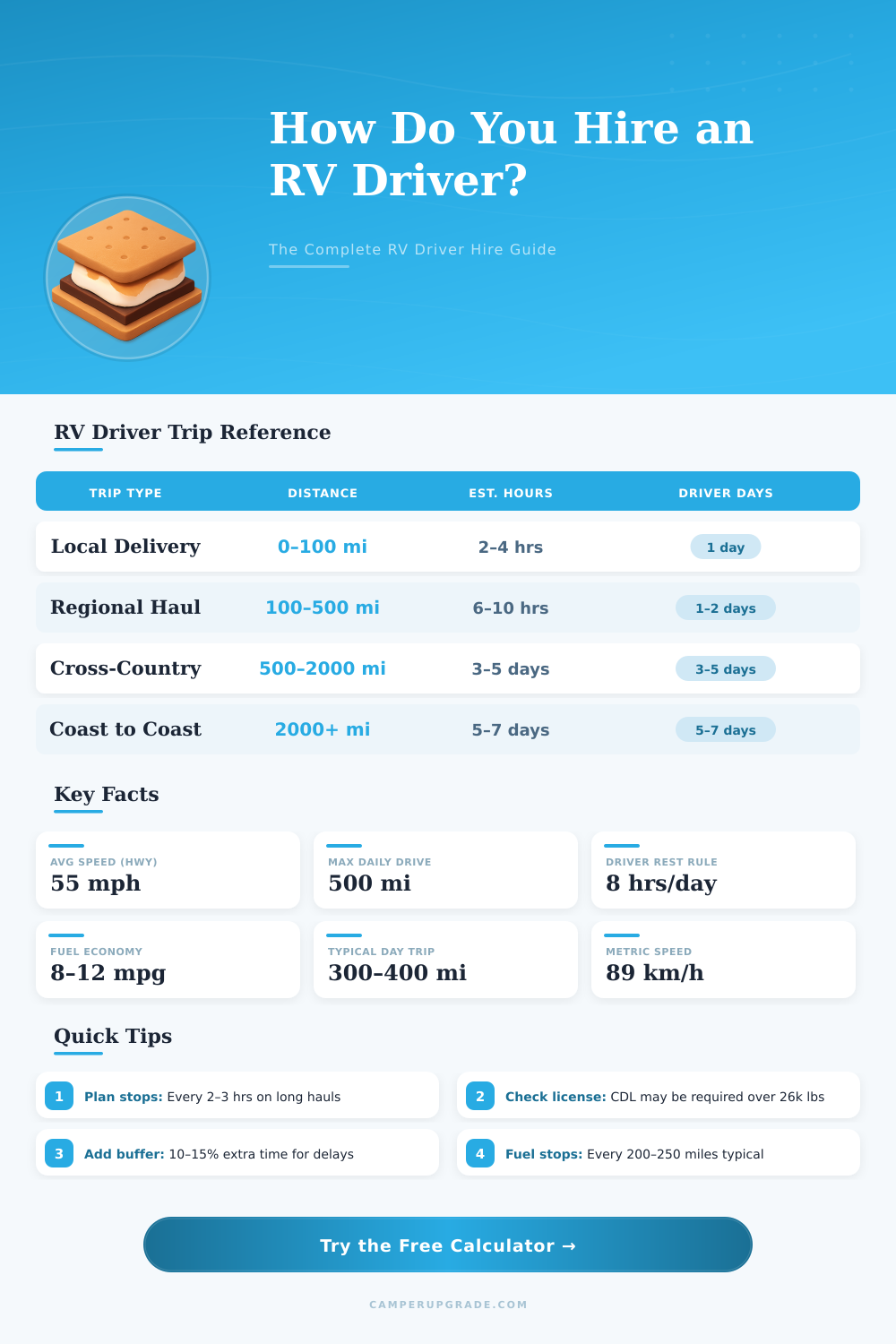
| Trip Distance | Metric (km) | Est. Drive Days | Est. Total Hours | Driver Type |
|---|---|---|---|---|
| Under 100 mi | Under 161 km | 1 day | 2–3 hrs | Local Delivery |
| 100–300 mi | 161–483 km | 1 day | 3–6 hrs | Local/Short Haul |
| 300–500 mi | 483–805 km | 1–2 days | 6–10 hrs | Regional Haul |
| 500–1,000 mi | 805–1,609 km | 2–3 days | 10–20 hrs | Cross-Country |
| 1,000–2,000 mi | 1,609–3,219 km | 3–5 days | 20–38 hrs | Cross-Country |
| 2,000–3,000 mi | 3,219–4,828 km | 5–7 days | 38–55 hrs | Full Transfer |
| 3,000+ mi | 4,828+ km | 7–10 days | 55–75+ hrs | Full Transfer |
| RV Type | Typical Length | GVWR Range | CDL Needed? | Pilot Car? |
|---|---|---|---|---|
| Class A Motorhome | 26–45 ft | 14,000–30,000 lbs | Rarely | If >40 ft |
| Class B Van Camper | 17–24 ft | 6,000–11,500 lbs | No | No |
| Class C Motorhome | 21–35 ft | 10,000–16,500 lbs | Rarely | No |
| Fifth Wheel Trailer | 22–45 ft | 12,000–30,000 lbs | Sometimes | If oversized |
| Travel Trailer | 10–35 ft | 2,000–14,000 lbs | No | No |
| Toy Hauler | 24–44 ft | 10,000–24,000 lbs | Sometimes | If oversized |
| Super C | 35–50 ft | 22,000–33,000 lbs | Often | Yes (>48 ft) |
| Skoolie / Bus Conversion | 35–45 ft | 26,000–36,000 lbs | Yes | Yes |
| Distance (mi) | @ 45 mph | @ 55 mph | @ 60 mph | @ 65 mph |
|---|---|---|---|---|
| 100 mi (161 km) | 2.2 hrs | 1.8 hrs | 1.7 hrs | 1.5 hrs |
| 250 mi (402 km) | 5.6 hrs | 4.5 hrs | 4.2 hrs | 3.8 hrs |
| 500 mi (805 km) | 11.1 hrs | 9.1 hrs | 8.3 hrs | 7.7 hrs |
| 750 mi (1,207 km) | 16.7 hrs | 13.6 hrs | 12.5 hrs | 11.5 hrs |
| 1,000 mi (1,609 km) | 22.2 hrs | 18.2 hrs | 16.7 hrs | 15.4 hrs |
| 2,000 mi (3,219 km) | 44.4 hrs | 36.4 hrs | 33.3 hrs | 30.8 hrs |
| 3,000 mi (4,828 km) | 66.7 hrs | 54.5 hrs | 50.0 hrs | 46.2 hrs |
| Total Distance | 200 mi/day | 300 mi/day | 400 mi/day | 500 mi/day |
|---|---|---|---|---|
| 500 mi (805 km) | 3 days | 2 days | 2 days | 1 day |
| 1,000 mi (1,609 km) | 5 days | 4 days | 3 days | 2 days |
| 1,500 mi (2,414 km) | 8 days | 5 days | 4 days | 3 days |
| 2,000 mi (3,219 km) | 10 days | 7 days | 5 days | 4 days |
| 2,500 mi (4,023 km) | 13 days | 9 days | 7 days | 5 days |
| 3,000 mi (4,828 km) | 15 days | 10 days | 8 days | 6 days |
Guide an RV affect you as if you would enter a whole other world compared with driving your everyday car. Those vehicles are huge and here the real challenge: you not always well feel, where the rig indeed sits on the way, as you usually do with a car. Normal vehicles give you clear sightlines and reliable mirrors; also they are made to slip through the air without too much wobble.
RVs, on the other hand, are real tanks compared, what explains why you sometimes will see one wedged halfway in front of a fast food place, or will hear about something that got hit at the back.
How to Drive an RV Safely
To rent or drive an RV, you will need a valid Driver license, but here the good news: for most you do not need a commercial Driver license. The weight limit is around 26 000 pounds according to estimated total vehicle weight, anything under that limit and you are safe. Cross to 26 001 pounds or more, and suddenly a CDL becomes needed.
Some of those bigger rigs with extra axles feel almost as driving a big bus, what maybe needs special approval depending on where you drive. Even so many drivers somehow slip without it and never meet trouble, though highway patrol can be a whole otehr creature.
Because RVs involve so much space, it matters to drive with real care and keep good distance between vehicles much more than in a car. Also you must mind the height, low overpasses and tree branches are not your friends. When you already are on the highway, it gets a bit easier.
Stay in the right outside lane and simply stay there usually reduces the tension. Mind about eventual swing when you enter gas stations or move in RV parks, because the back part swings broadly. While backing up, turn a bit from the left-hand side so that the free space stays at your side…
Like this your mirrors truly let you sea what happens left.
Driving an RV requires much more attention than slipping in a normal car. And they do not cruise that quickly also. Many expert RV guys keep their driving days to less than six hours, because that becomes mentally tiring.
The distance that you cover simply does not matter likewise as it would matter in a car.
If the driving stress too exhaust you, many services will send someone else to take the wheel. Hiring a professional Driver removes a big part of the pressure, especially if you travel with family or friends. Some rental companies even offer fancy RVs with a Driver that cares about everything, from the van to lodging you.
There are also “drive relocation” jobs, drivers that move RVs from one place to another by real driving, instead of towing them on a truck. Those RVs go to sales lots or to other places. Anyone that works full time in RV transportation needs a CDL, clean driving record and solid experience with big vehicles and towing.
Knowing their way around GPS devices and electronic recorders surely helps also.
Portable radios are useful when someone must direct the Driver through narrow places. Truck driving schools last more than five weeks, and RV training probably would cost the same. Why not find an empty parkinglot and polish your skills until you feel confident?
That is the clever step.