⚡ RV Converter Size Calculator
Find the right converter size for your RV — enter your appliances and RV type to get an accurate recommendation
| Appliance | Typical Amps DC | Watts (12V) | Notes |
|---|---|---|---|
| LED Lighting (full RV) | 3–8A | 36–96W | Much less than incandescent |
| 12V Refrigerator | 5–12A | 60–144W | Compressor cycles on/off |
| Water Pump | 3–7A | 36–84W | Only runs when water flows |
| Furnace Blower | 4–10A | 48–120W | Ignition spike to 12A |
| TV (12V, 19–32in) | 2–8A | 24–96W | LCD or LED type |
| Slide-Out Motor | 15–30A | 180–360W | Surge load, short duration |
| Awning Motor | 8–15A | 96–180W | Intermittent use |
| USB / Phone Charging | 1–3A | 12–36W | Per device, multiply as needed |
| Fan (12V Ceiling) | 1–5A | 12–60W | Speed-dependent |
| CO/Smoke Detectors | 0.2–0.5A | 2–6W | Always on |
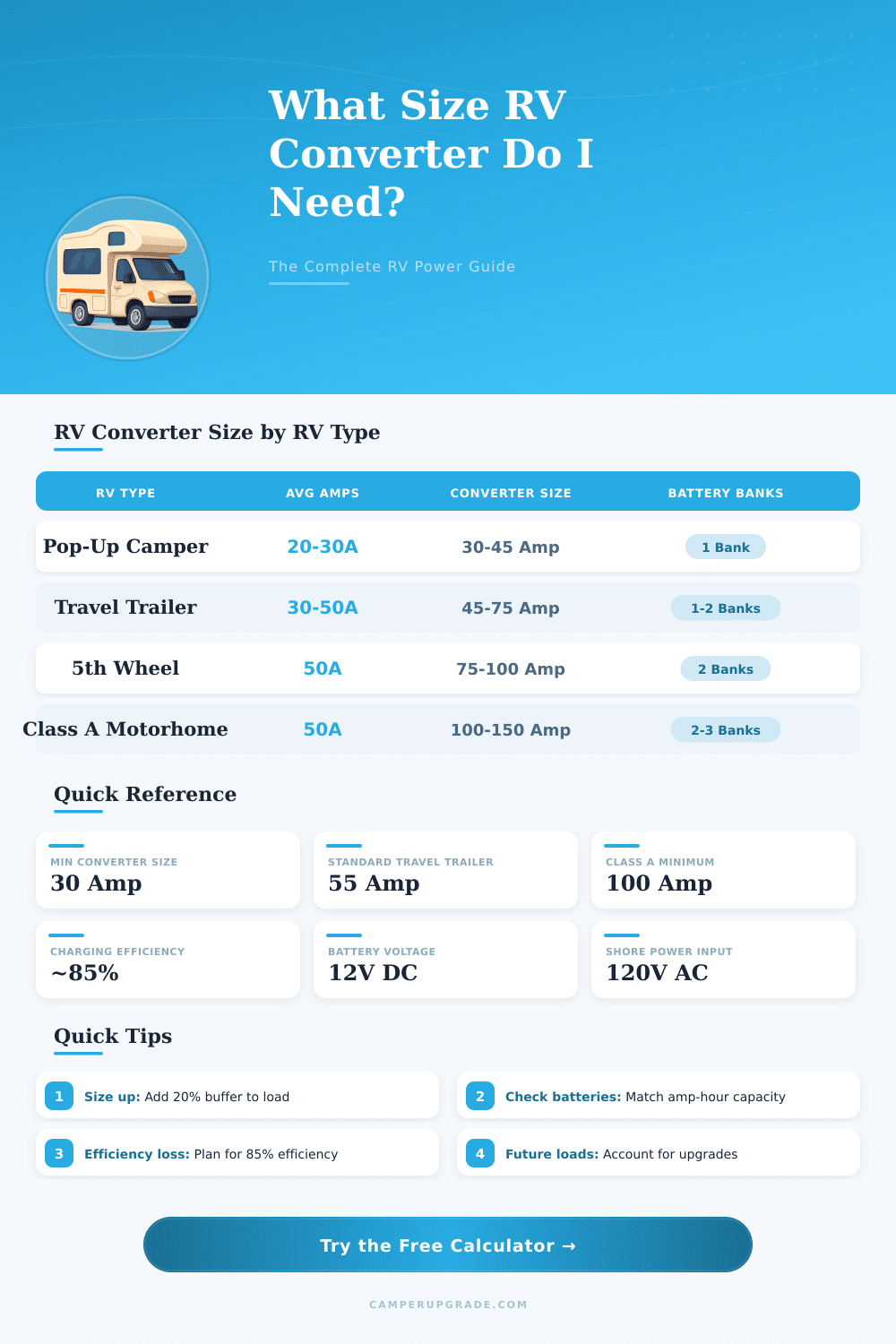
| Converter Size | Usable Output | Charge 100Ah (50% discharged) | Best For |
|---|---|---|---|
| 30 Amp | ~25A after loads | 2–3 hours | Pop-ups, small trailers |
| 45 Amp | ~35A after loads | 1.5–2.5 hours | Mid-size travel trailers |
| 55 Amp | ~40A after loads | 1.5–2 hours | Standard travel trailers |
| 75 Amp | ~55A after loads | 1–1.5 hours | 5th wheels, Class C |
| 100 Amp | ~75A after loads | ~1 hour | Class A, large 5th wheels |
| 150 Amp | ~110A after loads | Under 1 hour | Luxury rigs, multi-bank |
| Battery Config | Total Capacity | Usable (50%) | Min Converter Needed |
|---|---|---|---|
| 1x 100Ah | 100 Ah | 50 Ah | 30 Amp |
| 2x 100Ah | 200 Ah | 100 Ah | 45–55 Amp |
| 3x 100Ah | 300 Ah | 150 Ah | 55–75 Amp |
| 4x 100Ah | 400 Ah | 200 Ah | 75–100 Amp |
| 2x 200Ah (Lithium) | 400 Ah | 360 Ah (90%) | 100–150 Amp |
| 4x 200Ah (Lithium) | 800 Ah | 720 Ah (90%) | 150 Amp+ |
The Converter in an RV ranks between the main parts of the electrical system. It receives 120V AC shore energy and converts it to 12V DC energy Like this it powers devices like lamps, slides, water pumps and other 12-volt setups. Also, it takes care of charging the battery.
If the RV is connected to 30- or 50-ampere shore energy, that arrives as alternating electricity. The Converter turns it to direct electricity, so everything inside works correctly.
How an RV Converter Works
Some folks commonly confuse converters with inverters. These do different tasks. A Converter converts AC 110V to DC 12V. An inverter instead turns DC 12V back to AC 110V. Both are needed for proper use in an RV.
The inverter takes DC from the coach batteries and produces 110V AC for devices like bleneders and others that require AC.
You find the Converter usually beside the fuse panel or as its part. It sometimes sits in the wall behind that panel. Usually it sits inside around two feet of the AC power inlet on the outside of the RV.
Because the Converter is installed in the RV, it automatically turns on when shore energy connects.
Modern converters come as 3-stage or 4-stage chargers. A 4-stage charger works to care for various kinds of batteries. Some models have adjustable voltage, that you can set between 13 and 16.5 volts.
Popular brands include Progressive Dynamics, WFCO, PowerMax and JATO. Progressive Dynamics is commonly seen as good cost-efficiency, because it does knot destroy the batteries.
Signs of a broken Converter are dark lamps, slow fans or outlets that stop working. Testing includes use of a voltmeter to check the state of the battery and the output of the Converter. The battery should read between 12.3V and 12.9V, while the output of the Converter should sit between 13.6V and 14.4V.
Before turning to help, try to check for blown fuses, tripped breakers and does the cooling fan work.
Switching to lithium batteries is a big reason now. It is not always easy to change. The current Converter maybe needs to be replaced with a lithium-ready model.
Even so, some newer RVs since 2019 already can have the right Converter installed. You also can add a DC-to-DC Converter so that the existing unit properly charges lithium batteries. When upgrading, you must choose a stronger amp Converter.
Using a 45-ampere unit to replace a 30-ampere one widely works well. Also the wires matter, because too thin wires at 12 volts cause more severe voltage-drop problems thanat 120 volts.
When the RV is not plugged in to shore energy and only runs on DC, the Converter does not need to be on. The DC energy from the battery can still flow through it and cover the needs of the people inside without it turning on.