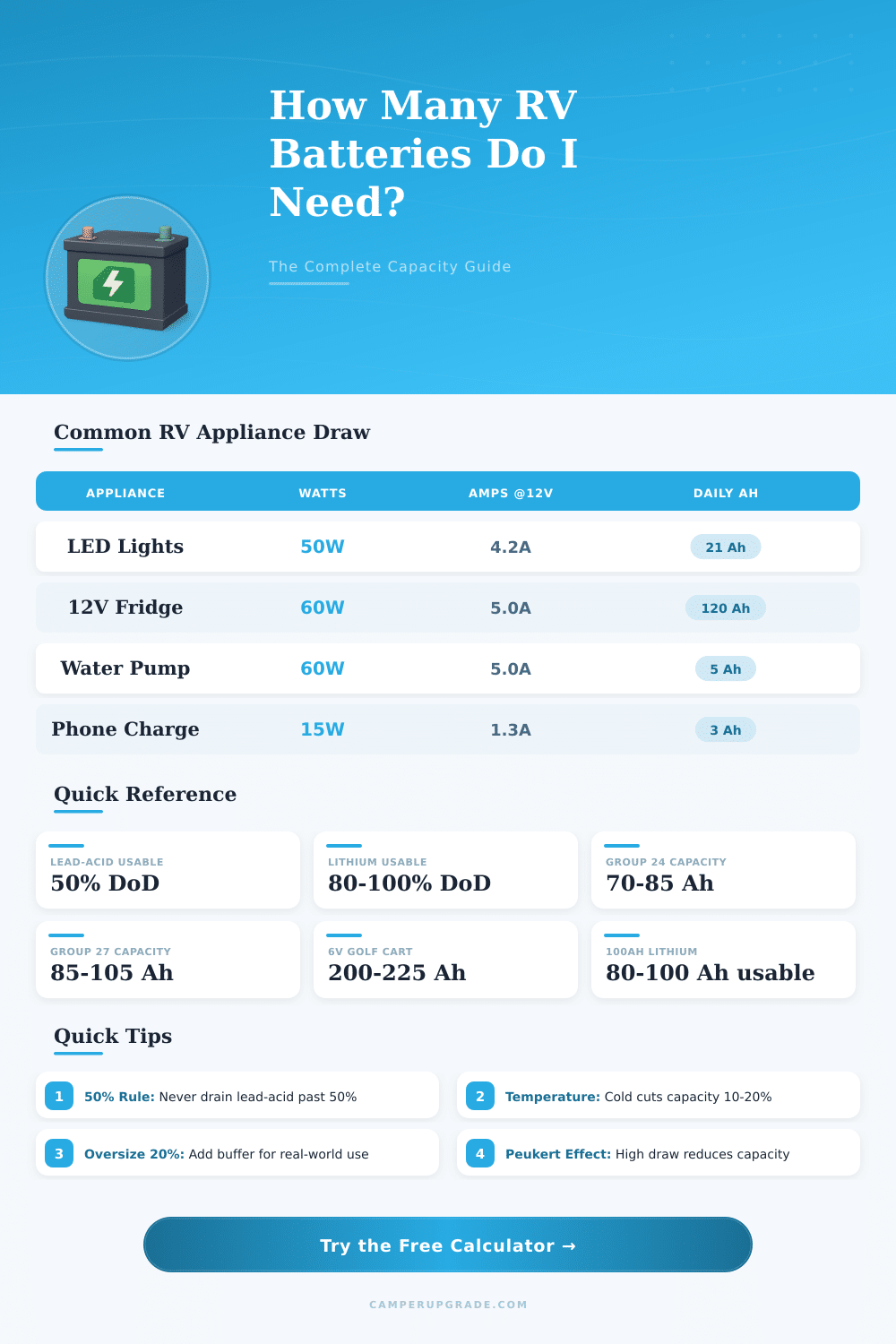
🔋 RV Battery Capacity Calculator
Calculate exactly how much battery capacity your RV needs based on your appliances and usage
Usable DoD
Usable DoD
Usable DoD
Usable DoD
Lifespan
Lifespan
Lifespan
Lifespan
| Appliance | Watts | Amps @12V | Typical Hrs/Day | Daily Ah @12V |
|---|---|---|---|---|
| LED Interior Lights | 50 | 4.2 | 5 | 20.8 |
| 12V RV Fridge | 60 | 5.0 | 24 | 120.0 |
| Water Pump | 60 | 5.0 | 1 | 5.0 |
| Phone Charger | 15 | 1.3 | 3 | 3.8 |
| Laptop | 65 | 5.4 | 4 | 21.7 |
| Vent Fan | 40 | 3.3 | 8 | 26.7 |
| 32" TV | 50 | 4.2 | 3 | 12.5 |
| Microwave | 1000 | 83.3 | 0.25 | 20.8 |
| Coffee Maker | 800 | 66.7 | 0.17 | 11.3 |
| RV Air Conditioner | 1500 | 125.0 | 6 | 750.0 |
| CPAP Machine | 60 | 5.0 | 8 | 40.0 |
| Starlink Router | 50 | 4.2 | 12 | 50.0 |
| Instant Pot | 700 | 58.3 | 0.5 | 29.2 |
| Hair Dryer | 1200 | 100.0 | 0.17 | 16.7 |
| Electric Heater | 1500 | 125.0 | 4 | 500.0 |
| Battery Size | Nominal Ah | Weight (lbs) | Weight (kg) |
|---|---|---|---|
| Group 24 (Lead-Acid) | 70–85 Ah | 43–55 | 19.5–25 |
| Group 27 (Lead-Acid) | 85–105 Ah | 54–65 | 24.5–29.5 |
| Group 31 (Lead-Acid) | 95–125 Ah | 60–75 | 27–34 |
| 6V Golf Cart (Pair = 12V) | 200–225 Ah | 62–72 each | 28–33 each |
| 100Ah LiFePO4 | 100 Ah | 24–30 | 11–13.6 |
| 200Ah LiFePO4 | 200 Ah | 44–55 | 20–25 |
| 300Ah LiFePO4 | 300 Ah | 65–80 | 29.5–36 |
| Daily Ah Need | Lead-Acid @50% DoD | AGM @50% DoD | LiFePO4 @80% DoD | LiFePO4 @100% DoD |
|---|---|---|---|---|
| 100 Ah | 200 Ah bank | 200 Ah bank | 125 Ah bank | 100 Ah bank |
| 200 Ah | 400 Ah bank | 400 Ah bank | 250 Ah bank | 200 Ah bank |
| 300 Ah | 600 Ah bank | 600 Ah bank | 375 Ah bank | 300 Ah bank |
| 500 Ah | 1000 Ah bank | 1000 Ah bank | 625 Ah bank | 500 Ah bank |
| 750 Ah | 1500 Ah bank | 1500 Ah bank | 938 Ah bank | 750 Ah bank |
| Setup Type | Daily Ah @12V | Lead-Acid Bank | LiFePO4 Bank |
|---|---|---|---|
| Minimal (lights + phone) | 25–40 Ah | 1x Group 27 | 1x 100Ah |
| Weekend Boondocking | 75–120 Ah | 2x Group 27 | 1x 200Ah |
| Full-Time (no AC) | 150–250 Ah | 4x 6V Golf Cart | 2x 200Ah |
| Remote Work + Full-Time | 200–350 Ah | 6x 6V Golf Cart | 2–3x 200Ah |
| With AC (moderate use) | 500–900 Ah | Impractical | 4–5x 200Ah |
Lead-acid batteries lose about 10–20% capacity at 32°F (0°C). At 0°F (-18°C), capacity can drop by 30–40%. LiFePO4 batteries handle cold better but most cant charge below 32°F without a heated BMS. If you camp in winter, add 20–30% extra capacity to your calculations.
High-current draws reduce effective capacity on lead-acid batteries. A 100Ah lead-acid battery at a 5-amp draw delivers close to 100Ah, but at 50 amps it might only deliver 70–80Ah effectively. LiFePO4 batteries are nearly immune to this effect, delivering consistent capacity regardless of discharge rate.
A 12V RV fridge running 24 hours eats about 120 amp hours daily, which honestly blew my mind. Thats already more than a single Group 27 lead acid battery can safely deliver at 50% depth of discharge. Add 50 watts of LED lights for 5 hours and youre looking at another 21 Ah, give or take.
The fridge alone demands roughly 1440 watt hours per day, and with inverter losses at 90% efficiency youre closer to 1600 Wh. LiFePO4 batteries weigh about 27 pounds per 100 Ah compared to 60 for flooded lead acid. Big difference.
How to Choose an RV Battery
A 400 Ah lithium bank comes in around 108 pounds total while the equivalent lead acid bank (needing 800 Ah nominal for the same usable capacity) hits somewhere around 480 pounds. Cold weather knocks 10 to 20% off lead acid capacity at 32 degrees Fahrenheit. I didnt expect that to matter until one February trip where my batteries read half empty by morning despite barely running anything.
The information below does not come from any computer program or automatic translator. It is based on actual users’ memories, discussions in forums and experiences from various communities found everywhere on the net.
RV batteries provide energy for all systems except the motor in a recreational vehicle. Among them are lamps, water pumps fans and control panels. Think of them like a tank in a car, but for the electrical parts instead of fuel.
When the battery is too small, the devices will not operate for a long time. When it is too big, one wastes money, place and extra weight.
There are several kinds of domestic batteries for an RV. The three main types are flooded lead-acid, AGM (absorbed glass mat) and lithium-ion. Each of them works for usage in an RV, but each has its strengths and weaknesses.
Current owners of an RV can choose between different types of battery chemistry, and no longer deal only about simple lead-acid or nothing.
Lithium batteries became a favourite upgrade. One 100Ah lithium iron phosphate (LiFePO4) battery matches almost three AGM batteries in usable capacity. Three AGM batteries weigh around 90 kilos, while one LiFePO4 battery has only around 12 kilos.
Lithium batteries charge more quickly, last twice as long and handle deeper drains without problems. They do not release dengerous gases, do not require topping up and do not leak acid. LiFePO4 batteries do not have dangerous lead or acids, are fully recyclable and offer clean energy solutions.
They also resist shocks and vibrations, designed for tough road conditions.
A battery of 100 Ah lithium can weigh only 24 pounds and cost around 305 dollars. It is not rare now to sea a big RV with a bank of 1000 Ah lithium batteries. Years ago, such an installation would be costing a whole fortune.
AGM batteries have their own quirks. It is important to know that if an AGM battery (at least some brands). Becomes fully drained, a fast charger will not revive it.
It works well to replace a dead AGM battery with a new one. AGM batteries charge fairly slowly and require regular care. It commonly happens that batteries stay at a steady 14.2 volts on shore power, without transfer to float charge.
Batteries of 6 volts connected in series form another option. A battery of 12 volts and 100 Ah or two of 6 volts and 100 Ah in series both deliver 1200 watt-hours of capacity. Interstate lead-acid batteries of 6 volts, combined with solar panels, operate without problems during journeys across the country.
Their simple care is a big plus, and they are available almost everywhere, even in Mexico.
Sizes of batteries are very important. Typical deep-cycle sizes are Group 24, Group 27, Group 31 and 8D. Group 24 has dimensions around 10.25 × 6.81 × 8.88 inches. Group 27 measures about 12.06 × 6.81 × 8.88 inches.
Group 31 are around 13.00 × 6.81 × 9.44 inches. One must consider dimensions, because many boxes and spots for RV batteries have limited space, especially in travel trailers. Always measure the length, width, height, fixtures and position of poles before buying.
Batteries of Group 31 give around 95 to 125 amp-hours, which works for big RV or those with high energy needs. Choosing the biggest amp-hour battery in the budget is a good strategy for folks that do boondocking or camping without hookups.
Marine deep-cycle batteries can serve also as domestic in an RV. Some systems even have a solenoid that allows the domestic battery to help start the engine, if the start battery fails. Even so, car batteries and deep-cycles are not designed for the same uses.
Car batteries give a short burst for the starter, while deep-cycles provide low, stable energy for a long time.
Storing batteries during winter is another concern. Shore power can sometimes overheat and damage them. It is better to use a special trickle charger than leave them on shore power during storage.
A multimeter helps to check voltage level at the battery, while connected andturned on. Five years is considered a good lifetime for a battery. An online calculator can help estimate the right size of a battery bank, including types of devices, everyday watt-hours and needs of backup energy.