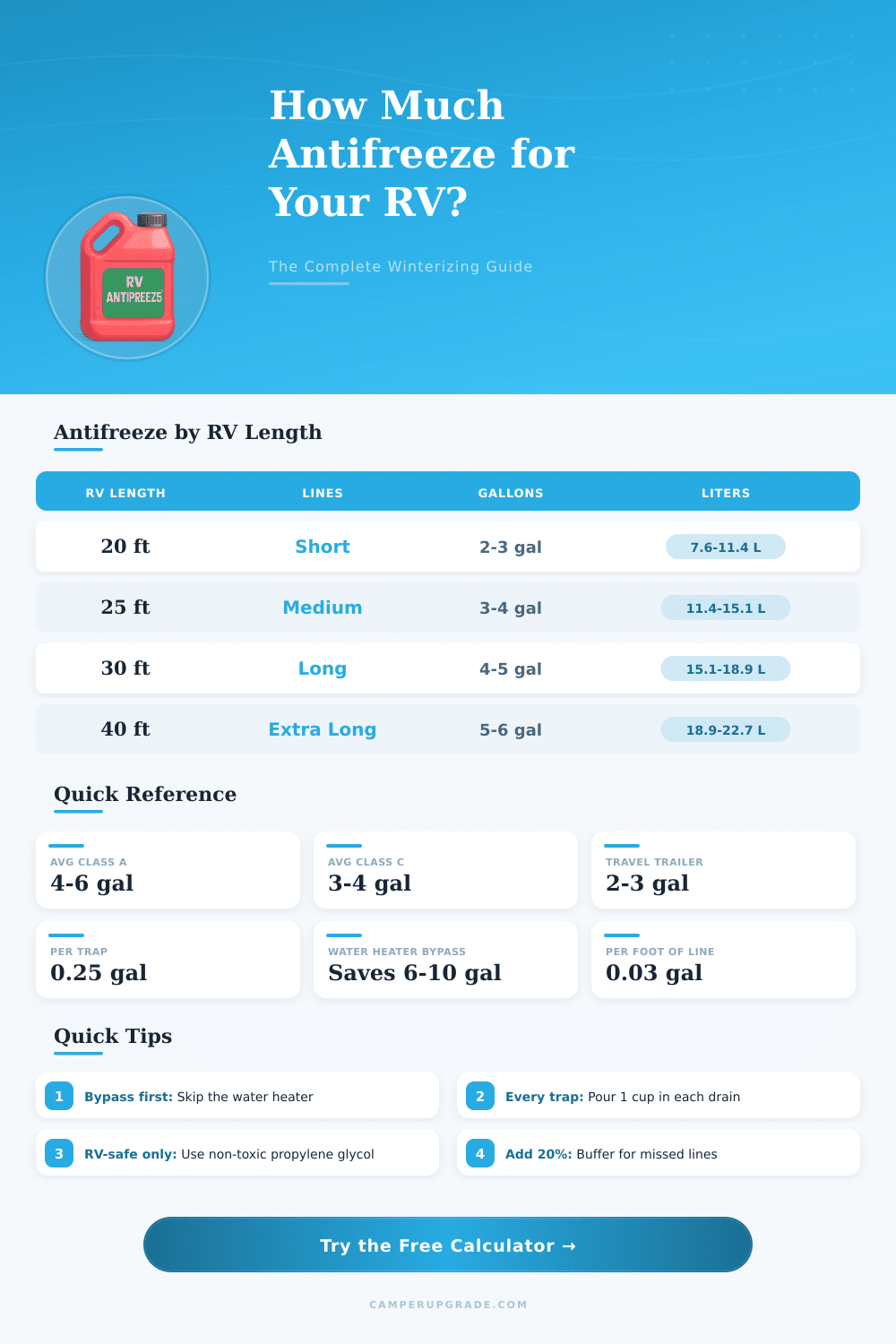
🧊 RV Antifreeze Calculator
Calculate exactly how much non-toxic antifreeze you need to winterize your RV plumbing system
| RV Type | Length | Gallons (with bypass) | Liters |
|---|---|---|---|
| Pop-Up Camper | 12–18 ft | 1–2 gal | 3.8–7.6 L |
| Small Travel Trailer | 18–24 ft | 2–3 gal | 7.6–11.4 L |
| Large Travel Trailer | 25–33 ft | 3–4 gal | 11.4–15.1 L |
| Class C Motorhome | 22–33 ft | 3–4 gal | 11.4–15.1 L |
| Class A (Small) | 28–34 ft | 3–5 gal | 11.4–18.9 L |
| Class A (Large) | 35–45 ft | 5–6 gal | 18.9–22.7 L |
| 5th Wheel | 28–42 ft | 3–5 gal | 11.4–18.9 L |
| Toy Hauler | 28–44 ft | 4–6 gal | 15.1–22.7 L |
| Component | Gallons | Liters | Notes |
|---|---|---|---|
| Per foot of 1/2" PEX line | 0.01 gal | 0.04 L | Most common RV water line |
| Per foot of 3/4" PEX line | 0.02 gal | 0.09 L | Main supply line |
| Each P-trap / drain | 0.25 gal | 0.95 L | Pour directly into drain |
| Toilet flush (per cycle) | 0.5 gal | 1.9 L | Flush until pink appears |
| 6-gallon water heater (no bypass) | 6.0 gal | 22.7 L | Install bypass to save! |
| 10-gallon water heater (no bypass) | 10.0 gal | 37.9 L | Install bypass to save! |
| Ice maker line | 0.5 gal | 1.9 L | Run until pink at dispenser |
| Washer hookup line | 0.75 gal | 2.8 L | Run through both hot & cold |
| Outdoor shower / hookup | 0.5 gal | 1.9 L | Each external connection |
| RV Size | Gallons Needed | 1-Gal Bottles | 36-oz Bottles |
|---|---|---|---|
| Pop-Up / Small | 1–2 gal | 2 | 5–7 |
| Medium (20–28 ft) | 2–4 gal | 3–4 | 7–14 |
| Large (28–35 ft) | 3–5 gal | 4–5 | 11–18 |
| Extra Large (35+ ft) | 5–6 gal | 5–6 | 18–22 |
| Product Type | Freeze Protection | Burst Protection | Dilution |
|---|---|---|---|
| Standard RV Antifreeze (PG) | -50°F (-46°C) | -100°F (-73°C) | Ready to use |
| RV Premixed | -50°F (-46°C) | -100°F (-73°C) | Ready to use |
| RV Concentrate | Varies | Varies | Mix 50/50 with water |
| Marine Grade | -100°F (-73°C) | -200°F (-129°C) | Ready to use |
| Eco / Soy-Based | -50°F (-46°C) | -80°F (-62°C) | Ready to use |
| RV Supreme | -100°F (-73°C) | -200°F (-129°C) | Ready to use |
A 30-foot Class C with a bypass kit installed needs around 3 to 4 gallons of RV antifreeze, which works out to roughly 11 to 15 liters. Skip the bypass and that 6-gallon water heater alone eats through an extra 22.7 liters. Each P-trap takes about a quarter gallon, and Ive found most rigs have 4 to 6 of them.
A 40-foot Class A with 2 bathrooms and 16 faucets pushed me to nearly 6 gallons total with a 10% buffer.
RV Antifreeze: How Much You Need and How to Use It
Antifreeze for RV help to protect the water pipes in fun vehicles against cold during winter season. It replaces the water in tubes, seals and valves with special liquid that does not freeze easily. If it is missing, staying water in the lines can freeze, expand and break the tubes.
Fixing such damages costs a lot of money and time.
Important detail to know: Antifreeze for RV is entirely different to that for cars. Antifreeze for engines have ethylene glycol, that is highly poisonous. One never use it in the water system of RV.
Antifreeze for RV is made safe because it flows through drinking water tubes. The most reliable option for drinking water systems uses propylene glycol and does not have ethanol. One easily spots it thanks to the bright pink color, while automotive Antifreeze usually looks green or orange.
There are several kinds of Antifreeze for RV. The best is made up of pure propylene glycol. Some brands that one finds in big stores like Walmart, mix propylene glycol with ethanol.
One label of product pointed between 10 and 25 percent of propylene glycol together with 5 to 10 percent of ethanol. Antifreeze based on ethanol burns easily, what disturbs some folks, although watre systems should stay sealed and without leaks.
Antifreeze for RV freezes at quite low temperatures. Around 5 degrees Fahrenheit, it becomes thick and forms a mass. Other than water, it does not expand while freezing.
Here is the main advantage. Some products promise protection against bursting until minus 100 degrees Fahrenheit. The common pink Antifreeze of minus 50 degrees is enough four many regions, even where the thermometer falls under zero.
Antifreeze for RV does not limit to RV. It works for preparing boats for winter, vacation houses, trailers, campers and systems for filtering pools. Many brands are made specially for those various targets.
It does not damage copper, brass or plastic tubes.
During preparation for winter, one must first drain the water from the system before adding Antifreeze. Do not mix it with water. A bypass for the hot water tank is a liked option, so you do not lose six gallons of Antifreeze only filling the tank.
Pump the Antifreeze through the tubes, until it spills from every tap, both warm and cold. Pour a bit in every drain for safety. Do not forget the outside shower, because neglecting it can cause cracks in the showerhead.
Some users mix methods. First blow out the water lines with compressed air, later add Antifreeze for RV. Like this one avoids stuck water in hard places after a storm, and the Antifreeze gives extra protection.
In spring removing the Antifreeze happens easily. Hook a tube to the upper water inlet and open the valves for warm and cold water at every tap, until the flow clears. Later drain the water through the heater.
Do not reuse the Antifreeze for RV. It has 20 to 40 percent of propylene glycol mixed in water, and it evaporates from open cans over time. It can also make bacteria grow during warm days.
About disposal: based on propylene glycol, the Antifreeze for RV can simply be poured on soil or in a sewer system. But regular automotive Antifreeze never dump near homes. Using the wrong type can pollute the septic tanks of homes for years.
Antifreeze for windshield washers of cars is bad for water lines, because it poisons and the alcohol in it evaporates, leaving the tubes withoutprotection against freezing.
At Menards one sells even Antifreeze for RV in barrels of 50 gallons. Concentrated versions exist, starting around nine dollars each unit. One gallon commonly is enough for smaller devices.