❄️ RV Air Conditioner Size Calculator
Calculate the right BTU rating for your RV, camper, or travel trailer based on dimensions, insulation, and climate
| Floor Area (sq ft) | Floor Area (m²) | Mild Climate BTU | Hot Climate BTU |
|---|---|---|---|
| 50–100 | 4.6–9.3 | 5,000 | 7,000 |
| 100–150 | 9.3–13.9 | 7,000 | 10,000 |
| 150–200 | 13.9–18.6 | 9,000 | 13,500 |
| 200–250 | 18.6–23.2 | 11,000 | 15,000 |
| 250–320 | 23.2–29.7 | 13,500 | 18,000 |
| 320–400 | 29.7–37.2 | 15,000 | 22,000 |
| 400–500 | 37.2–46.5 | 18,000 | 28,000 |
| 500+ | 46.5+ | 22,000+ | 30,000+ |
| Insulation Quality | BTU Multiplier | Description | Typical RV Types |
|---|---|---|---|
| Poor | 1.30 (↑30%) | Thin walls, single pane, no floor insulation | Pop-ups, older trailers |
| Average | 1.00 (Baseline) | Standard fiberglass batt, dual pane optional | Most travel trailers |
| Good | 0.85 (↓15%) | Upgraded foam, dual pane, sealed seams | Newer Class C/A |
| Excellent | 0.70 (↓30%) | 4-season, spray foam, triple pane | Arctic-rated 5th wheels |
| BTU Rating | Amps (120V) | Watts (Running) | Best For |
|---|---|---|---|
| 5,000 | 4–5 | 450–550 | Small pop-ups, teardrops |
| 8,000 | 6–8 | 700–900 | Small trailers, van conversions |
| 11,000 | 8–10 | 900–1,150 | Mid-size trailers (20–26 ft) |
| 13,500 | 11–13 | 1,200–1,500 | Standard RVs (24–32 ft) |
| 15,000 | 12–15 | 1,400–1,700 | Large RVs (30–38 ft) |
| 2 × 13,500 | 22–26 | 2,400–3,000 | Class A, large 5th wheels (36+ ft) |
| 2 × 15,000 | 24–30 | 2,800–3,400 | 40+ ft with slideouts |
| Climate Zone | Temp Range | BTU Multiplier | Notes |
|---|---|---|---|
| Mild | Under 85°F (29°C) | 0.85 | Pacific NW, mountain areas |
| Warm | 85°F–95°F (29°C–35°C) | 1.00 | Most US summer campgrounds |
| Hot | 95°F–105°F (35°C–40°C) | 1.20 | Southwest, Deep South |
| Extreme | Over 105°F (40°C) | 1.40 | Desert camping, Death Valley |
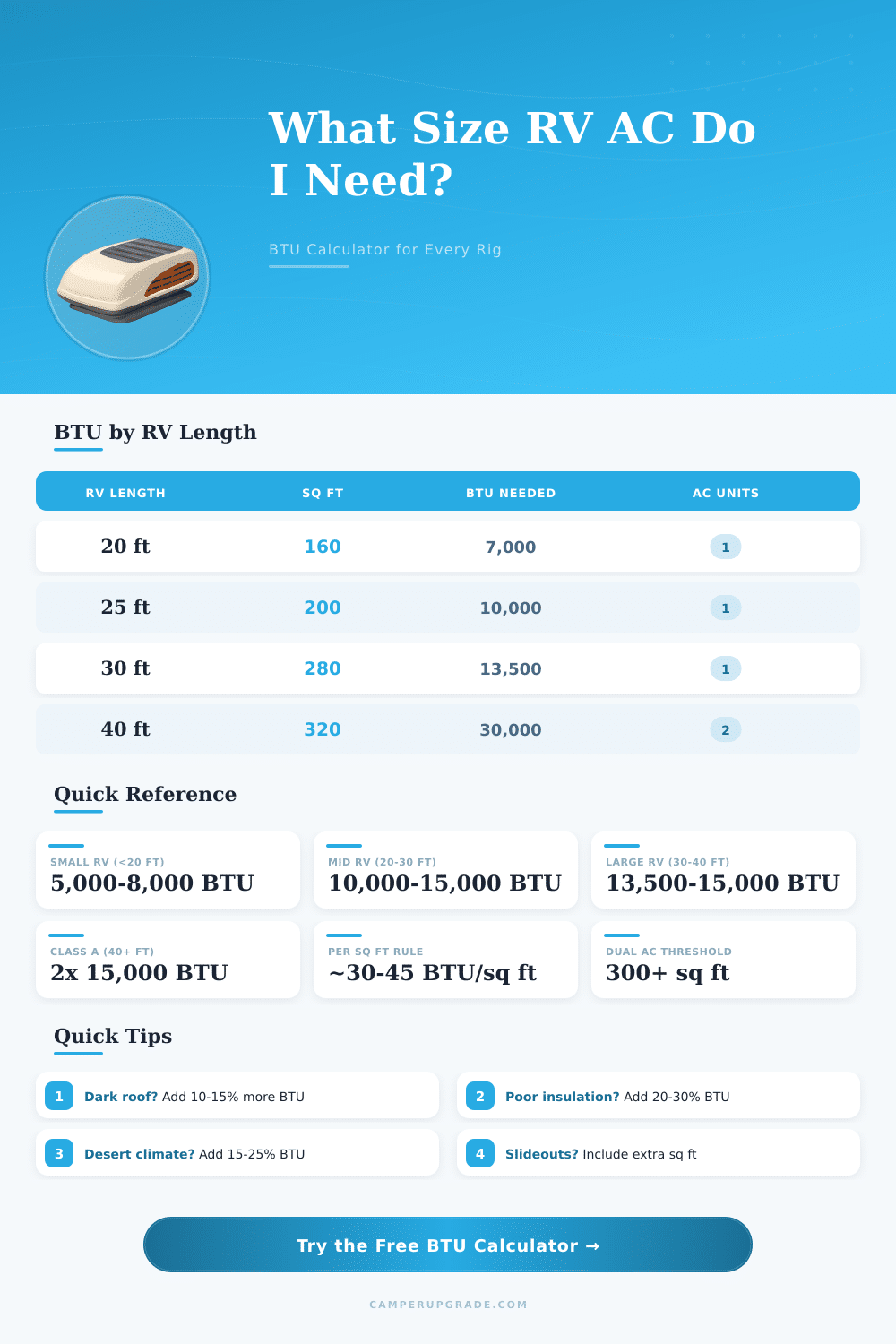
35 BTU per square foot is the baseline number I kept landing on for RV cooling, but honestly that only holds in mild weather. Push into 95+ degree territory and youre looking at 45 to 60 BTU a square foot, which changes everything for a 300 sq ft Class A. Insulation quality alone can swing your total need by 30% in either direction. A 28 foot travel trailer with about 200 sq ft of floor space needs around 11,000 to 13,500 BTU.
Bump that to a 40 footer with slideouts and suddenly youre at 22,000 or more, which means two rooftop units pulling 24 amps combined at 120V.
How to Pick the Right RV Air Conditioner
A travel vehicle requires good cooling, that is important for each person that likes to travel in summer heat. The most many models available now on the market already have installed or highly raised model with high profile or more elegant variant with low profile for the Air Conditioner unit on the roof. Between them are the Dometic Fresh Air, the Coleman Mach 15, the Furrion Chill and the Advent ACM150, those with high profile usually take a bit more space than the versions with low profile.
So the Air Conditioner units for RVs usually only manage to cool the inside by around 20 degrees from the outside temperature. Hence, when outside burns 95 degrees, reaching comfortable 73 degrees inside can become a real challenge. The secret is to set the Air Conditioner quite early, before the inside gets too warm.
Trying to cool the vehicle after inside reaches 90 degrees almost is mission impossible.
The company Coleman-Mach genuinely works in all parts of climate control; Air Conditioner units, heat pumps, ceiling setups, thermostats, converters, and almost everything needed for RVs, ships and outdoor travel rigs. Dometic also is an important player, with units of 11 000 up to 15 000 BTU. The old Dometic Brisk II once was seen as a reliable universal solution, that worked for a broad range of RVs, and although it already does not produce, you yet find them everywhere for sael.
Furrion Air Conditioner units are known because of fast cooling and steady keeping of pleasant temperature in the RV, whether you struggle against gross summer heat or simply travel through mild regions. And do not forget GE, they entered the contest, for instance with Forest River, that installed some of his Class-C motors like the Forester, Solera and Sunseeker with 15 000 BTU roof units from GE.
Today exist even new, more energy saving options. I talk about units, that reach 40 % more impact and use variable speeds of engines, so that you do not require a separate soft starter. There are 8 000 BTU models, that work well for bedrooms and little RVs, and also the mighty 18 000 BTU version, that cares about big areas.
Moreover, TURBRO were among the first, that launched a reliable inverter Air Conditioner for RVs, what ensures more silent work.
Insulation plays a big role, naturally. Bad insulated RV simply can not stay cold, even with the best Air Conditioner. I recall one case with a 19-foot trailer, where the unit simply did not fit, because insulation lacked, but the same BTU model worked great in a more well insulated 26-foot version.
And ducted cooling certainly deserves attention, it spreads the cold heir more even than simply blowing from a central spot.
Want to run Air Conditioner units only on 15-amp power? In theory yes, but it depends on the specific model. The big ones will not work for that.
Even if the Air Conditioner itself uses less than 15 amps, when you at the same time use other heavy devices like a fridge or water heater, you likely break the fuse. Power panels in RVs are quite limited, and those units genuinely pull a lot of power. A soft starter can help with the starting power needs, because it uses a capacitor to ease the start of the compressor.
Portable Air Conditioner units offer an option for RVs, that cannot fit a second roof unit. Even so they take a lot of space, are very noisy during use outside and are seen as less efficient. Besides everything, you must ensure, that they are flat set during travel.
Two-hose models usually beat the one-hose ones, and mini-windows offer high efficiency, although the setup differs from standard roof mounting.
One spot to watch is the use of low speed for the Air Conditioner… It can cause freezing, so keep attention. Roof units can be reset, but few workers want to take that task, because it is slow and costs more.
The controls of the Air Conditioner are on themselves, while the inside panel is a separate part. You can even install a smart thermostat to control everything. When comes time for update or refill, there are complete roof systems and standalone parts from brands like Furrion, GE, RecPro and Advent Air.
Changing of new distributionboxes, thermostats and filter aids help the whole system stay smooth and efficient.