🏕 Camper Roof Weight Calculator
Calculate your roof area, load capacity, and material weight to keep your camper safe
| Snow Type | Weight per in/sq ft | 3 in on 240 sq ft | 6 in on 240 sq ft |
|---|---|---|---|
| Fresh Dry Snow | 1.25 lbs | 900 lbs | 1,800 lbs |
| Settled Snow | 2.08 lbs | 1,498 lbs | 2,995 lbs |
| Wet / Packed Snow | 5.20 lbs | 3,744 lbs | 7,488 lbs |
| Ice | 5.70 lbs | 4,104 lbs | 8,208 lbs |
| Equipment | Weight (lbs) | Weight (kg) | Footprint (sq ft) |
|---|---|---|---|
| 100W Solar Panel | 16–22 | 7–10 | 8–10 |
| 200W Solar Panel | 25–35 | 11–16 | 12–15 |
| 400W Solar Panel | 40–50 | 18–23 | 20–24 |
| 13,500 BTU AC Unit | 80–100 | 36–45 | 3–4 |
| 15,000 BTU AC Unit | 100–120 | 45–54 | 4–5 |
| Rooftop Cargo Box | 50–150 | 23–68 | 10–18 |
| Rooftop Tent (2-person) | 120–150 | 54–68 | 25–35 |
| Rooftop Tent (4-person) | 150–180 | 68–82 | 35–50 |
| Roof Rack System | 20–50 | 9–23 | Varies |
| Satellite Dish | 10–30 | 5–14 | 2–4 |
| Camper Size | Roof Area (sq ft) | Roof Area (m²) | Max Load at 15 lbs/sq ft |
|---|---|---|---|
| 16 ft × 7 ft | 112 | 10.4 | 1,680 lbs (762 kg) |
| 20 ft × 7.5 ft | 150 | 13.9 | 2,250 lbs (1,021 kg) |
| 25 ft × 8 ft | 200 | 18.6 | 3,000 lbs (1,361 kg) |
| 30 ft × 8 ft | 240 | 22.3 | 3,600 lbs (1,633 kg) |
| 35 ft × 8.5 ft | 297.5 | 27.6 | 4,463 lbs (2,024 kg) |
| 40 ft × 8.5 ft | 340 | 31.6 | 5,100 lbs (2,313 kg) |
| Load Type | Distribution | Recommended Support | Notes |
|---|---|---|---|
| Solar Panels | Distributed | Mount to rafters | 2–3 lbs/sq ft installed |
| AC Unit | Point load | Reinforced opening | Spreads over 3–5 sq ft |
| Snow | Uniform | Monitor accumulation | Clear above 3 in wet snow |
| Person Walking | Point load | Step on rafters only | 250 lbs on 1–2 sq ft |
| Cargo Box | Linear | Roof rack on rafters | Check rack weight limit |
| Rooftop Tent | Distributed | Cross-bar rack system | Add occupant weight |
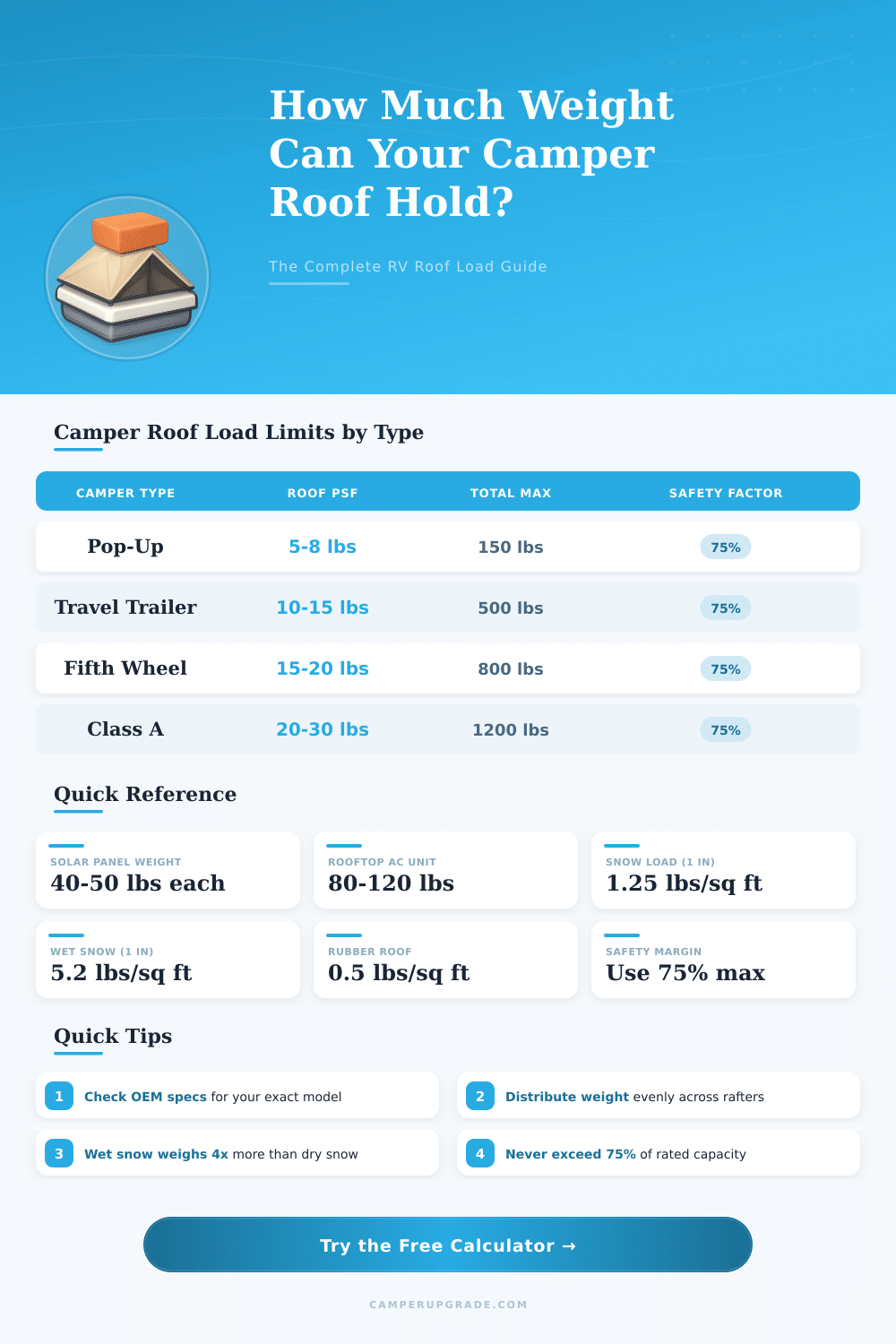
Most travel trailers Ive looked at top out around 10 to 15 lbs per square foot of roof capacity, which on a 30 by 8 foot rig gives you somewhere around 2400 to 3600 lbs total. Sounds like a lot until you realize 3 inches of wet snow dumps about 5.2 lbs a square foot, meaning that same 240 sq ft roof is suddenly carrying 3744 lbs. Thats enough to blow past the rating on lighter builds.
A single 400W solar panel weighs 40 to 50 lbs and covers roughly 22 square feet, so four of them add maybe 200 lbs spread across 88 sq ft (not bad at all).
Camper Roofs: Materials, Weight and How to Fix Them
The information below does not come from a computer or translation program. It is based on actual user experiences, forum posts and general community experiences from the net.
Roofs of Campers use various materials, and knowing what kind covers the top is important for repair or refill. Rubber coverings, fiberglass surfaces, aluminum layers, PVC panels and also ABS-plastics are very common. Pop-up Roofs of Campers usually are made up of sheet metal with plywood base below or from artificial material with similar support.
New models of Campers commonly have bonded Roofs to ease the Weight. They are built by joining the internal ceiling, layer of foam insulation and thin plywood layer for the Roof base, later pressed together by means of vacuum press.
When talking about the strongest Roofs, school buses, fancy motorhome trucks of high class and Airstream-models own the best. After that come single-piece gel-coated fiberglass versions. Marks like Casita, Oliver, KC and Bigfoot use such full-fiberglass structure.
A closed single-piece fiberglass Roof works well, if one plans to drag objects like a ship up.
Fixing the Roof of a Camper depends on the used material. For rubber, self-leveling mass well closes little splits or holes. For fiberglass, special fiberglass repair kits are teh best method.
PVC-Roofs one can cover by means of heat-bonded PVC-patch. Rubber patches attach by means of cement type of glue. Textured aluminum usually gets fixed by means of asphalt patch material.
If talking about defective edges or aluminum strips, a store for Camper parts can advise, but bring photographs and know the material saves a lot of time.
Sealing joints are also important. Places, where physical panels touch, and spots around windows or fans, really require round sealant for seal. Remove dirty areas with cracked mass and again cover by means of something like Dicor self-leveling mass works well.
Without hollowing mass works more four near or edge parts of the Roof. Annual or twice-yearly cleaning of rubber Roof, together with usage of protectants, extends its life. One advises to again coat the Roof of a Camper yearly, so that it stays in good state.
Do-it-yourself upper kits for RV-Roofs store everything needed for full setup and workspace for flat RV and Camper coverings. PVC-rubber Roof covers come in various sizes and are made in United States. Strong Covering is prepared as travel-ready prior Roof mass, that gives good sealed traits and layered support for Campers and RV.
Replacing the whole Roof can cost a lot. Often around six thousand dollars, even seven thousand, appeared, what seems too much for old models. Even so one can do it yourself.
Refill on Palomino, damaged by heavy snow burden, turned out surprisingly simple task, although some friends helped to remove the old and show the new. Taking photos of everything during the work is very useful.
The Flexarmor system for Roof deserves the investment. It shows wonderful trust during rain, and even touch of tree branches leave only little trace. Tiny mold can appear, if the Camper stands outside in winter, but it washes off easily.
Spent money for good Roof solution means no issue about leaks during camping journey. Leaks in the Roof can destroy a Camper.
Before raising the Roof on a pop-up model, checking that the Camper stands level is key. For a quick temporary fix at a defective membrane, press tape can serve. The fixed ring, that keeps the old layer, loosens, the plastic inserts and the ring again covers it.
Some pop-up Roofs were redone entirely with double-bent aluminum sheet, what gives almost extra four inches of space when fully opened. Back-up corner arcs for the Roof come in sets of four for marks like Arb River and Rockwood. Before starting any Roof work, it matters to ask basics: how big is the Camper, whether it is first time, are the kitsready or need to cut, and will the old Roof go or get covered over.