🔥 30 Gallon Propane Tank Runtime Calculator
Calculate exactly how long your 30 gallon propane tank will last for any appliance or combination of appliances
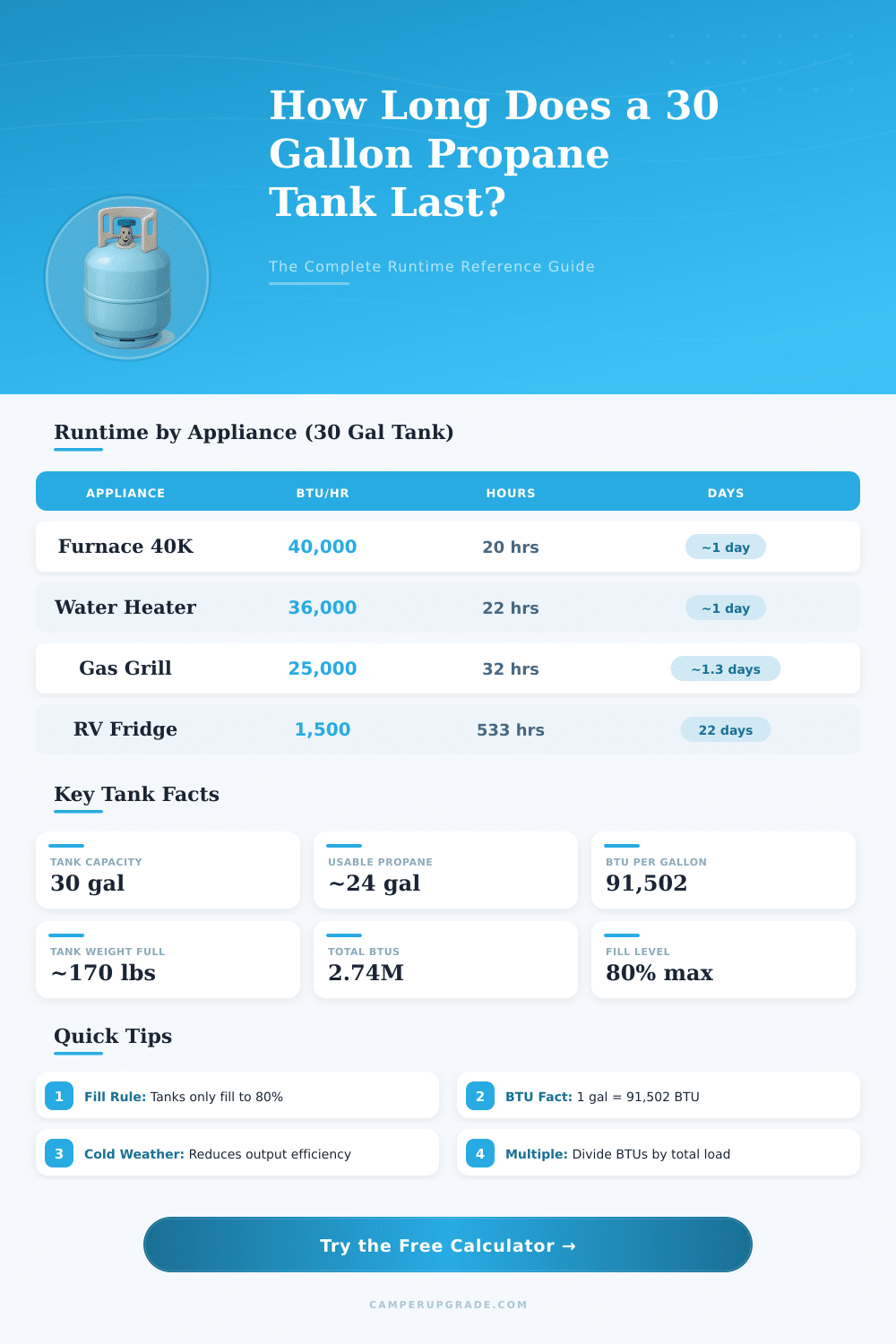
Based on 80% fill (24 usable gallons = 2,196,048 BTU)
| Appliance | BTU/hr | Hours Runtime | Days Runtime | Gal/hr Used |
|---|---|---|---|---|
| RV Furnace (large) | 40,000 | 54.9 hrs | 2.3 days | 0.44 gal/hr |
| RV Furnace (small) | 20,000 | 109.8 hrs | 4.6 days | 0.22 gal/hr |
| RV Water Heater | 36,000 | 61.0 hrs | 2.5 days | 0.39 gal/hr |
| Patio Heater | 46,000 | 47.7 hrs | 2.0 days | 0.50 gal/hr |
| Gas Grill | 25,000 | 87.8 hrs | 3.7 days | 0.27 gal/hr |
| Fire Pit | 55,000 | 39.9 hrs | 1.7 days | 0.60 gal/hr |
| Camp Stove | 9,000 | 244.0 hrs | 10.2 days | 0.10 gal/hr |
| RV Refrigerator | 1,500 | 1,464 hrs | 61.0 days | 0.016 gal/hr |
| Generator (5kW) | 80,000 | 27.5 hrs | 1.1 days | 0.87 gal/hr |
| Tank Size | Total Gallons | Usable (80%) | Total BTUs (80%) | Weight Full |
|---|---|---|---|---|
| 20 lb (BBQ) | 4.7 gal | 3.8 gal | 347,708 BTU | ~37 lbs |
| 30 lb | 7.1 gal | 5.7 gal | 521,561 BTU | ~54 lbs |
| 30 gallon | 30 gal | 24 gal | 2,196,048 BTU | ~170 lbs |
| 40 lb | 9.4 gal | 7.5 gal | 686,265 BTU | ~72 lbs |
| 100 lb | 23.6 gal | 18.9 gal | 1,729,388 BTU | ~170 lbs |
| 100 gallon | 100 gal | 80 gal | 7,320,160 BTU | ~560 lbs |
| 120 gallon | 120 gal | 96 gal | 8,784,192 BTU | ~670 lbs |
Approximate daily propane use for a 40,000 BTU RV furnace (50% duty cycle assumed in cold weather)
| Outside Temp | Est. Duty Cycle | Gal/Day | Days on 30 Gal Tank (80%) |
|---|---|---|---|
| 60°F (15°C) | 15% | 0.63 gal | ~38 days |
| 45°F (7°C) | 25% | 1.05 gal | ~23 days |
| 32°F (0°C) | 40% | 1.68 gal | ~14 days |
| 20°F (-7°C) | 55% | 2.31 gal | ~10 days |
| 0°F (-18°C) | 70% | 2.94 gal | ~8 days |
| -10°F (-23°C) | 85% | 3.57 gal | ~7 days |
The choice of propane tank offers almost endless options, and finding one that fits your needs really depends on what you plan to do with it. From small compact 20-pound tanks to huge tanks that store more than 2,000 gallons, you find everything. The right size relates to the distance of your home to the install spot and to the number of devices that run on propane.
For large setups those clients usually choose tanks around 30,000 gallons although some go up to 120,000 gallons if they want something extreme.
How to Choose the Right Propane Tank
When folks think about a propane tank, they commonly imagine the usual 20-pound tank that one lays on a grill, that matches to about 4.7 gallons of capacity. Even so there exists a whole range of options: tanks in 5, 10, 11, 30 and 40 pounds, that serve different uses. Also the materials differ, you meet both steel and aluminum, that can be vertical or horizontal depending on the use.
Horizontal models are used in vans for moving liquid propane, while those mounted tnaks are usually certified specially for travel vehicles.
Those tanks answer for various tasks. From camping and grilling to garden homes or even whole-home heating systems. A little 5-pound tank works well for portable use, that one easily moves around.
If you use a 20-pound tank at half capacity during some hours daily, it will last for a hole week of home season. Moreover, the 10-pound model of Flame King fits perfectly in a truck bed, what makes it very practical for camping trips.
To receive a filled tank, refilling usually costs less than exchange. If you go to a place like U-Haul for refilling, it will come to around 17 to 20 dollars, because it deals with almost 4 gallons. Exchange at the local store?
It will hit your wallet harder, except that those exchange tanks are on purpose filled only to around 75 percent; for safety. A new 20-pound tank, if you buy it without gas, costs around 50 dollars, although one commonly sees them at 65 dollars. Refilling a fully empty tank runs about 18 dollars, because it stores around 4.5 gallons.
Here is something that surprises many: propane does not spoil or break down really. It stays almost forever without going bad. Except put fresh paint on sometimes and swap the valve every few years, almost no care is needed.
Even so tanks have a date of expiration, and some fill stations refuse to refill those that are past due. When recertification becomes needed, sometimes it is better to buy a new tank from a money viewpoint.
Propane becomes very flammable and explosive when you compress it, which matters for safety plans. A sudden incident with a pressed tank could turn into something much more dangerous. Temperature changes make propane dramatically expand and shrink, so one does not fill tanks to the edge.
It is much better to keep small tanks outside than inside for more safety. If you transport tanks in a car, strap them well and make sure thatair can flow around them.
For owners of travel vehicles, most set themselves up with two 20-pound or two 30-pound tanks. Some try to grow the capacity, but commonly the available space limits them. Propane refrigerators use fuel wisely, and two 20-pound tanks can last a whole year, if you do not use it too often.