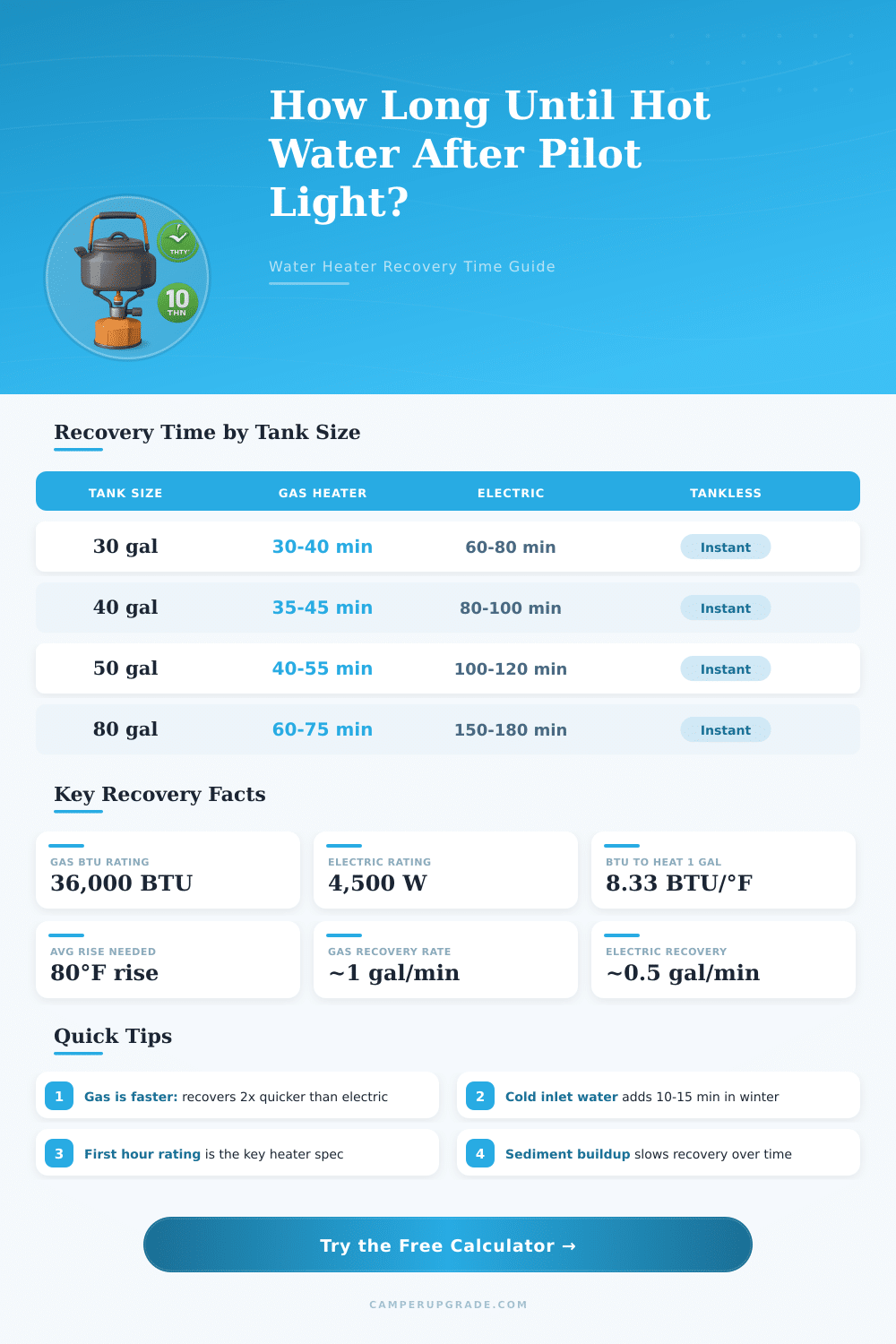
🔥 Water Heater Recovery Time Calculator
Find out exactly how long after lighting your pilot light your water will be hot
| Heater Type | Typical BTU / Watts | Recovery Rate (gal/hr) | Recovery Rate (L/hr) |
|---|---|---|---|
| Natural Gas — Standard | 36,000 BTU | ~40 gal/hr | ~151 L/hr |
| Natural Gas — High Efficiency | 40,000 BTU | ~44 gal/hr | ~167 L/hr |
| Propane | 36,000 BTU | ~40 gal/hr | ~151 L/hr |
| Electric — Standard (single) | 4,500 W | ~20 gal/hr | ~76 L/hr |
| Electric — High Efficiency | 5,500 W | ~25 gal/hr | ~95 L/hr |
| RV Propane (small tank) | 8,000–10,000 BTU | ~9 gal/hr | ~34 L/hr |
| Climate / Region | Winter Inlet (°F) | Summer Inlet (°F) | Winter Inlet (°C) |
|---|---|---|---|
| Northern US / Canada | 35–45°F | 60–70°F | 2–7°C |
| Midwest US | 45–55°F | 65–72°F | 7–13°C |
| Mid-Atlantic / Southeast | 50–60°F | 68–75°F | 10–16°C |
| Southern US / Southwest | 60–70°F | 72–80°F | 16–21°C |
| Pacific Northwest | 45–55°F | 60–68°F | 7–13°C |
| Fixture / Use | Gallons Used | Liters Used | % of 40 Gal Tank |
|---|---|---|---|
| Shower (8 min, 60% hot) | ~14 gal | ~53 L | 35% |
| Bath (full tub) | ~20–25 gal | ~76–95 L | 50–63% |
| Dishwasher (full cycle) | ~6 gal | ~23 L | 15% |
| Clothes Washer (warm) | ~15–20 gal | ~57–76 L | 38–50% |
| Hand Washing (per use) | ~1 gal | ~4 L | 2.5% |
| Kitchen Sink (10 min) | ~2–4 gal | ~8–15 L | 5–10% |
RV water heaters are quite a common part in almost all current RVs. They allow you to enjoy a warm shower after a hard day or wash dishes without heating water over a campfire. There are various kinds to choose from for instance tankless, gas-electric and coated versions.
Which one you choose depends on your camping style and what matters most to you.
Types of RV Water Heaters
Tankless water heaters are built especially for RVs, camper vans and travel trailers. They give quick warm water while saving energy and space. Like this they take less space, which makes them good for small RVs or for those that want to free up room.
Among them the Furrion tankless water heater is popular, made specially for use in RVs, with a flow of 2.4 gallons per minute. Another well known model is the Fogatti InstaShower 8Plus, that works by means of 12V DC power and fits in an opening of 15 inches.
However tankless devices are not perfect. The temperature of the water can shift, with cold pauses during showering or dishwashing. The water must flow a bit before the heater notices it and lights the burner.
During remote camping without drain connections, a lot of water gets wasted simply because of waitnig until it warms. Indeed some owners of RVs dumped their tankless heaters and went back to tank models because of those troubles.
Tank water heaters stay the more common choice. They come in sizes like six or ten gallons. Many of them work by means of propane and electricity, which some people call hybrid.
When connected to shore power, you can switch to electricity. Electrical warming of water takes longer then by means of propane, even so. A typical method is first heating by means of propane and later switching to electricity to keep the heat.
Models only for propane use very little electricity, only for the igniter and thermostat. Electrical versions can use up to 15 amps of AC power.
Because RVs usually do not have a built-in water heater, portable water heaters became very popular. They work by means of propane or electricity, and some have both options. They include a pump for water pressure and connection to tubes.
Also they cost fairly little.
The Truma water heater offers a funny middle ground. It has a tank, but works almost like a tankless device, giving steady warm water without swings in temperature, while propane and water are available. DSI water heaters use direct spark lighting, and you turn them on through the control panel of the RV.
The pilot light should start in six to eight seconds in gas mode. Replacement partsand thermostats are widely available for the most common brands.