🦟 Insect Repellent Duration Calculator
Find out exactly how long your bottle of insect repellent will last based on bottle size, formula type, and usage habits.
Kids / Short Trips
Day Hikes
Camping
Expeditions
Natural Option
Sensitive Skin
General Use
Application (Spray)
| Coverage Area | Spray (fl oz) | Lotion (fl oz) | Metric (mL) |
|---|---|---|---|
| Face + Arms Only | 0.10 | 0.08 | 3–4 mL |
| Arms + Legs | 0.18 | 0.14 | 5–7 mL |
| Full Body (exposed) | 0.25 | 0.20 | 7–9 mL |
| Full Body + Clothing | 0.40 | 0.30 | 12–15 mL |
| Bottle Size | Metric | Apps (Spray, Full Body) | Apps (Lotion, Full Body) |
|---|---|---|---|
| 1 fl oz (travel) | 30 mL | 4 apps | 5 apps |
| 2 fl oz | 59 mL | 8 apps | 10 apps |
| 4 fl oz (standard) | 118 mL | 16 apps | 20 apps |
| 6 fl oz | 177 mL | 24 apps | 30 apps |
| 8 fl oz (family size) | 237 mL | 32 apps | 40 apps |
| 12 fl oz (bulk) | 355 mL | 48 apps | 60 apps |
| Formula | Active Ingredient | Duration (typical) | Reapply Frequency |
|---|---|---|---|
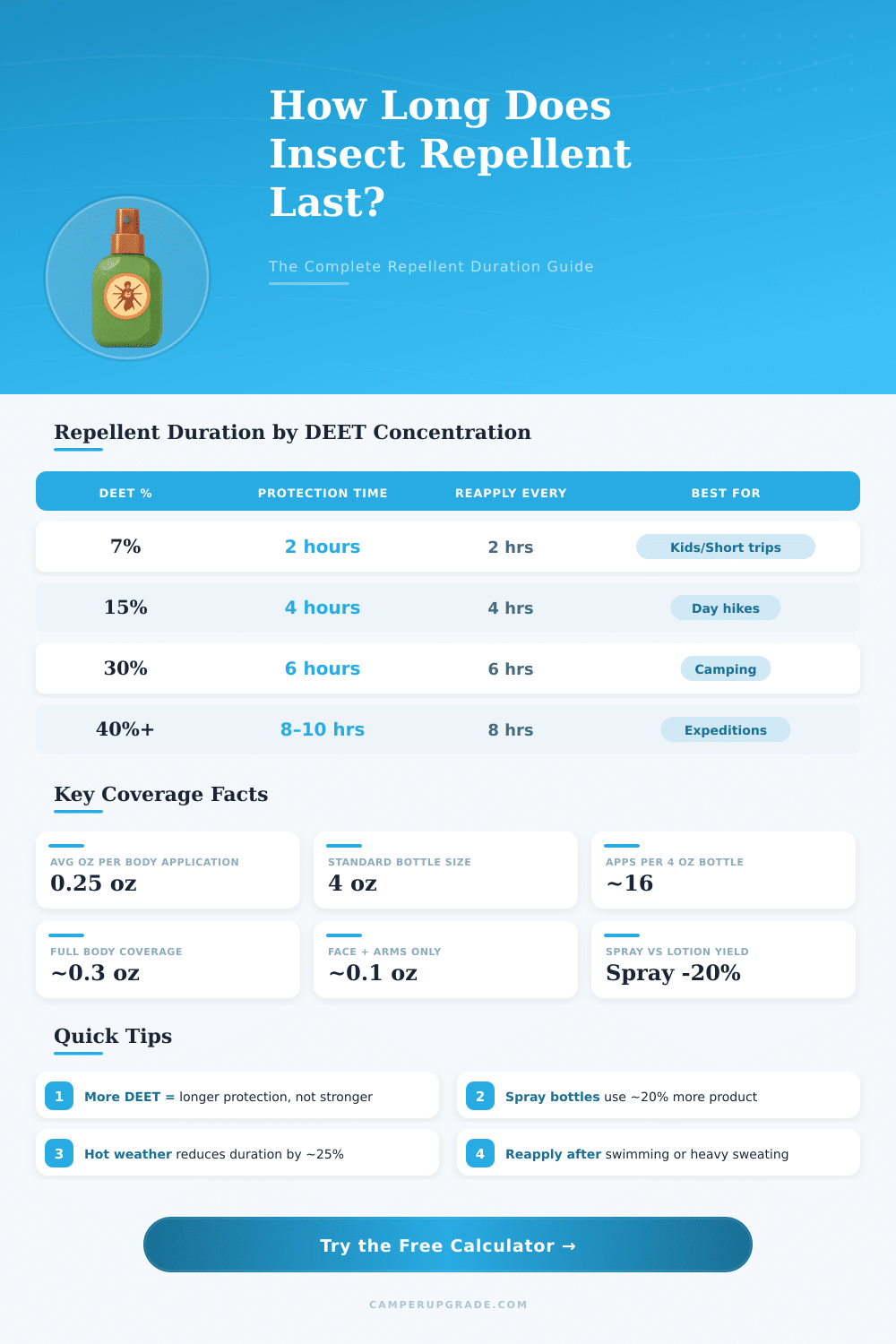
| DEET 7% | N,N-Diethyl-meta-toluamide | ~2 hours | Every 2 hrs |
| DEET 15% | N,N-Diethyl-meta-toluamide | ~4 hours | Every 4 hrs |
| DEET 25% | N,N-Diethyl-meta-toluamide | ~5 hours | Every 5 hrs |
| DEET 30% | N,N-Diethyl-meta-toluamide | ~6 hours | Every 6 hrs |
| DEET 40%+ | N,N-Diethyl-meta-toluamide | 8–10 hours | Every 8 hrs |
| Picaridin 20% | KBR 3023 | ~8 hours | Every 8 hrs |
| IR3535 | Ethyl butylacetylaminopropionate | ~8 hours | Every 8 hrs |
| Oil Lemon Eucalyptus | PMD (p-Menthane-3,8-diol) | ~6 hours | Every 6 hrs |
| Scenario | People / Days | 4 oz Spray Bottles | 4 oz Lotion Bottles |
|---|---|---|---|
| Weekend Camping | 2 people / 2 days | 2 bottles | 2 bottles |
| Week-Long Hiking Trip | 1 person / 7 days | 2 bottles | 1–2 bottles |
| Family Beach Week | 4 people / 7 days | 6–8 bottles | 5–6 bottles |
| Daily Backyard Use | 1 person / 30 days | 2–3 bottles | 2 bottles |
| International Travel | 2 people / 14 days | 4–5 bottles | 3–4 bottles |
Insect Repellent is basically some material that one uses on the skin, clothing or surfaces to stop mosquitoes and other bugs from biting or walking on the body. Many folks simply call it mosquito spray or mosquito deterrent. The way those products work is really easy, they simply reduce the attraction for biting insects, instead of really killing them.
When dealing with the main ingredients, it helps to know a bit of info about them. DEET has been around since 1957 and has a lot of studies that back its power. It received approval from the EPA, and really, one considers it the best standard for repellents against mosquitoes.
What You Need to Know About Insect Repellent
That said picaridin works just as well, and many folks do favor it. Brands like Sawyer Picaridin Insect Repellent and Natrapel come in spray and wipe forms, which is handy for use. There is also IR3535, which some see as a reliable replacement for DEET, in case one wants to try somthing different.
Now, permethrin is a totally other thing. Never put this on the skin, it is only for clothing and gear. Here is the problem: some reports show that certain items stay quite flammable even after drying, so one must be careful.
Devices from Thermacell work totally differently. They heat insecticide from the permethrin family into steam that forms protection in around three metres wide.
If you favor natural solutions, oil from lemon eucalyptus is the only natural repellent that CDC really advises. It proved effective just like DEET against mosquitoes and lasts around for hours. One finds also products without DEET, made with plant base like citronella.
They come as sprays, wipes, roll-ons and such patches. The downside? Those oils do not have FDA approval for protection against diseases that insects spread, for instance Zika or Lyme disease.
The smoke of a campfire itself works as a natural repellent. Want to boost its effect? Add plants like sage, lemon balm or citronella leaves.
Many products have scents that mosquitoes actively flee. Burning citronella and neem products, candles, coils, such stuff, can stop mosquitoes from entering your area.
In rural places even a simple box fan can push away mosquitoes and bugs. Diatomaceous ground is a natural and safe option that really helps, especially when children or pets are near it. Putting outdoor insect killer around the edge of the camp gives firm protection.
The tradeoff is that repellents only target certain insects and do not lastlong outside. In addition, use of Insect Repellent on its own does not affect the non-biting mosquitoes, it only distances the blood-hungry ones.