🔥 Hot Water Tank Heating Time Calculator
Find out exactly how long your water heater takes to fully reheat — gas, electric, or heat pump
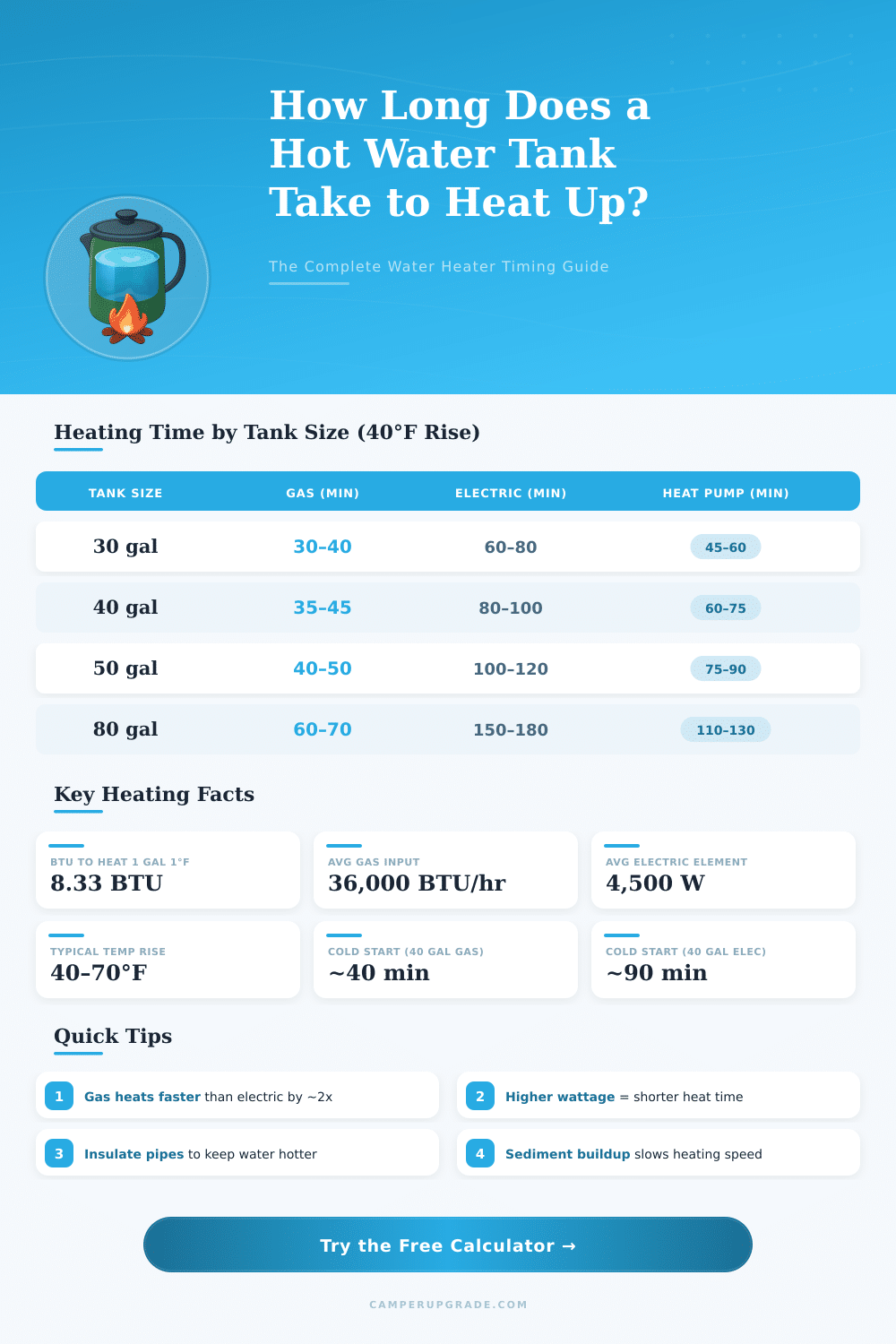
| Tank Size | Gas (36K BTU, 80%) | Electric (4,500W, 98%) | Heat Pump (~2,000W) | Temp Rise |
|---|---|---|---|---|
| 20 gal (76 L) | ~18 min | ~40 min | ~55 min | 65℉ rise |
| 30 gal (114 L) | ~27 min | ~61 min | ~82 min | 65℉ rise |
| 40 gal (151 L) | ~36 min | ~81 min | ~109 min | 65℉ rise |
| 50 gal (189 L) | ~45 min | ~101 min | ~136 min | 65℉ rise |
| 60 gal (227 L) | ~55 min | ~121 min | ~163 min | 65℉ rise |
| 80 gal (303 L) | ~73 min | ~162 min | ~218 min | 65℉ rise |
* Based on 55℉ incoming water, 120℉ target. Actual times vary with efficiency and inlet temp.
| Temp Rise (℉) | Temp Rise (℃) | BTU per Gallon | kJ per Litre | 40-gal Total BTU |
|---|---|---|---|---|
| 20℉ | 11.1℃ | 166.6 BTU | 46.5 kJ/L | 6,664 BTU |
| 30℉ | 16.7℃ | 249.9 BTU | 69.8 kJ/L | 9,996 BTU |
| 40℉ | 22.2℃ | 333.2 BTU | 93.1 kJ/L | 13,328 BTU |
| 50℉ | 27.8℃ | 416.5 BTU | 116.3 kJ/L | 16,660 BTU |
| 65℉ | 36.1℃ | 541.5 BTU | 151.2 kJ/L | 21,658 BTU |
| 80℉ | 44.4℃ | 666.4 BTU | 186.1 kJ/L | 26,656 BTU |
| 100℉ | 55.6℃ | 833.0 BTU | 232.6 kJ/L | 33,320 BTU |
| Heater Type & Size | Typical FHR | Recovery Rate | Good For |
|---|---|---|---|
| Gas 30 gal | 55–65 gal/hr | ~20 gal/hr | 1–2 people |
| Gas 40 gal | 70–85 gal/hr | ~27 gal/hr | 2–3 people |
| Gas 50 gal | 85–100 gal/hr | ~34 gal/hr | 3–4 people |
| Electric 40 gal | 55–65 gal/hr | ~17 gal/hr | 2 people |
| Electric 50 gal | 65–75 gal/hr | ~21 gal/hr | 2–3 people |
| Heat Pump 50 gal | 70–90 gal/hr | ~15 gal/hr | 2–3 people |
A hot water tank is the most common kind of device for heating water in houses. It is made up of an insulating tank that keeps and heats used water until needed. Such tanks come in versions for electric, propane and natural gas.
They deliver quick supply of warm water, that usually works for everyday needs.
Hot Water Tanks: How They Work and How Long They Last
Hot water tanks usually carry 40, 50 or 55 gallons or even more. How big one buys depends on the amount of people in the house and the maximum water use. For instance, a four-person family commonly takes some showers and runs the washing machine, hence they require a bit more tank space.
An important thing to know is, how long such tanks really last. Some hot water tanks can serve more than 25 years, if one cares for them well. Tanks from stainless steel tend to be more reliable over years.
Models with plastic cover, as the Rheem Marathon, commonly last around 16 years and work almost like new, while older metallic tanks a bit rust and brake inwardly after only 7 years. The life of a tank depends also on the usage. When several people use warm water daily in the long term, the tank wears out more soon.
Rust is the main enemy of a hot water tank. Zinc anode poles help to defend against it. Those anode poles protect the internal metal by wearing down themselves.
Even tanks with glass cover will eventually fail. Also deposit can build up inwardly, and if the tank fills with it, it wastes a lot of gas while heat tries to pass through. Flushing the deposit one time yearly is wise advice, especially if the water is hard.
Signs of a failed tank are weak pressure of warm water. Then it helps to try flushing the deposit. When the heater runs, but does not flow warm water, that can be dangerous and even cause explosion of the tank.
Hybrid electric hot water tanks reach up to 200 percent efficiency, because they use the surrounding heat beside the device. Gas tanks with tank have efficiency of 80 to 92 percent. Tankless gas models are even better, because they heat only the water that is used in the moment, not the stored water in a tank.
Even so, tanks have their advantages, as longer service life and almost endless warm water, if one chooses the right size.
Changing from tank to tankless system can reduce the bill monthly through gas costs. Even so, tankless devices struggle a bit with low water flow. The most common home tankless units require minimal flow to start heating.
A pump with valve helps to shorten the waiting time. Also, if the power goes out and the system is electric, there is no warm water until it returns. Tanks handle that a bit differently, because thestored water stays quite warm for a bit of time.