🥾 Hiking Pace Calculator
Calculate your hiking speed, estimated time, and distance with elevation adjustment using Naismith's Rule
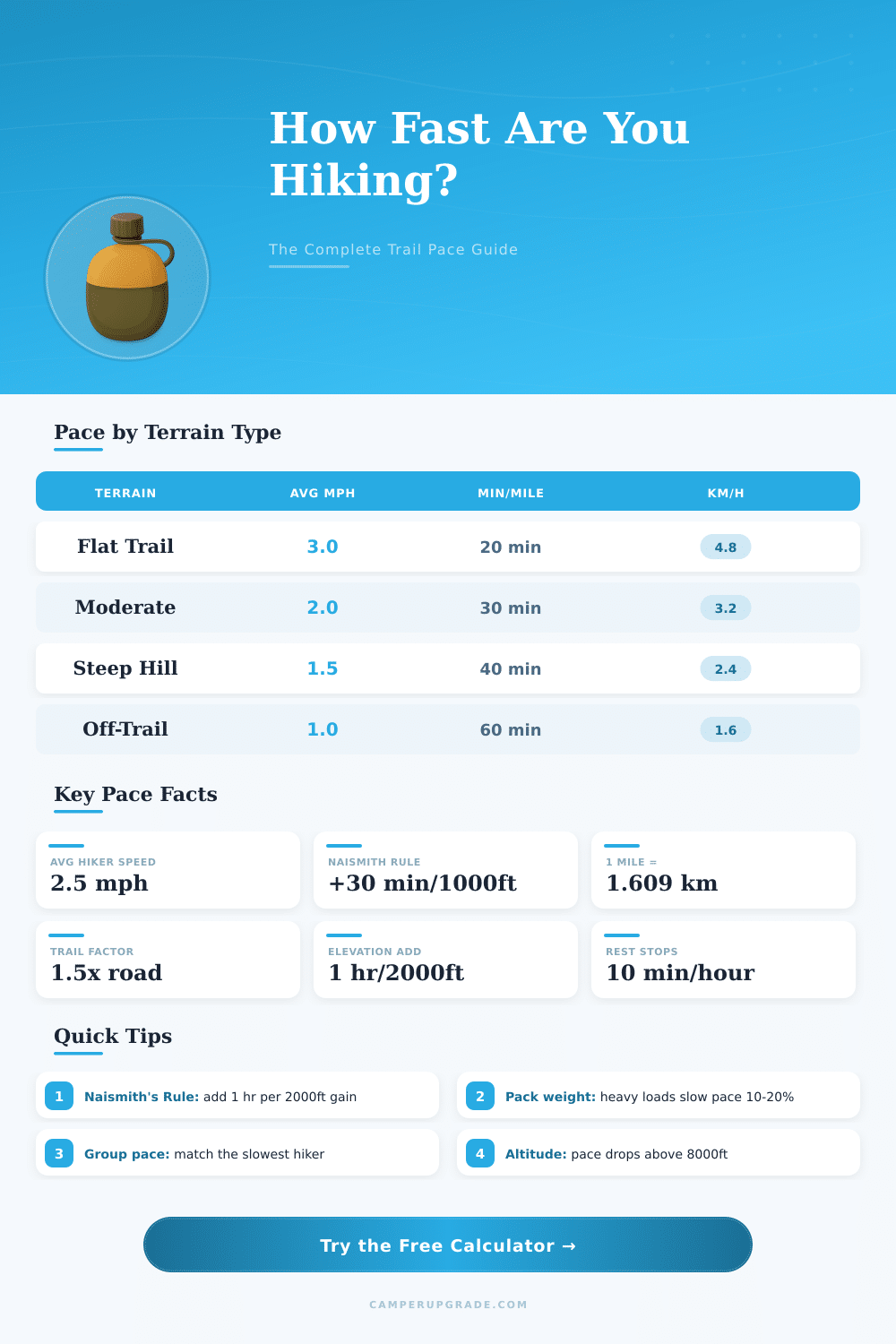
| Terrain Type | Slow (mph) | Average (mph) | Fast (mph) | km/h Avg |
|---|---|---|---|---|
| Flat Paved | 2.5 | 3.5 | 5.0 | 5.6 |
| Dirt Trail (Flat) | 2.0 | 3.0 | 4.5 | 4.8 |
| Moderate Mountain | 1.5 | 2.0 | 3.0 | 3.2 |
| Rocky / Technical | 1.0 | 1.5 | 2.5 | 2.4 |
| Off-Trail / Bush | 0.5 | 1.0 | 1.8 | 1.6 |
| Deep Snow | 0.5 | 0.8 | 1.5 | 1.3 |
| Well-Maintained Path | 2.5 | 3.2 | 4.0 | 5.1 |
| Elevation Gain | Time Added (Naismith) | Elevation (meters) | Time Added (metric) |
|---|---|---|---|
| 500 ft | +15 min | 152 m | +9 min |
| 1,000 ft | +30 min | 305 m | +18 min |
| 1,500 ft | +45 min | 457 m | +27 min |
| 2,000 ft | +60 min | 610 m | +36 min |
| 3,000 ft | +90 min | 914 m | +54 min |
| 4,000 ft | +120 min | 1,219 m | +72 min |
| 5,000 ft | +150 min | 1,524 m | +90 min |
| Pack Type | Weight (lbs) | Weight (kg) | Pace Reduction |
|---|---|---|---|
| No Pack / Daypack | 0–10 | 0–4.5 | 0% |
| Light Pack | 10–20 | 4.5–9 | 5% |
| Moderate Pack | 20–35 | 9–16 | 10% |
| Heavy Pack | 35–50 | 16–23 | 18% |
| Very Heavy | 50+ | 23+ | 25% |
| Distance | Easy Pace | Moderate Pace | Difficult Terrain |
|---|---|---|---|
| 2 mi / 3.2 km | 40 min | 60 min | 90 min |
| 5 mi / 8 km | 1h 40min | 2h 30min | 3h 30min |
| 8 mi / 13 km | 2h 40min | 4h 00min | 5h 20min |
| 10 mi / 16 km | 3h 20min | 5h 00min | 6h 40min |
| 14 mi / 22.5 km | 4h 40min | 7h 00min | 9h 20min |
| 20 mi / 32 km | 6h 40min | 10h 00min | 13h 20min |
Your hiking pace is more important than one could believe when one prepares a journey. Maybe you want to end the hike before a thunderstorm starts, or reach the campsite before the night will come. Counting exactly how much time is needed to go between two places on the way helps to make the whole plan much more easily.
Average adults walk about 2.5 miles each hour, if they do not stop for rest or photos. Newcomers though? They commonly move between 1 and 2 miles each hour.
Choose the Right Hiking Pace
Rocky soil and heavy rises naturally slow each, but flatter and smooth paths allow you to keep a more stable rhythm. When you already have a bit of experience with hiking, you probably reach between 2 and 3 miles each hour. Trail-runners are a whole otehr cause, they fit 6 to 8 miles each hour.
Fast hikers fall somewhere between, usually 3 to 5 miles each hour.
Here is the Rule of Naismith, a famous method that counts time. It guesses that average hikers cover three miles each hour on almost flat ground without pauses… So one mile each 20 minutes.
Add 30 minutes for every 1,000 feet of height that you climb. Many use this result as the weakest base time. Newer apps for hiking and calculators are more precise, because they consider the trail trouble, changes in height and you’re own skill.
When you walk in a group, remember that everything depends on the slowest member.
In truly difficult ground or on sharp rises, even expert hikers commonly must go only at 1.5 to 1.75 miles each hour. In very severe cases, that can sink to around 1 mile each hour. Downhill ground normally gives between 2 and 2.25 miles each hour, while flat and well kept trail means 2.5 miles each hour or even more.
Your whole weight plays a big role, heavy packs slow you clearly. Also the altitude matters. In good conditions, many hikers manage 2,600 to 2,800 feet of height each hour at a comfortable pace.
Some hikers manage 20 to 30 miles or more in one day, especially if they use the light and have a lot of day. Others, whether because of slower pace or because of high heights and weather problems, can reach only 8 to 12 miles a day. Hiking with a dog changes everything, because those chances for sniffing and detours add up quickly.
But here is the key point: no formula counts hiking time perfectly. Too many factors matter. Whether you go alone, with some friends or in a big group, everything changes your pace.
For long trails, the good plan is to find a pace that you can keep comfortably from the start to finish. Focus on the hours of hiking, not on the distances. If everyone ends at thetrailhead healthy and happy, you have the right pace.