🥾 Hiking Calorie Calculator
Estimate calories burned on any hike based on weight, distance, elevation, terrain & pack load
Cal/hr Flat–Mod
Cal/hr Flat–Mod
Cal/hr Flat–Mod
Cal/hr Flat–Mod
Cal/hr Steep Climb
Cal/hr Steep Climb
Cal/hr Steep Climb
Cal/hr Steep Climb
| Activity | MET Value | Cal/hr (155 lb) | Cal/hr (70 kg) |
|---|---|---|---|
| Walking, flat, 2 mph | 2.8 | 197 | 197 |
| Hiking, flat, no pack | 5.3 | 373 | 373 |
| Hiking, moderate grade | 6.3 | 443 | 443 |
| Hiking, steep grade | 7.8 | 549 | 549 |
| Hiking with 10–20 lb pack | 7.1 | 499 | 499 |
| Hiking with 20–40 lb pack | 7.8 | 549 | 549 |
| Hiking with 40+ lb pack | 9.0 | 633 | 633 |
| Trail running | 9.8 | 689 | 689 |
| Scrambling / rock hopping | 8.0 | 563 | 563 |
| Snow hiking / snowshoe | 8.6 | 605 | 605 |
| Grade % | Burn Multiplier | Elevation/Mile (ft) | Elevation/km (m) |
|---|---|---|---|
| 0% (flat) | 1.0x | 0 | 0 |
| 5% (gentle) | 1.3x | 264 | 50 |
| 10% (moderate) | 1.7x | 528 | 100 |
| 15% (steep) | 2.1x | 792 | 150 |
| 20% (very steep) | 2.5x | 1056 | 200 |
| 30% (extreme) | 3.2x | 1584 | 300 |
| Pack Weight | % Increase | Extra Cal/hr (155 lb person) | Metric Equivalent |
|---|---|---|---|
| 5 lbs | +3–4% | +13–18 | 2.3 kg |
| 10 lbs | +5–8% | +25–35 | 4.5 kg |
| 20 lbs | +10–15% | +50–65 | 9.1 kg |
| 30 lbs | +15–22% | +75–95 | 13.6 kg |
| 40 lbs | +20–30% | +100–130 | 18.1 kg |
| 50+ lbs | +28–38% | +130–170 | 22.7+ kg |
| Hike Description | Distance | Elev. Gain | Est. Calories |
|---|---|---|---|
| Campground Nature Loop | 1.5 mi / 2.4 km | 100 ft / 30 m | 180–220 |
| Easy Day Hike | 3 mi / 4.8 km | 500 ft / 152 m | 380–460 |
| Moderate Loop Trail | 6 mi / 9.7 km | 1500 ft / 457 m | 820–1000 |
| Steep Summit Push | 8 mi / 12.9 km | 3500 ft / 1067 m | 1500–1900 |
| Canyon In & Out | 5 mi / 8 km | 2000 ft / 610 m | 750–950 |
| Mountain Day Trek | 10 mi / 16.1 km | 4000 ft / 1219 m | 2000–2500 |
| Backpacking Day (loaded) | 12 mi / 19.3 km | 3000 ft / 914 m | 2400–3100 |
| Trail Running | 4 mi / 6.4 km | 800 ft / 244 m | 580–720 |
| Terrain Type | Multiplier | Extra Effort % | Example |
|---|---|---|---|
| Paved / Smooth | 1.0x | Baseline | Paved greenways, boardwalks |
| Gravel / Packed Dirt | 1.1x | +10% | Fire roads, rail trails |
| Moderate Trail | 1.2x | +20% | Typical hiking trail |
| Rocky / Uneven | 1.35x | +35% | Rocky mountain paths |
| Scramble / Talus | 1.5x | +50% | Boulder fields, hand scrambles |
| Sand / Loose | 1.6x | +60% | Beach, desert sand, dunes |
| Snow / Mud | 1.7x | +70% | Snowpack, muddy trail sections |
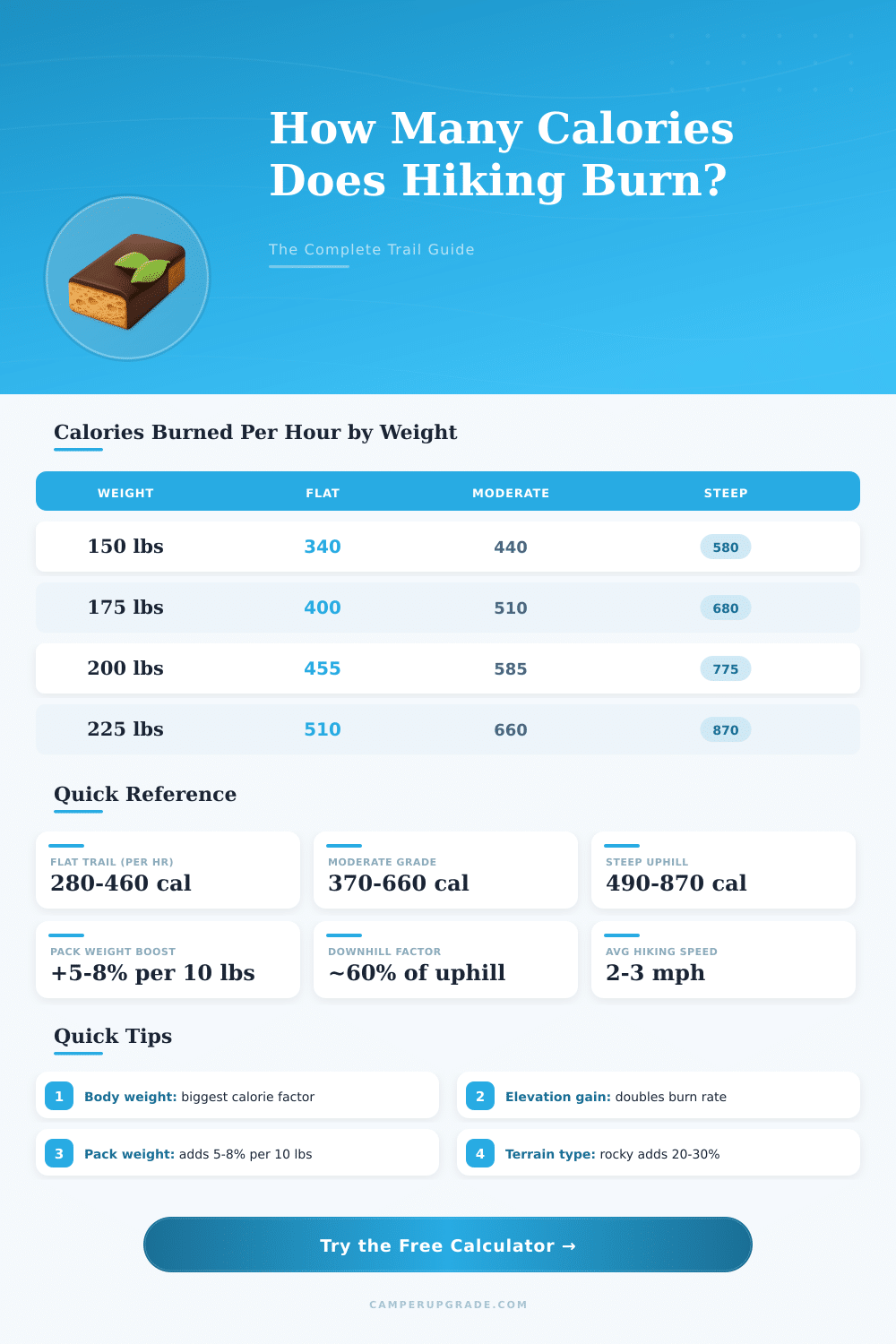
A 155-pound hiker on flat terrain burns roughly 370 calories per hour, bump that to steep uphill and youre closer to 550. Thats a huge jump. I kept running into a base MET value of 5.3 for general hiking, but the second you add grade the number climbs fast.
At a 10% grade the multiplier hits about 1.7x, and 20% pushes it to 2.5x. Rocky terrain alone adds 35% more effort over smooth trail, which I honestly didnt expect to be that dramatic. Pack weight matters more than most people think — every 10 pounds adds somewhere around 5 to 8% more calorie burn.
How Many Calories You Burn Hiking and What to Eat
A 35-pound backpacking load on a 12-mile day? Youre looking at 2400-ish to 3100 calories for someone around 175 lbs. Thats basically an entire days food gone in one hike.
Converting units, 175 pounds is about 79 kg and 12 miles works out to 19.3 km.
Walk one mile on flat ground burns around 100 Calories even so many things change. The slope, weight of your pack and your own body mass can really change the amount of Calories burned. On steep ground one finds around 270 Calories for one mile.
Add 1000 feet of height and that adds almost 260 Calories. Like this Hiking with real effort really burns much more than simple Hiking.
Most ratings estimate the Calories burned during Hiking between 300 and 600 per hour. Some reach even 400 to 500 Calories each hour, but everything depends on your body weight, speed, terrain and how hard you work. When you put good effort in the march, you probably will spend hundreds of Calories each hour.
Usually one says, that folks burn between 2 and 5 Calories for every kilo of body mass during one hour of walking. Take your whole weight, included of the pack and gear, multiply that by around 4 Calories each hour, and you will get quite a good guess.
The standard upward speed is around 2 miles each hour, if you bear a pack. Walk 3 or 4 miles each hour are then considered really fast. However the Calories each mile stay quite steady regardless of the pace.
Slower walking lowers the cost each minute, but you cover more distance during the time. Faster step burns more per moment, but brings you to the end point sooner.
Long hikes really add up quickly. Doing 20 or so miles in one day, one can spend around 4,000 to 5,000 Calories. For the big long-trail hikers, they easily burn 6,000 to 10,000 Calories a day.
The hard part is getting sew much Calories in, the most long-trail hikers aim for around 5,000 to 6,000 Calories a day, but almost always there is a gap. Weight loss during long hikes is really common, so making sure that you do not lose too much becomes really important.
Good planning of your Calories needs is key. Aim for around 200 to 300 Calories each hour, while you indeed climb. For a 6-hour march you would want 750 to 1,500 Calories in your pack.
And before you even start, ensure a solid meal of 300 to 500 Calories at least one hour before. That prior meal should be rich in carbs, with a bit of protein, and low in fat and fiber.
For multi-day trips a good starting point is around 1.5 pounds of food per day, what matches around 3,000 Calories. But the usual need for long-trail Hiking beats that, we talk about more than 5,000 Calories a day to keep body weight stable. For a 5-day trip aiming for 2,000 to 2,500 Calories each day is reasonable.
When you carry everything on your back, calorie-dense foods, that save weight and space, become key. Stuff like nuts, nut butter and oils give big Calories without taking too much space. Those low-dense foods like bars and chips only take a lot of space and add extra weight for the same amount of Calories.
While on a 3-day trip using the dense choices could save you almost a whole pound of heavy weight compared to the light, bulky stuff.
Good breakfast on the trail is something like oats with cinnamon, nuts and dried fruits. For a main meal rice or couscous with lentils, chickpeas and tuna in oil is a good choice. And do not forget to add hot chocolate with extra sugar and butter or cream, that will give you a nice Calories boost.
The secret is toeat something every hour, while you move, to keep your energy steady and your fuel tank full.