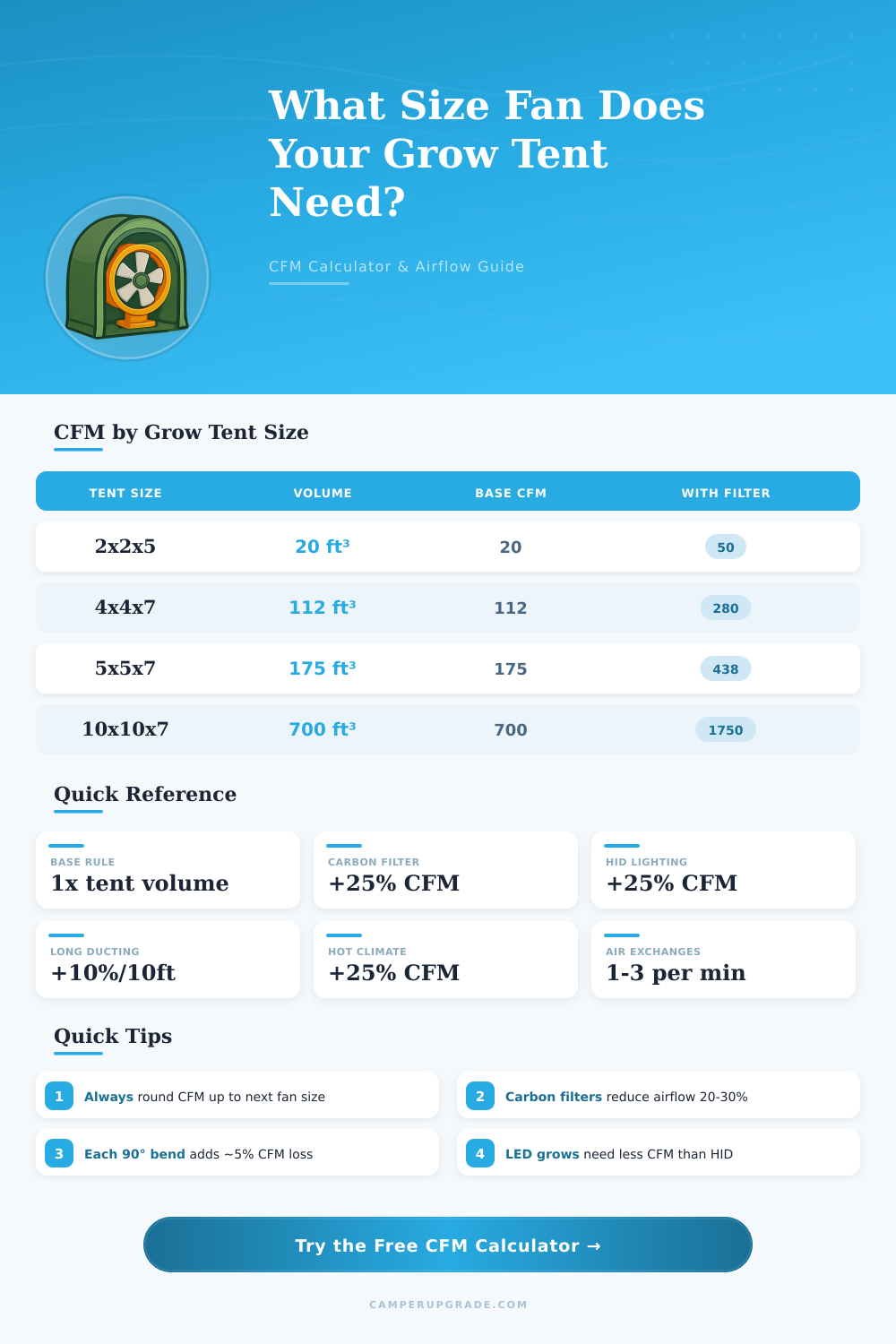
🌱 Grow Tent Fan Size Calculator
Calculate the exact CFM exhaust fan size for your grow tent based on dimensions, equipment, and environment
| Tent Size | Volume (ft³) | Base CFM | With Carbon Filter | Fan Diameter |
|---|---|---|---|---|
| 2×2×5 ft | 20 | 20 | 25–50 | 4 in |
| 2×4×5 ft | 40 | 40 | 50–80 | 4 in |
| 3×3×6 ft | 54 | 54 | 68–108 | 4–6 in |
| 4×4×7 ft | 112 | 112 | 140–224 | 6 in |
| 4×8×7 ft | 224 | 224 | 280–448 | 6–8 in |
| 5×5×7 ft | 175 | 175 | 219–350 | 6 in |
| 5×10×7 ft | 350 | 350 | 438–700 | 8 in |
| 8×8×7 ft | 448 | 448 | 560–896 | 8–10 in |
| 10×10×8 ft | 800 | 800 | 1000–1600 | 10–12 in |
| Fan Diameter | Diameter (mm) | Typical CFM Range | Typical m³/h Range | Best for Tent Volume |
|---|---|---|---|---|
| 4 in | 100 mm | 80–205 CFM | 136–348 m³/h | Up to 40 ft³ |
| 6 in | 150 mm | 200–440 CFM | 340–748 m³/h | 40–250 ft³ |
| 8 in | 200 mm | 400–740 CFM | 680–1258 m³/h | 250–500 ft³ |
| 10 in | 250 mm | 600–1060 CFM | 1020–1802 m³/h | 500–850 ft³ |
| 12 in | 305 mm | 900–1500 CFM | 1530–2550 m³/h | 850+ ft³ |
| Material | lbs / yd³ | kg / m³ | Notes |
|---|---|---|---|
| Potting Soil / Soilless Mix | 800–1,100 | 475–653 | Varies with moisture |
| Coco Coir | 400–700 | 237–415 | Dry to saturated range |
| Perlite | 200–400 | 119–237 | Very lightweight |
| Clay Pebbles (Hydroton) | 650–900 | 386–534 | Reusable, lightweight |
| Rockwool | 300–500 | 178–297 | Dry weight; heavy wet |
| Vermiculite | 350–550 | 208–326 | Good moisture retention |
| Compost / Worm Castings | 1,000–1,400 | 593–831 | Dense, heavy material |
| Peat Moss | 300–600 | 178–356 | Compressed bales expand |
| Depth (in) | Depth (cm) | Coverage (sq ft) | Coverage (m²) |
|---|---|---|---|
| 1 | 2.5 | 324 | 30.1 |
| 2 | 5.1 | 162 | 15.1 |
| 3 | 7.6 | 108 | 10.0 |
| 4 | 10.2 | 81 | 7.5 |
| 6 | 15.2 | 54 | 5.0 |
| Bag Size | Volume | Bags per Yard | Coverage at 3 in |
|---|---|---|---|
| 2 cu ft bag | 0.074 yd³ | 13.5 bags | 8 sq ft |
| 3 cu ft bag | 0.111 yd³ | 9 bags | 12 sq ft |
| 1 cu ft bag | 0.037 yd³ | 27 bags | 4 sq ft |
| 1.5 cu ft bag | 0.056 yd³ | 18 bags | 6 sq ft |
A 4x4x7 grow tent has 112 cubic feet of air volume, and thats your starting CFM number for one full air exchange per minute. Slap a carbon filter on and youre looking at around 140 to 168 CFM once you add that 25% bump for static pressure. I didnt expect ducting to matter as much as it does, but every 10 feet of run eats about 10% of your airflow and each 90 degree bend chews through another 5%.
Cultivate good air flow in a grow Tent is one of the most useful things for indoor farming. Such fans move the air in the Tent, copying natural wind that helps the plants. When the air spreads more evenly, you avoid warm spots and pockets of humidity.
Grow Tent Fans, Airflow and CFM
They also help stronger stem growth in your plants. Without good airflow things can quickly fail.
There are many kinds of fans made for grow Tent setups. Clip fans attach right to the poles of the Tent. Other common choices are swinging wall fans, standing fans, tower fans, pedestal fans and super-quiet models.
Brands like Hurricane, Active Air, Air King, AC Infinity and Vivosun are common go-to choices for many growers. Some think that one swinging tower Fan together with an exhaust Fan works just as well, without need of clip fans everywhere.
Clip fans stay popular because they take very little space. The clip model of Hydro-Crunch 6-inch, for instance, has 10 different speed levels, adjustable tilt and automatic swing. It gives more flexible airflow and cooling for grow Tent setups or other narrow places.
Some models even have 10-level swing range, so that you can direct the wind to certain places or cover the whole area without it stuck on obstacles. With 10 speed settings to offer, you can set the right airflow for any stage of plant growth.
The Vivosun 13-inch floor Fan is another really good option. It swings both sideways and up and down, which really well mixes the air in the Tent. It also has “natural breeze” setting, that changes the strength instead of running at constant speed.
That helps to reduce direct air blow, that could strain the plants.
For hanging fans, the Honeywell HT900 is a solid choice. It does not swing, but it does move a lot of air. Place one up and another below in the Tent can work very well and stay budget-friendly.
Even some tiny USB fans, like 120mm 5V models, can be tied and have speed control on high, medium or low. They are especially quiet and ideal for small grows, where you can place some around.
Exhaust fans are also key. Inline duct fans ensure good airflow, temperature control and management of humidity. The Cloudline series of AC Infinity are very popular for this.
The S-models have manual speed controls, while the T-series let you set minimum and maximum temperature settings. For a 4×4 Tent, an 8-inch model of AC Infinity can deliver the needed CFM at lower speeds, staying pretty quiet. A 6-inch unit works for 2×4 and 3×3 Tent setups.
Pulling air from the top makes most sense, because warm air rises.
Overall, pulling warm air out of the Tent is more effective than trying to force fresh air inside. That works like a computer Fan, that usually blows out. For counting airflow needs, CFM is the main measure.
CFM means cubic feet per minute and shows how much air a Fan can move in 60 seconds. As a simple rule, divide the volume of the Tent by 3 to get the minimum needed CFM. But extras like carbon filters and duct bends can really drop the efficiency.
A carbon filter alone can reduce the power of the Fan by around 25%, and one single 90-degree bend can reduce it by another 30%.
For example, a 4x3x6 grow Tent has a basic CFM of 72. After you count extras and the heat of the grow light, the needed CFM usually grows quite a lot. The negative pressure of the exhaust Fan also can cause the Tent walls to suck inward.
Opening the intake flaps fixes that, but that can drop the humidity too low. Some growers run the exhaust Fan for temperature and extra humidity control.
The good news is that there are many sturdy, energy-saving Fan options with adjustable settings and easy setup. Even so, hanging fans in the Tent can be a bit hard, especially when the exhaust pull draws the walls inward. That can over time push the motor of a clip Fan against thewall, which is not very good for lasting use.