🏕 Campsite Ground Cover Calculator
Calculate exactly how much gravel, mulch, sand, or other ground cover you need for your campsite, RV pad, fire pit, or outdoor area.
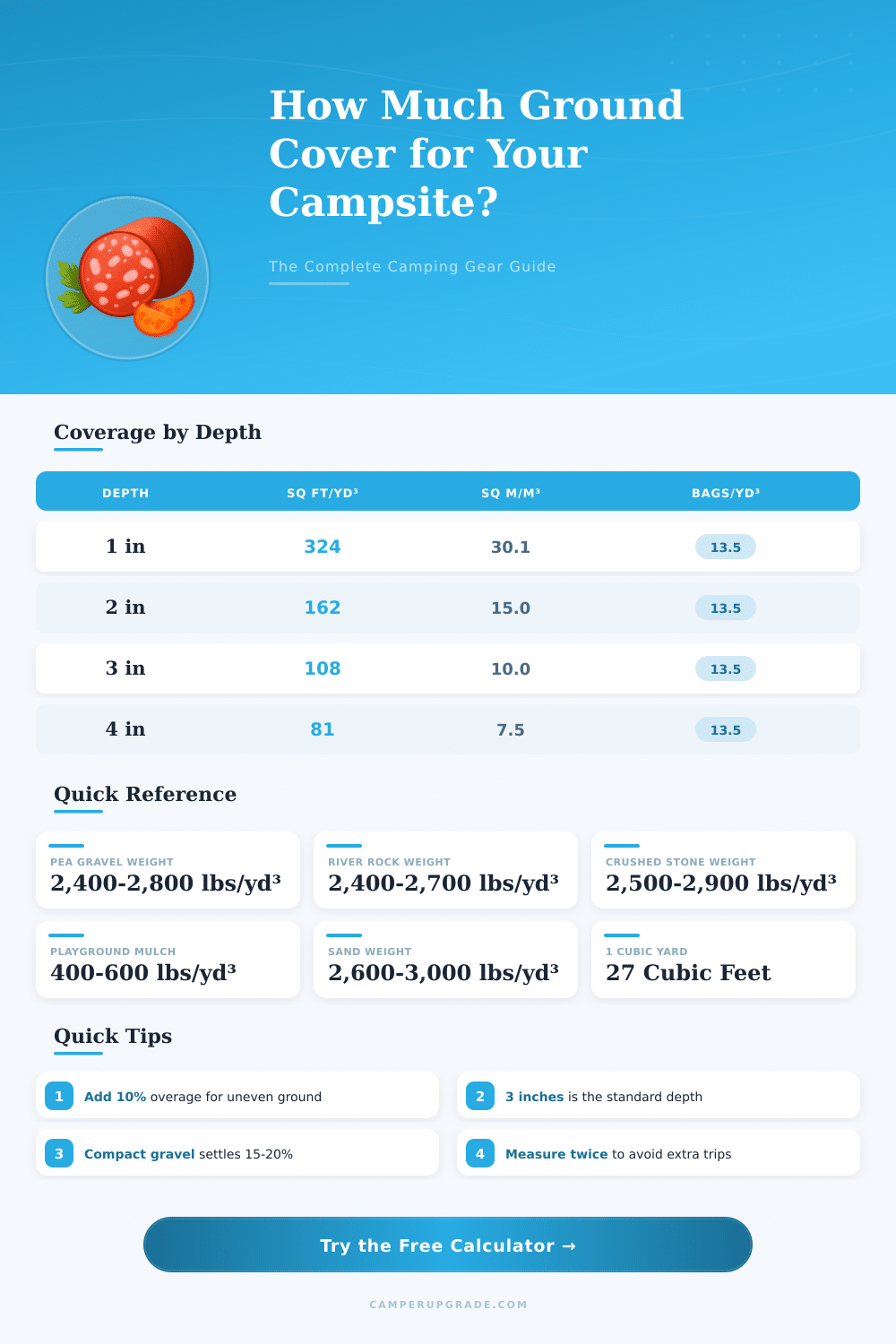
| Depth | Sq Ft / Yd³ | Sq M / M³ | Metric Depth |
|---|---|---|---|
| 1 in | 324 | 30.1 | 2.5 cm |
| 2 in | 162 | 15.0 | 5.1 cm |
| 3 in | 108 | 10.0 | 7.6 cm |
| 4 in | 81 | 7.5 | 10.2 cm |
| 6 in | 54 | 5.0 | 15.2 cm |
| Bag Size | Volume/Bag | Bags/Yd³ | Coverage at 3 in |
|---|---|---|---|
| 0.5 cu ft bag | 0.5 cu ft | 54 | 2 sq ft |
| 1 cu ft bag | 1 cu ft | 27 | 4 sq ft |
| 2 cu ft bag | 2 cu ft | 13.5 | 8 sq ft |
| 3 cu ft bag | 3 cu ft | 9 | 12 sq ft |
| Project | Area (sq ft) | Yd³ at 3 in | 2 cu ft Bags |
|---|---|---|---|
| Small Tent Pad (8×10) | 80 | 0.74 | 10 |
| Tent Platform (12×12) | 144 | 1.33 | 18 |
| Fire Pit Circle (10 ft dia) | 79 | 0.73 | 10 |
| Standard RV Pad (12×40) | 480 | 4.44 | 60 |
| Large RV Pad (16×50) | 800 | 7.41 | 100 |
| Campsite (20×20) | 400 | 3.70 | 50 |
| Pathway (4×20) | 80 | 0.74 | 10 |
| Awning Area (8×20) | 160 | 1.48 | 20 |
Note: Here are some tips from articles based on real experiences and tips that people shared in Camping communities and between makers.
When you prepare a Camping trip, think about protection, clearly, a tent is the first item on the list. Also keeping foods fresh, drinking water and resources for a campfire are important. After you set up your tent on flat ground, the real fun starts: build your collection with stuff that truly will last.
Basic Camping Gear and Tips
The range of available items is truly big and wild, canvas bags and packs, Camping kitchens, Camping cots, you name it.
Your basic Gear should include a tent, ground tarp, pegs and a mallet. Do not forget a sleeping bag, sleeping pad or mattress, a Camping pillow and something warm as cover. For hammocks, the best tents are lightweight, easily packed and simple to hang anywhere.
The NRS straps and Nite Ize Camjams are worth their weight a lot, ideal for setting shelter up, securing items or attaching hammocks.
Lights are more key than one believes. A lantern on the head is absolutely needed. Truly handy are little battery lamps or rechargeable lights that you hang on the tent ceiling, it leaves your hands free while you get ready for sleep.
LED string lights can add a merry atmosphere, if that pleases you. A first aid kit is also needed. Simply, one that already sits in your car works very well.
Change from backpacking to car Camping changes everything the moment you add a chair and table. Coleman kitchens ease the cooking. Two coolers?
That is a good idea. One for foods, the other one for drinks. Pop-up tents, like the fast models from Coleman, skip the hole trouble of setup and packing.
A six-person model fits a mattress or sleeping pad with a lot of space for your items. Even three cots for Camping fit, if needed.
Sea to Summit make some truly great sleeping pads for Camping and inflatable pillows that often win prizes. Close to Zero focus on lightweight systems for backpacking, offering clever all-in-one bags for easy setup. For Camping tasks, a good clamp knife is useful, imagine cutting kindling wood or sticks.
Bringing a canoe opens entirely new options. You reach islands without other folks beside you and can carry more Gear than backpacking or cycling ever would allow. A really big kitchen and big tent becomes real, and you can drop the cold meal routine fully.
Most important is finding items that fit your everyday life. Price and brand name do not matter truly a lot. Everything depends on your real plans, the land that you visit, the weather and the length of the journey.
Thrift shops and flea markets often have great finds, especially during winter. Tents appear often in those stores. Do not forget rain Gear, a nylon tarp with a bit of paracord can create a good windscreen and sleepingshelter under the open sky.
Work gloves from leather and a compact Camping hatchet help around the fire well.