🚙 RV Pad Gravel Calculator
Calculate exactly how much gravel, crushed stone, or ground cover you need for your RV pad, campsite, or outdoor area
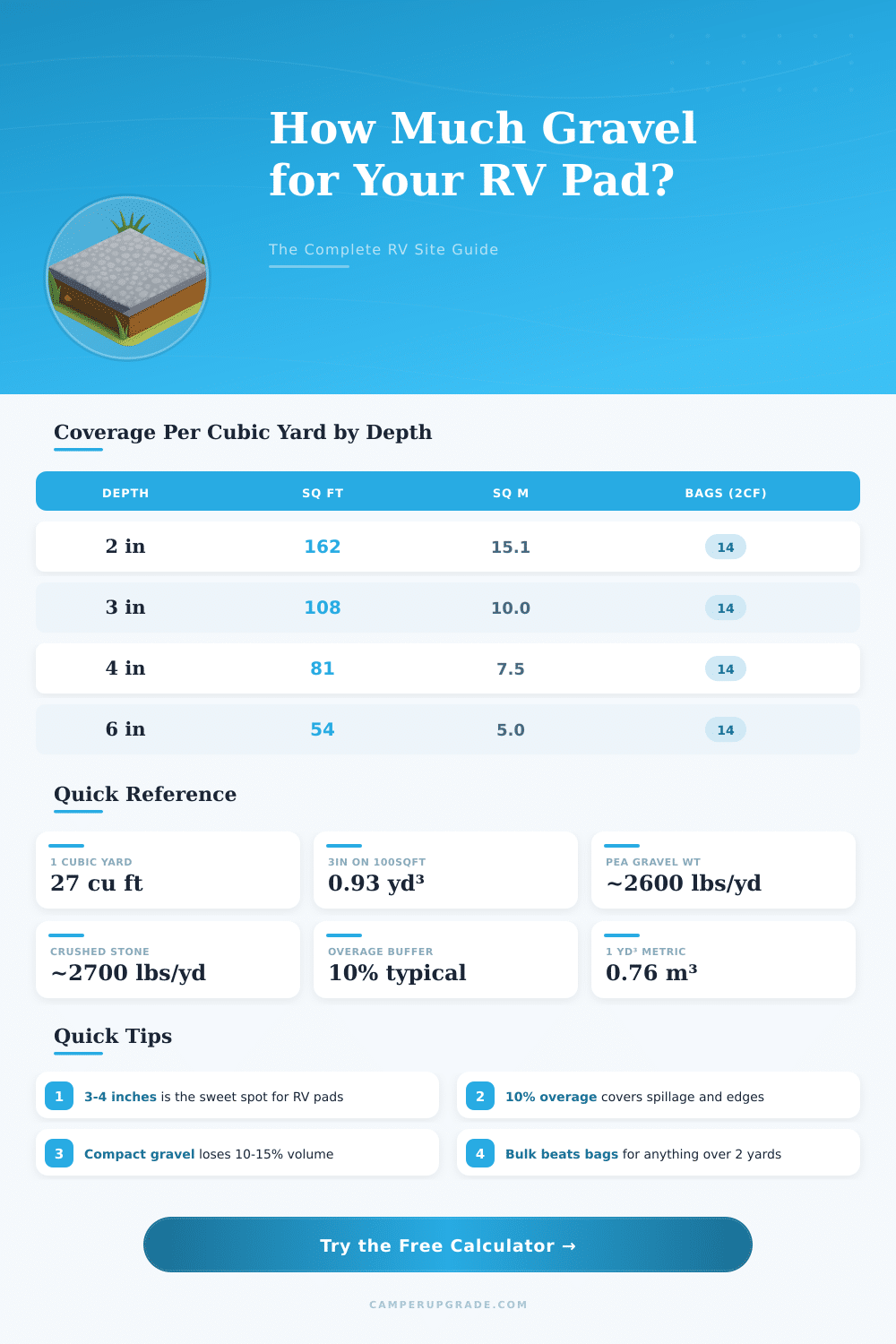
| Depth | Sq Ft / Yard | Sq M / Yard | Metric Depth |
|---|---|---|---|
| 1 in | 324 | 30.1 | 2.5 cm |
| 2 in | 162 | 15.1 | 5.1 cm |
| 3 in | 108 | 10.0 | 7.6 cm |
| 4 in | 81 | 7.5 | 10.2 cm |
| 6 in | 54 | 5.0 | 15.2 cm |
| Bag Size | Volume / Bag | Bags / Cubic Yard | Coverage at 3 in |
|---|---|---|---|
| Small Bag | 0.5 cu ft | 54 bags | 2 sq ft |
| Standard Bag (2 cu ft) | 2.0 cu ft | 13.5 bags | 8 sq ft |
| Large Bag (3 cu ft) | 3.0 cu ft | 9 bags | 12 sq ft |
| Super Sack (1 yd³) | 27 cu ft | 1 bag | 108 sq ft |
| Project | Area (sq ft) | Cu Yds at 3 in | Bags (2 cu ft) |
|---|---|---|---|
| Small Patio Pad | 72 | 0.67 | 9 |
| Fire Pit Area 10×10 | 100 | 0.93 | 13 |
| Awning Zone 8×20 | 160 | 1.48 | 20 |
| Campsite 20×20 | 400 | 3.70 | 50 |
| RV Pad 12×40 | 480 | 4.44 | 60 |
| Full Hookup 16×50 | 800 | 7.41 | 100 |
| Double RV Pad 20×40 | 800 | 7.41 | 100 |
| Heavy Duty 12×60 | 720 | 6.67 | 90 |
A single cubic yard covers about 108 square feet at 3 inches deep, and that number caught me off guard the first time I ran it. Bump up to 4 inches and youre down to 81 sq ft per yard. Crushed stone runs around 2700 pounds a yard so even a 480 sq ft RV pad at 4 inches needs roughly 5 yards (well over 6 tons).
Road base compacts 15 to 20 percent more than pea gravel, which Ive found only loses about 10 percent. I always tack on 10 percent overage because edges and low spots eat material fast.
Gravel Guide: Uses, How Much You Need, and Gravel Bikes
The information below is not done by some calculator or converter tool online. It comes from actual reactions of users, forum conversations and experiences of the community, gathered through the whole net.
Gravel is a loose mix from rocky chips. It forms naturally on the ground by means of settling and wearing geological processes, but one also produces it in big amounts for sale as smashed stone. One sorts grit according to the size of the grains: in geology it means rocky pieces with diameter between 4 and 76 mm.
Actually it is not “made” in the normal sense; rock masses break apart and split from the parent rock because of common water or gravity. Those bits can be of metre or more until only some millimeters.
Between the most common uses of grit are driveways. Seems as if each rural house has a gravel driveway. Almost none from them uses grid fabric, edge drain-slices or any base layer.
Most commonly one simply sheds tons and tons of smashed mix from the stone crusher. When one takes care, it looks great. Some even look nice with short grasses growing along the centre, although some owners want no plants.
Grit costs less than concrete or asphalt. One can spread and roll it by means of nothing more than rake and shovel, and it does not require packing.
To have solid gravel surface, good way is start by means of basic layer from bigger stones, about half the size of baseball. Later one lays up smashed mix (crusher run). The sand and small stones sink into the big basic stone, and it becomes very firm, almost as concrete.
Finally one can add thin upper layer of pea gravel for a bit “dress” the look.
Grit is also liked for parking pads for caravans (RV). Build such pad commonly is a self-made project. One method is do a wall, shed the grit inward, and later rake it until it is flat.
Commonly appear questions about how deep the grit must be, what type more answers, pea gravel or smashed stone, and what material use for the bank so that it does not migrate. Lay mat or bit of cross board between the tyres and the gravel surface can help, because sometimes moisture can slowly climb in the tyres with the time. Gravel pads are much more cheap than concrete pads and also more easily removed if the property ever is sold.
Pea gravel and smashed stone are useful for RV-areas, but also for yard areas around fire. Gravel pad is one from the most budget-friendly ways to install courtyard for fire space. Some plans intend to build 20-foot by 20-foot gravel courtyard for fire, with chairs around it.
The gravel fire look attracts, but the costs matter; bids for 15- until 16-foot round can be between 3 500 and 5 000 American dollars if one instead uses paving stones.
Camp on grit is entirely other matter. Some campgrounds require that tents be set up on gravel pads. Sleep on grit can be uncomfortable.
Hammering poles in grit is a challenge, although big nail-like poles work quite well. Sometimes it is possible to camp on the normal ground right beside the gravel pad instead.
Changing topic entirely: there are also gravel bikes. They evolved from the desire for adventure-ready bikes. Basically they deal about crossing between mountain bike and road bike.
Gravel bikes are designed to be faster than mountain bikes and more rugged than average road bike. They handle various weather conditions and road surfaces while staying comfortable. They have lower bottom crank height for stability compared with cyclocross bike.
Choices include 700c or 650b wheels, thick pace or smooth tyres. Most gravel bikes have road bike position with drop bars. Gravel bikes and cyclocross bikes almost always have broader tyres than road bikes.
Gravel bike well answers for rough terrain and ways full of cracks, where road bike feels confined but mountain bike feels a bit boring. Gravel riding commonly meens fewer traffic, because cars tend to avoid gravel roads, and it gives bigger feeling of adventure without needing the technical skills of mountain biking.
For just riding on paved ways, strong road bike could be better choice. Such “endurance” bikes more well work on pavement and can accept broader tyres, around 38 until 40 mm. The real advantage of gravelbikes appears chiefly outside the pavement.