🚛 RV Pad Gravel Calculator
Calculate exactly how much gravel or ground cover material you need for your RV pad, campsite, or outdoor project
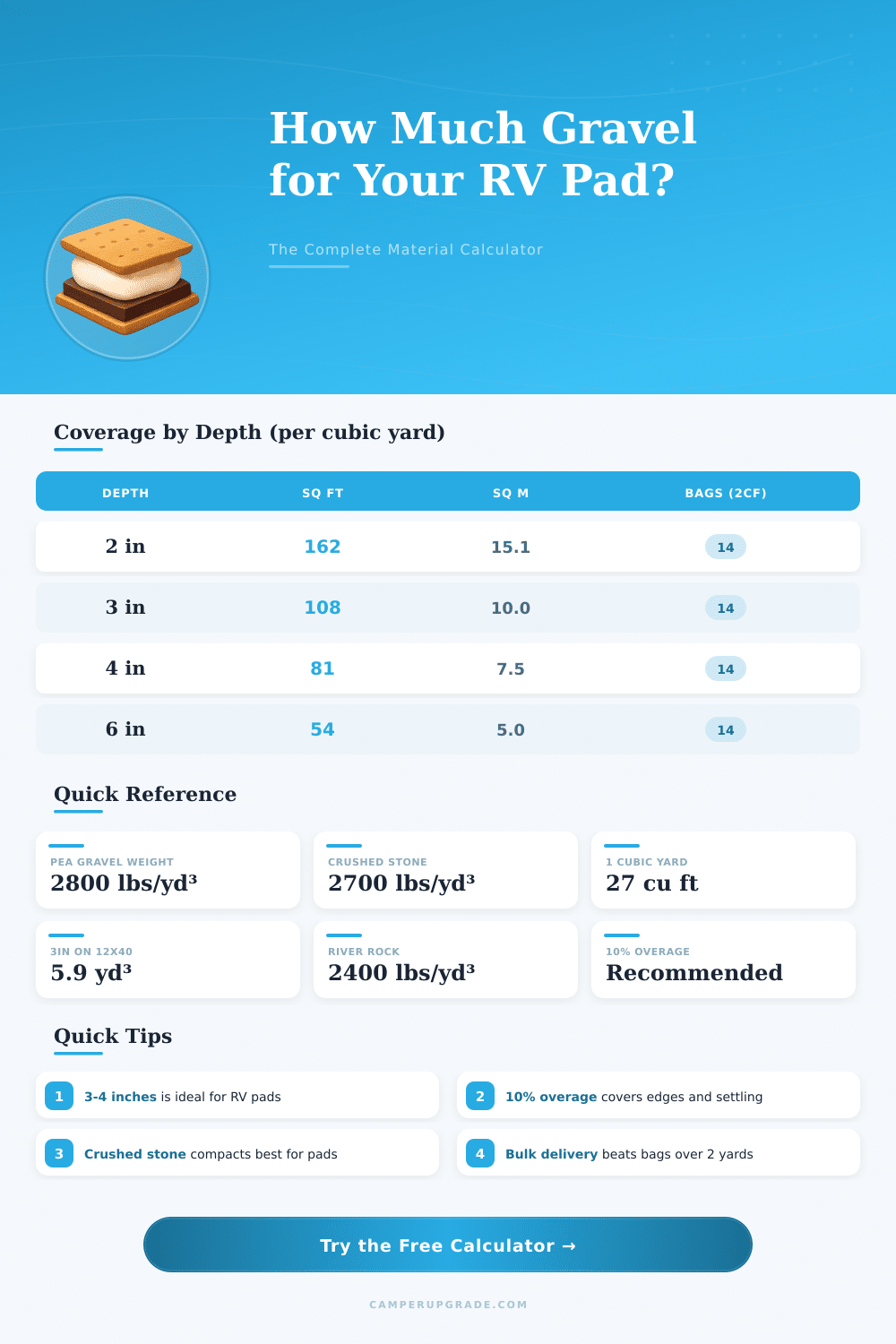
| Depth | Sq Ft Covered | Sq Meters | Depth (cm) |
|---|---|---|---|
| 1 in | 324 | 30.1 | 2.54 |
| 2 in | 162 | 15.1 | 5.08 |
| 3 in | 108 | 10.0 | 7.62 |
| 4 in | 81 | 7.5 | 10.16 |
| 6 in | 54 | 5.0 | 15.24 |
| Bag Size | Volume | Bags per Cubic Yard | Coverage at 3 in |
|---|---|---|---|
| Small Bag | 0.5 cu ft | 54 | 2.0 sq ft |
| Medium Bag | 1.0 cu ft | 27 | 4.0 sq ft |
| Large Bag (2 cu ft) | 2.0 cu ft | 13.5 | 8.0 sq ft |
| XL Bag (3 cu ft) | 3.0 cu ft | 9 | 12.0 sq ft |
| Super Sack | 1.0 cu yd | 1 | 108 sq ft |
| Project | Area (sq ft) | Cubic Yards at 3 in | Bags Needed (2 cu ft) |
|---|---|---|---|
| Small RV Pad (10×30) | 300 | 2.8 | 38 |
| Standard RV Pad (12×40) | 480 | 4.4 | 60 |
| Large RV Pad (16×50) | 800 | 7.4 | 100 |
| Campsite Area (20×20) | 400 | 3.7 | 50 |
| Fire Pit Circle (10×10) | 100 | 0.9 | 13 |
| Walkway (4×60) | 240 | 2.2 | 30 |
| Awning Zone (8×20) | 160 | 1.5 | 20 |
| Full Site (30×30) | 900 | 8.3 | 113 |
A standard 12 by 40 foot RV pad runs 480 square feet, and at 3 inches deep youre looking at roughly 4.4 cubic yards of gravel. Thats around 12,000 pounds of crushed stone give or take. Bump that to 4 inches and I kept landing closer to 5.9 yards, which honestly felt like a huge jump for just one extra inch.
Compaction eats another 10 to 15 percent on top of that, so Ive always added overage.
Gravel Types, Uses and How Much You Need
The gravel are interesting natural thing, with their own special traits and uses. That lightweight rock pieces involve wide range of sizes since as little as nail until as heavy as fourth-column block. Rather to the sharp bits of mess, the bits of gravel have separate rounded form, that water and gravity slowly created during time.
But the gravel are not simply random set of stones. Various sizes do various tasks; since the half until two-column “edition 3 gravel”, that is basic in construction, until the bigger 1.5- until 4-column stones, that answers for control erosion and back walls. So exists the always popular three-quarter-column “edition 57 crushed stone”, that well balances drainage and skill bear burden.
And we do not forget the handy “crushed stone blend”. Mix from stone dust and various crushed stone sizes.
Pea gravel, with its little, uniform pebbles genuinely shine for garden paths, tree lines and decorative landscaping. It drains especially well and stays in place more flatly than bigger stones. The weakness?
It can split under heavy foot traffic, so it is not the best for driveways.
Talking about driveways, the three-quarter-column gravel are among the most favourite choices. It gives good balance between stability and drainage, whether one chooses granite stone, limestone, river stone or even recycled concrete pieces. The gravel is also the usual solution for French drains, foundations and backfills, actually, almost any rural farm has a gravel driveway.
Most of them simply fill themselves with crushed stone blend, without need of cutting or base layer. With a bit of effort, such gravel roads can seem genuinely wonderful, when one adds some low grasses for nice impression.
One big advantage of the gravel? It costs much less than concrete or asphalt for a road. Everything, what it requires, are a rake, shovel and some loads of material to spread it equally.
No heavy compacting is needed. Gravel roads maybe are not as nice, but they do the same role as there paved brothers, in fraction of the cost.
The size and kind of gravel, that one chooses, genuinely affect the general style, little for fancy paths, bigger for rustic and bold look. When one counts supply, one ton of gravel usually covers around 60 square feet in 4-column depth. Naturally, the exact density ranges according to the particular mix of gravel.
Ah, and we can not ignore “gravel bikes”; whole new type, that combines the strength of mountain bike with the speed of road bike. With lower bottom frame for stability and options for 700c or 650b wheels, those clever bikes shine on rough roads, where average road bikes hesitate. The broad tyres give comfort without the heavy feeling of real mountain bike.
In addition, such gravelroads have fewer traffic loads, what adds adventurous feeling without the technical needs of off-road cycling.
For those, that favour smooth surfaces, endurance bike could be better. Those prior roads well fit broad 38-40 mm tyres. But the real charm of gravel bikes you discover, when one leaves the asphalt.