🪵 Firewood Drying Time Calculator
Estimate how long your firewood needs to season based on species, split size, and climate conditions
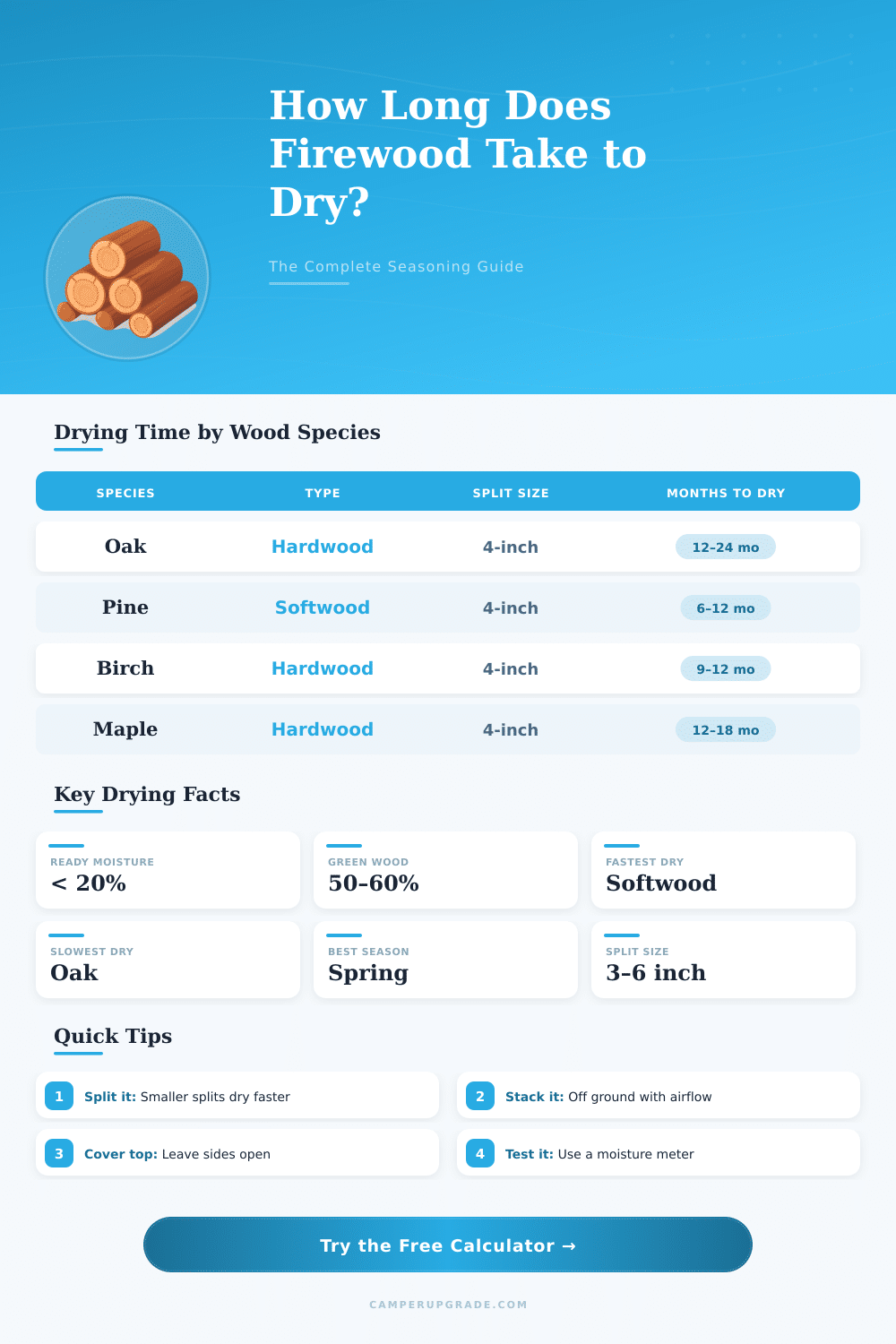
| Species | Type | Small Split (3 in) | Standard (4 in) | Large (6 in) |
|---|---|---|---|---|
| Oak | Hardwood | 9–12 mo | 12–18 mo | 18–24 mo |
| Maple | Hardwood | 8–12 mo | 12–18 mo | 16–22 mo |
| Ash | Hardwood | 6–9 mo | 9–12 mo | 12–18 mo |
| Birch | Hardwood | 6–9 mo | 9–12 mo | 12–15 mo |
| Cherry | Hardwood | 6–9 mo | 9–12 mo | 12–15 mo |
| Elm | Hardwood | 12–18 mo | 18–24 mo | 24–36 mo |
| Walnut | Hardwood | 9–12 mo | 12–18 mo | 18–24 mo |
| Pine | Softwood | 4–6 mo | 6–8 mo | 9–12 mo |
| Spruce | Softwood | 4–6 mo | 6–9 mo | 9–12 mo |
| Douglas Fir | Softwood | 5–7 mo | 7–10 mo | 10–14 mo |
| Climate Type | Humidity | Time Modifier | Notes |
|---|---|---|---|
| Dry / Arid | Low (<30%) | −25 to −35% | Hot, low humidity accelerates drying |
| Temperate | Moderate (30–60%) | Baseline | Four distinct seasons, standard drying |
| Humid / Coastal | High (>60%) | +30 to +50% | Slow drying; good stacking critical |
| Cold / Northern | Varies | +15 to +25% | Short warm season limits drying window |
| Method | Airflow | Time Modifier | Moisture Risk |
|---|---|---|---|
| Off Ground, Top Covered | Good | Baseline | Low |
| Off Ground, Open Air | Excellent | −10 to −15% | Low (rain may add time) |
| Piled on Ground | Poor | +25 to +50% | High (rot risk) |
| Enclosed Shed | Low | +10 to +20% | Medium (ventilation needed) |
| Kiln-Dried | N/A | 1–3 days total | Very Low |
| Species | BTU/Cord (Million) | Burn Quality | Coaling |
|---|---|---|---|
| Oak | 24–29 | Excellent | Very Good |
| Maple | 25–29 | Excellent | Very Good |
| Ash | 23–25 | Very Good | Good |
| Birch | 20–23 | Good | Moderate |
| Cherry | 20–22 | Good | Moderate |
| Elm | 20–24 | Moderate | Fair (hard to split) |
| Walnut | 22–26 | Good | Good |
| Pine | 14–18 | Fair (high sap) | Poor |
| Spruce | 15–17 | Fair | Poor |
| Douglas Fir | 18–21 | Moderate | Moderate |
Firewood is any wood good for use as fuel. One usually thinks about it as sticks or branches that was not processed in form of wooden balls. Like this it stays in its natural state.
One can have firewood dried what wants to say that it already was peeled, or wet, what shows that it yet is fresh and damp.
Firewood: Types, Drying, Buying and Moving
Big spot to know are the oven-dried firewood. Folks dry that kind in controlled settings to reach low level of moisture. This helps it catch fire more easily and burn more well.
One considers it better quality, because it tends to produce fewer smoke and fewer buildup during burning. Some companies send oven-dried oak in handy boxes that easily stores. The wood lights soon and well works for fires without smoke.
This suits for people in homes with limited space for storage.
Choosing firewood, matter to consider some points. Amount of heat that it delivers are one from them. Also the time, as far as long it lasts to burn.
And the ease to light it from other sources. Oak and hickory commonly receive teh praise as popular options. Their wooden structure has more hydrogen than other species, and that extra hydrogen makes more heat.
Hard timbers, as oak and maple, deliver the most heat and form lasting coals, what pushes them ideal for cooking.
Ash forms other reliable choice. It burns more quickly than oak, but dries faster too, what forms fare change. White oak likewise well works as firewood.
Even so some species of wood can be tricky. Green oak is genuinely hard to split by means of a wedge and hammer.
Packages of firewood form usual way to buy it. They are made up of split sticks that arrives dry and ready for immediate use. Between popular species in such packages is oak, eucalyptus, madrone and ash.
All they burn strongly and steady. One can buy firewood by bit, quarter cord, half cord or whole cord. A cord matches 128 cubic feet.
Getting delivered firewood can cost around 250 to 300 dollars for one cord.
Recently cut firewood needs around six months to dry under the sky, and dry wood costs more. A moisture meter helps to check if the wood already works for burning. The ideal is around 20 percent of moisture or less.
Small sellers of firewood maybe do not have dry amounts ready in certain seasons of the year.
Moving firewood indeed forms a bigger topic than many folks think. Sending dry timbers long ways can spread harmful insects. Those creatures can exit, attack nearby trees and start destroying forests.
Some states do not allow moving firewood across local lines or state limits. Buying it near the place where it will burn stays the safest way. Firewood likewise is arenewable natural resource, what is worth to recall.