🔥 Fire Starter Duration Calculator
Calculate how long your fire starters will last based on type, quantity, and burning conditions
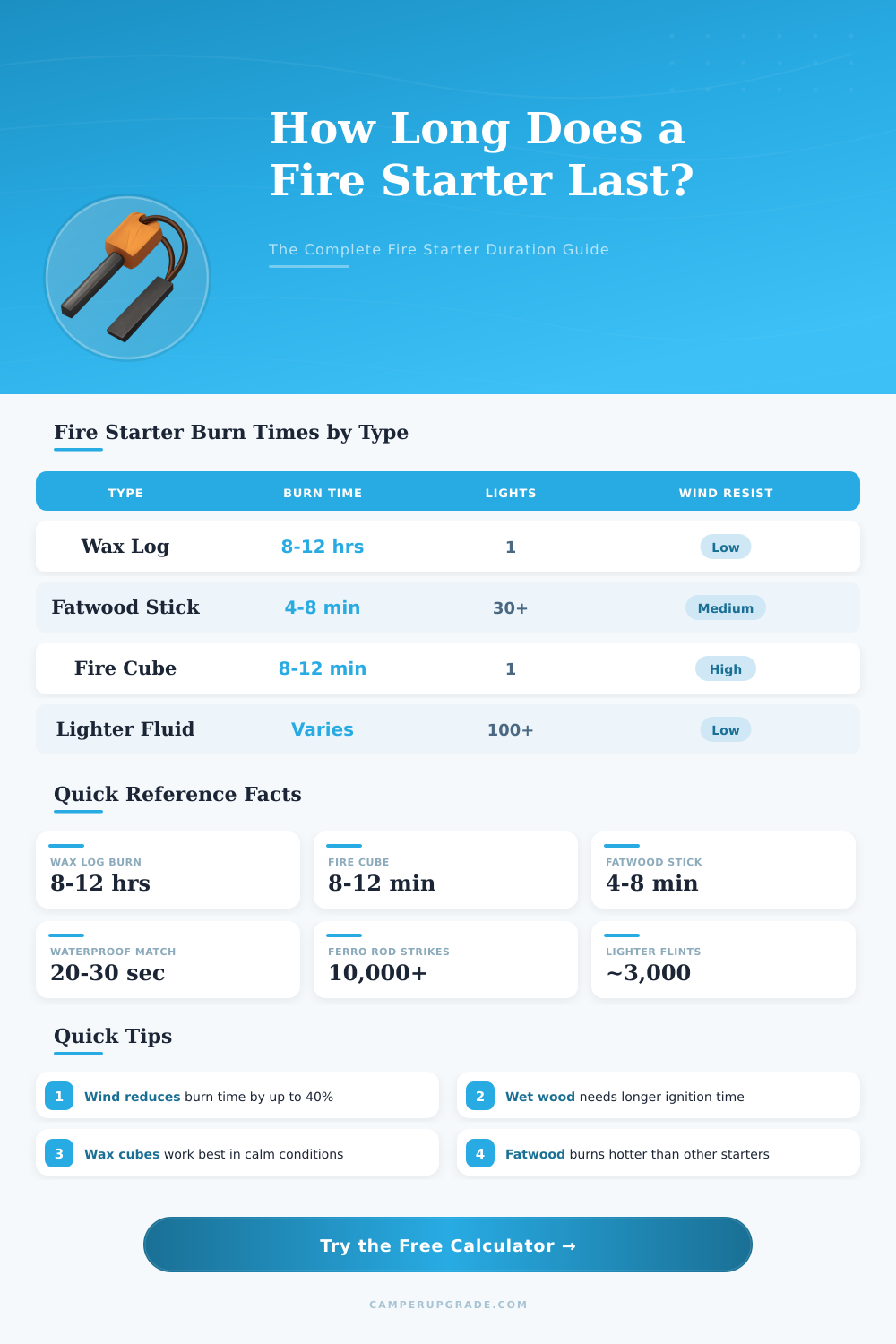
| Fire Starter Type | Burn Time (Calm) | Burn Time (Windy) | Uses Per Unit | Best For |
|---|---|---|---|---|
| Compressed Wax Log | 8–12 hours | 6–9 hours | 1 | Long fires, fireplaces |
| Fire Starter Cubes | 8–12 min | 5–8 min | 1 | Igniting wood/charcoal |
| Fatwood Sticks | 4–8 min | 2–5 min | 1 stick per use | Camping, field fire |
| Waterproof Matches | 20–30 sec | 15–20 sec | 1 | Ignition sparks |
| Disposable Lighter | ~30 min total | ~20 min total | 500–3,000 | Everyday use |
| Ferro Rod | N/A (spark) | N/A (spark) | 10,000+ | Survival, long-term |
| Fire Paste / Gel | 5–10 min | 3–6 min | 1 squeeze per use | Damp conditions |
| Natural Tinder Bundle | 2–5 min | 1–3 min | 1 | Primitive camping |
| Trip Length | Fires/Day | Wax Logs | Fire Cubes | Fatwood Sticks | Matches |
|---|---|---|---|---|---|
| 1 Night | 1 | 1 | 2 | 3 | 5 |
| Weekend (2 nights) | 1 | 2 | 4 | 6 | 10 |
| 3 Days | 2 | 6 | 12 | 18 | 30 |
| 1 Week | 2 | 14 | 28 | 42 | 70 |
| 2 Weeks | 2 | 28 | 56 | 84 | 140 |
| Emergency Kit (30 days) | 1 | 30 | 60 | 90 | 150 |
| Condition | Efficiency Factor | Impact on Starters | Recommended Adjustment |
|---|---|---|---|
| Calm / No Wind | 100% | None | No change |
| Light Breeze | 85% | Minor burn loss | Add 15% more |
| Moderate Wind | 70% | Significant loss | Add 30% more |
| Strong Wind | 50% | Major loss | Add 50% or use windscreen |
| Rain / Wet Conditions | 80% | Ignition difficulty | Use waterproof starters |
| Wet / Green Wood | 60% | More starters needed | Add 40–60% more |
| Scenario | Duration | Fires/Day | Wax Logs | Fire Cubes | Fatwood |
|---|---|---|---|---|---|
| Solo Backpacker | 3 days | 1 | 3 | 6 | 9 |
| Family Campsite | 3 days | 2 | 6 | 12 | 18 |
| RV Trip | 7 days | 1 | 7 | 14 | 21 |
| Bonfire Party | 1 night | 1 (big) | 3 | 6 | 10 |
| Bug-Out Bag | 72 hrs | 3 | 9 | 18 | 27 |
| Home Emergency Kit | 30 days | 2 | 60 | 120 | 180 |
Fire starters come in many different forms and styles, created for use at home or outside. They commonly light quickly and last through bad weather well. For those that camp in tents walk with backpacks, or simply burn wood at home, there are many options available.
Among the most popular kinds on the market are steel starters and those with magnesium. A magnesium fire starter works everywhere, but it still requires good tinder. Steel poles, magnesium bits, fire starter canes and striking tools answer for outdoor fire making and survival tools.
Simple Fire Starters and How to Use Them
Some of those can work even during rain, snow or strong winds.
One new fire starter lights right away only by pulling a string. It does not require matches, no lighters and no starter fluid. It burns more than 30 minutes and can even light wet wood.
Some used it in a wood stove with damp wood, pulled the string and it worked well. The flame did not delay at all.
There are also gel fire starters, that help to light a wood stove, campfire, fireplace, grill or home quickly and without effort, without using starter fluid. One square fire starter burns around six minutes, lights carbon easily and stays compact and resistant against spilling. Fat wood forms another option, that carries easily and feels well, especially during burning.
It is maid up of natural materials, without any chemicals.
Home steel fire starters enjoy big popularity. The old way is to fill cups from egg cartons with fluff from a dryer and pour melted wax over them. Another way mixes sawdust with cooled wax, pours that in egg cartons and lays matches.
Cotton balls with jelly in tiny sealed bags work very well. They light easily and burn quite long. Put fluff from a dryer in a tube of toilet paper and close it in a sealed bag, that probably costs the least and is easilyready.
A paper cup with a table spoon of cooking oil helps in a pinch. Simply keep one corner dry. Pads from cheese fill up with vegetable oil and work great as fire starters.
Needles of pine, cones of pine and blocks from wax can give fiery power. Skin of birch stores natural oils for burning. Even ripe cat-tails can fluff up and catch fire.
When the fire sticks to the tinder, keep feeding it with starter until the flames settle. Then lay bigger wood pieces so that the campfire truly flares. Search for a place away from wind, that is useful a lot, because breeze can blow out a new fire before it strengthens.