🛌 Down Sleeping Bag Lifespan Calculator
Estimate how many years your down sleeping bag will last based on usage, care & quality
| Total Nights Used | Approx. Loft Remaining | Warmth Retained | Bag Condition |
|---|---|---|---|
| 0 – 100 | 95 – 100% | Full warmth | Excellent |
| 100 – 300 | 85 – 95% | Near full | Very Good |
| 300 – 600 | 70 – 85% | Slightly reduced | Good |
| 600 – 900 | 55 – 70% | Noticeably reduced | Fair |
| 900 – 1200 | 40 – 55% | Significantly reduced | Poor |
| 1200+ | Below 40% | Greatly reduced | Replace |
| Care Level | Cleaning Frequency | Storage Method | Lifespan Multiplier |
|---|---|---|---|
| Poor | Rarely (< once / 3 yrs) | Compressed always | 0.5x (halved) |
| Average | Once per year | Sometimes compressed | 1.0x (baseline) |
| Good | Every 20-30 uses | Loose mesh bag | 1.3x (+30%) |
| Excellent | Professional + liner | Hung or loose always | 1.6x (+60%) |
| Storage Method | Effect on Down Clusters | Years Added / Lost | Recommendation |
|---|---|---|---|
| Always compressed | Crushes clusters permanently | –2 to –4 years | Avoid |
| Stuff sack (short-term) | Minimal if temporary | Neutral | OK for trips only |
| Loose mesh/cotton bag | Clusters fully expanded | +2 to +3 years | Recommended |
| Hung in closet | Excellent for loft | +3 to +5 years | Best option |
| Moisture Level | Typical Scenario | Risk to Down | Lifespan Impact |
|---|---|---|---|
| Low | Dry climates, always aired out | Minimal | Full lifespan |
| Moderate | Occasional rain, humid nights | Some clumping over time | –10 to –20% |
| High | Frequent wet, rarely dried fully | Mold, permanent clumping | –30 to –50% |
Bottom sleeping bag made from down are done for those that want to stay warm without having to carry too heavy stuff. Down ranks among the most lightweight, most pleasant and most lasting insulations that ensures that sleeping bag will be rich in comfort and easily compact. This is especially useful when you stuff them in a rucksack.
Synthetic insulations take up more space and switching to down allows to free enough place in your pack.
Down Sleeping Bags: Light, Warm and How to Care for Them
Some makers choose prime goose and duck down with fill power of 650+ or even 800+. Higher fill power in goose down gives the most lightweight and warmest sleeping bag insulation on the market. Those bags reach excellent balance between heat and weight, so they help you stay warm without too much mass.
Down sleeping bag works great for hiking, camping and even for less rough mountain trips.
Some lightweight models use a pillow for physical separation below, instead of filling the base with down. Like this one saves weight. Hoods and hand pockets help to keep the heat inside.
Down quilts offer another way to reduce the weight yet more. With a quilt there is no separatoin below, because sleeping bag just packs down under you, what makes it almost useless for heat in that part.
The main downside of down is its moisture. If down gets wet, it clumps and stops insulating. Synthetic materials keep their form even wet, what is better then nothing.
Even so today’s sleeping bags and quilts commonly have water resistant outsides and waterproof layers on the down itself, so they don’t get wet that quickly. Putting down sleeping bag in a waterproof pack liner is a good idea. Some folks pack their whole rucksack in a single use compact bag for extra guard.
Temperature ratings for sleeping bags can seem a bit tricky. The comfortable temperature shows how it feels during sleep without extra covers. Tested temperature is where you probably want to wear warm clothing.
The rating also assumes use of a sleeping pad with a particular insulating value, so a too lightweight pad could make you feeling more cold than planned. Adding a silk liner can expand the heat by some degrees and help the bag stay dry more long.
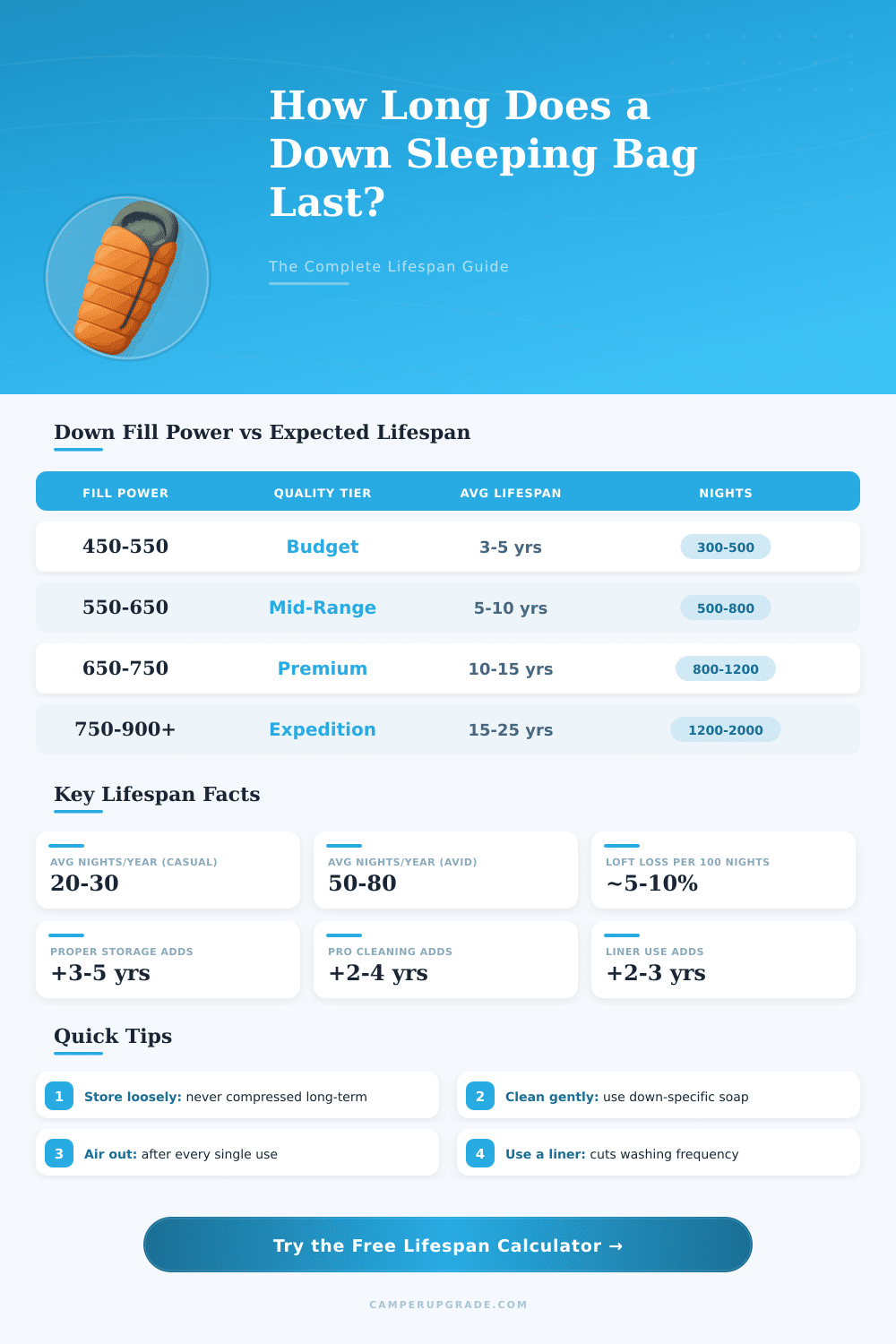
For care about down bags, one should not leave them packed when they are not used. After camping take out the bag, so that it can breathe and slowly rise. Lay it loose in a big storage bag and hang in a closet.
Down bags can get moldy if one leaves them dirty, so wash them regularly to avoid that. Some prefer syntheticdeposit above down sleeping bag for less warm nights, what also helps against moisture where it less steals heat.