⚡ Diesel Generator Runtime Calculator
Calculate how long your diesel generator can run continuously based on tank size, load, and fuel consumption rate
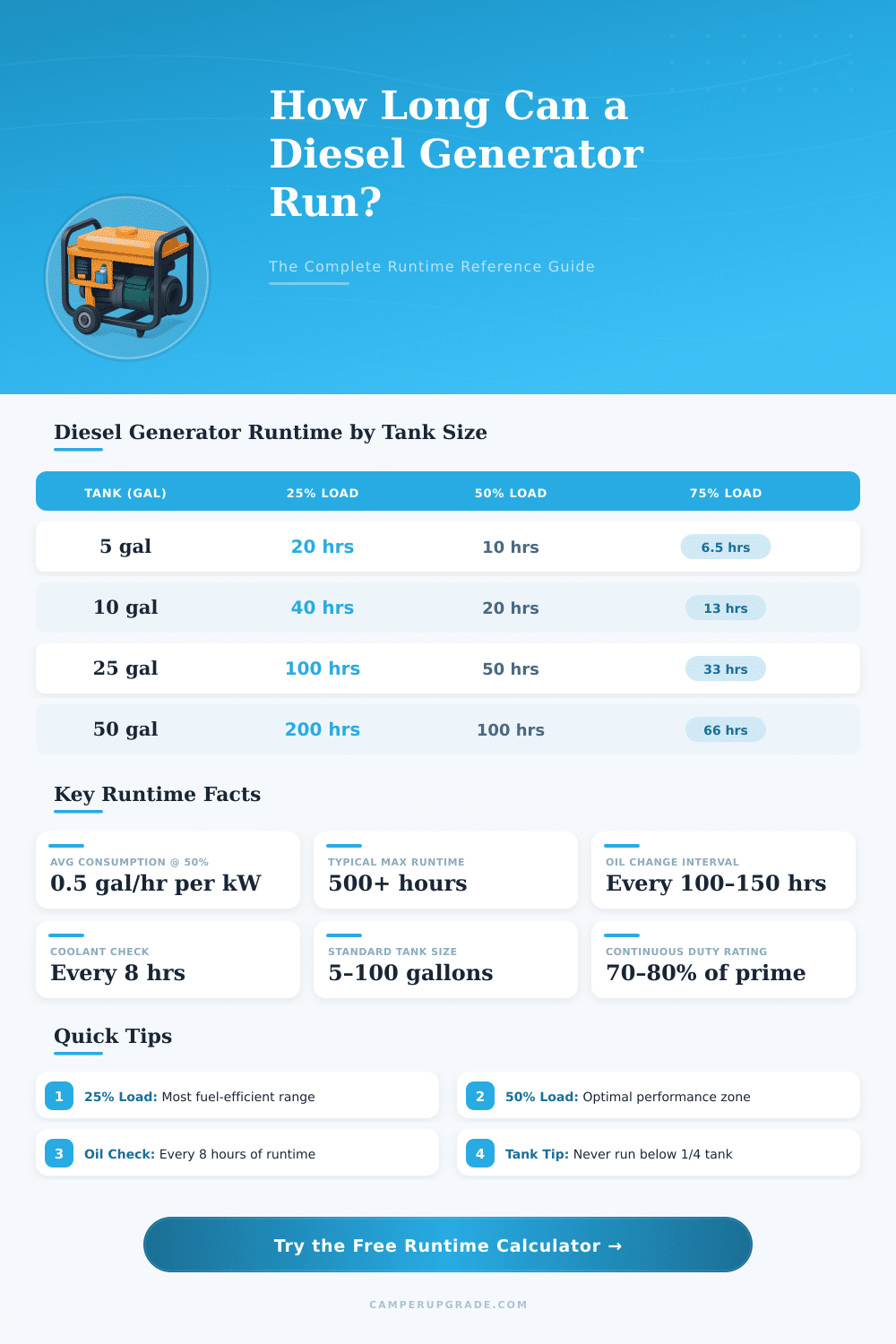
| Tank Size | Generator (kW) | 25% Load | 50% Load | 75% Load | 100% Load |
|---|---|---|---|---|---|
| 5 gal (18.9 L) | 5 kW | 5.6 hrs | 4.0 hrs | 2.9 hrs | 2.0 hrs |
| 10 gal (37.9 L) | 5 kW | 11.1 hrs | 8.0 hrs | 5.7 hrs | 4.0 hrs |
| 10 gal (37.9 L) | 10 kW | 5.6 hrs | 4.0 hrs | 2.9 hrs | 2.0 hrs |
| 25 gal (94.6 L) | 10 kW | 13.9 hrs | 10.0 hrs | 7.1 hrs | 5.0 hrs |
| 25 gal (94.6 L) | 20 kW | 6.9 hrs | 5.0 hrs | 3.6 hrs | 2.5 hrs |
| 50 gal (189.3 L) | 20 kW | 13.9 hrs | 10.0 hrs | 7.1 hrs | 5.0 hrs |
| 100 gal (378.5 L) | 30 kW | 18.5 hrs | 13.3 hrs | 9.5 hrs | 6.7 hrs |
| 250 gal (946 L) | 50 kW | 27.8 hrs | 20.0 hrs | 14.3 hrs | 10.0 hrs |
| Maintenance Task | Interval (Hours) | Interval (Days @ 24/7) | Notes |
|---|---|---|---|
| Check oil level | Every 8 hrs | Every 0.3 days | Critical for extended runs |
| Check coolant level | Every 8 hrs | Every 0.3 days | Check when cold |
| Check fuel filter | Every 50 hrs | Every 2 days | Replace if clogged |
| Oil change | Every 100–150 hrs | Every 4–6 days | Use diesel-rated oil |
| Air filter inspection | Every 100–200 hrs | Every 4–8 days | Clean or replace |
| Full service | Every 250–500 hrs | Every 10–21 days | By certified technician |
| Generator Size | @ 25% Load | @ 50% Load | @ 75% Load | @ 100% Load |
|---|---|---|---|---|
| 5 kW | 0.9 gal/hr (3.4 L/hr) | 1.25 gal/hr (4.7 L/hr) | 1.75 gal/hr (6.6 L/hr) | 2.5 gal/hr (9.5 L/hr) |
| 10 kW | 1.8 gal/hr (6.8 L/hr) | 2.5 gal/hr (9.5 L/hr) | 3.5 gal/hr (13.2 L/hr) | 5.0 gal/hr (18.9 L/hr) |
| 15 kW | 2.7 gal/hr (10.2 L/hr) | 3.75 gal/hr (14.2 L/hr) | 5.25 gal/hr (19.9 L/hr) | 7.5 gal/hr (28.4 L/hr) |
| 20 kW | 3.6 gal/hr (13.6 L/hr) | 5.0 gal/hr (18.9 L/hr) | 7.0 gal/hr (26.5 L/hr) | 10.0 gal/hr (37.9 L/hr) |
| 30 kW | 5.4 gal/hr (20.4 L/hr) | 7.5 gal/hr (28.4 L/hr) | 10.5 gal/hr (39.7 L/hr) | 15.0 gal/hr (56.8 L/hr) |
| 50 kW | 9.0 gal/hr (34.1 L/hr) | 12.5 gal/hr (47.3 L/hr) | 17.5 gal/hr (66.2 L/hr) | 25.0 gal/hr (94.6 L/hr) |
Diesel generator, commonly called diesel genset, ties a diesel engine with an electrical generator, usually an alternator, for producing electrical energy. Here is an explanation about its function: In the engine burns diesel fuel which changes chemical energy to mechanical. The mechanical rotation later turns the generator part, that creates electricity.
In several ways it is like a gas generator, but it beats it by means of better fuel efficiency.
Diesel Generators: How They Work and Their Good and Bad Points
One of the main benefits is the little attention that they require compared to other kinds of fuel. The most many diesel generators can work without stopping between 300 and 400 hours before comes time for average checks, like change of oil and filters. Models for heavy use, built for long service, can run even more long without pauses.
Fairly that reliability makes them ideal for times, when you require energy day after day in the natural surroundings.
When the main energy fails, back-up diesel generators quickly step in to settle the problem. They start automatically by means of a transfer swtich, what guarantees, that your electrical needs are met in only some seconds. Hospitals, data centers and other important buildings trust on them, because in those places simply no mistake is allowed.
Here something important to recall: diesel generators weigh a lot. Truly, there exist more little versions, but they are meant for main uses, working during weeks without stop. The most little models start at around 6000 watts, and they certainly are not portable by means of one hand.
Common marks of engines for those devices are Kubota, Perkins, John Deere and Yanmar. Especially Kubota stands out because of its reputation in genset uses.
One problem of diesel fuel in business is its short duration. It does not stay forever, what matters if you plan too store it for long time. A propane generator escapes that problem, propane lasts years without going bad.
It is cleaner also, releasing fewer strong gases and carbon monoxide. The price? Propane generators are more expensive at first and wear out more quickly because of the high temperatures of burning, that they require.
The noise is other important factor. A three-cylinder Perkins diesel can become truly loud, if your neighbour camps near. In road vehicles, where the generator is installed, that matters a lot.
Diesel motorhome cars usually lay them below before, during gas models commonly place them more near bedrooms. Even so there exist quiet diesel versions, like Onan units, that last severe cold, even under minus ten degrees Fahrenheit with special fuel and man-made oil.
Little diesel generators serve also as helpful energy sources in commercial trucks, working well by means of one gallon during eight hours to cool the air. The downside? They are noisy, involve much space and cost a lot.
Some national parks and managed campgrounds limit or ban diesel generators because of noisy problems and risks of fuel. Starting a diesel engine is more difficult than a gasgenerator also. The high compression makes the pull too strong for the most many folks.