🥫 Dehydrated Food Shelf Life Calculator
Estimate how long your dehydrated food will last based on food type, storage method, temperature & packaging
| Temperature | Shelf Life Multiplier | Example: Fruits | Example: Grains |
|---|---|---|---|
| 40–60°F (4–15°C) – Cool | 1.0x (Full) | 25–30 yrs | 25–30 yrs |
| 60–70°F (15–21°C) – Room | 0.65x | 16–20 yrs | 16–20 yrs |
| 70–80°F (21–27°C) – Warm | 0.40x | 10–12 yrs | 10–12 yrs |
| 80–90°F (27–32°C) – Hot | 0.20x | 5–6 yrs | 5–6 yrs |
| Container | Multiplier | Notes | Best For |
|---|---|---|---|
| Mylar Bag (sealed) | 1.0x | Best moisture & light barrier | Long-term storage |
| Metal Can (sealed) | 1.0x | Excellent protection | Very long-term |
| Glass Jar (sealed) | 0.85x | No light barrier unless dark glass | Medium-term |
| Vacuum-Sealed Bag | 0.80x | Good O2 control, less moisture barrier | Medium-term |
| Plastic Zip Bag | 0.40x | Poor moisture & O2 barrier | Short-term only |
| Open Container | 0.10x | No protection | Days to weeks |
| O2 Control Method | Multiplier | O2 Level Achieved | Impact |
|---|---|---|---|
| Oxygen Absorber | 1.0x | <0.1% O2 | Maximum preservation |
| Vacuum Sealed | 0.90x | ~1–2% O2 | Excellent preservation |
| Regular Seal | 0.55x | ~21% O2 (normal air) | Moderate reduction |
| Open Air | 0.15x | 21% O2 + humidity | Minimal protection |
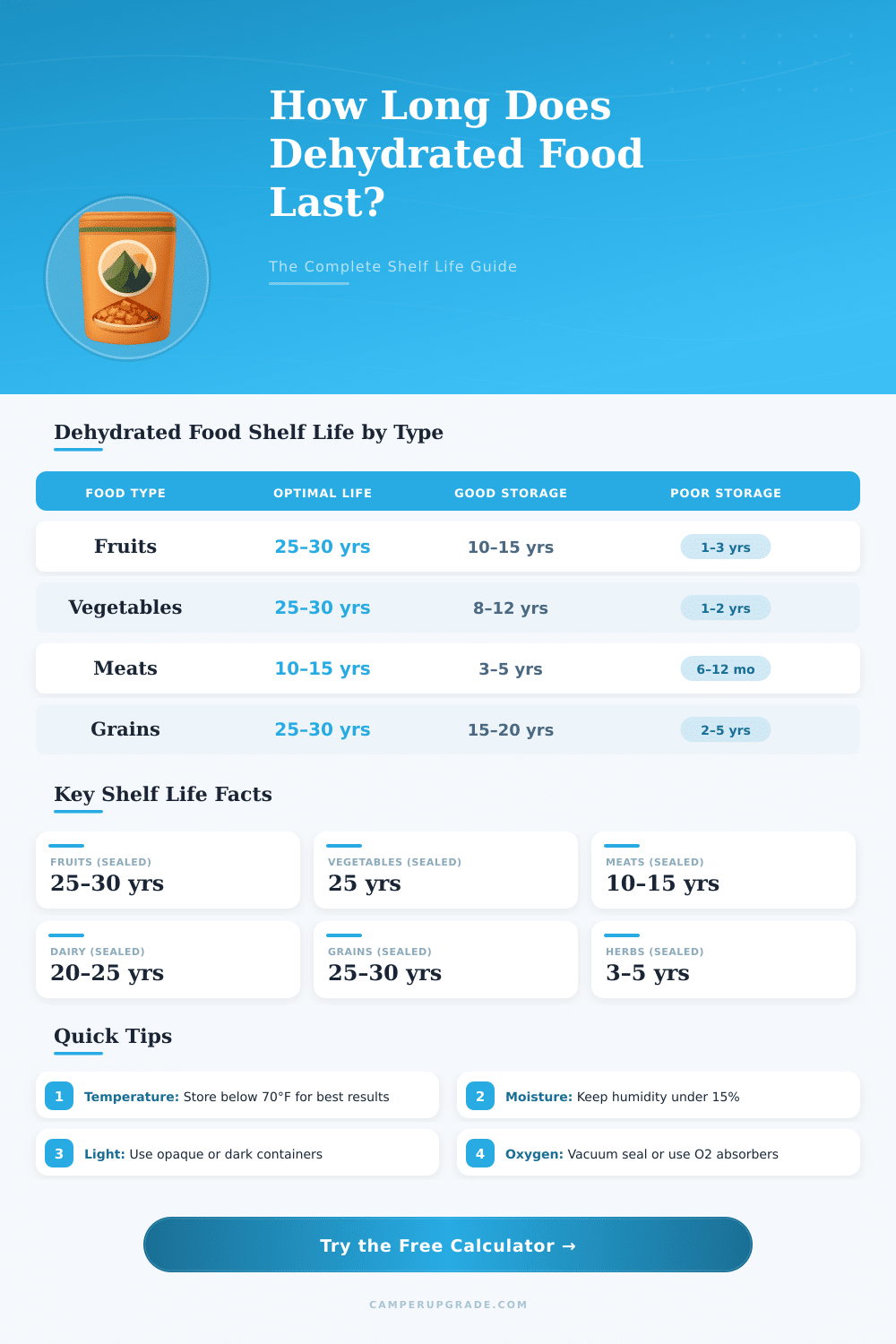
| Food Type | Optimal (Sealed, Cool) | Good (Glass, Room Temp) | Poor (Plastic, Warm) |
|---|---|---|---|
| Fruits | 25–30 years | 10–15 years | 1–3 years |
| Vegetables | 25–30 years | 8–12 years | 1–2 years |
| Meats | 10–15 years | 3–5 years | 6–12 months |
| Grains & Pasta | 25–30 years | 15–20 years | 2–5 years |
| Dairy | 20–25 years | 5–10 years | 1–2 years |
| Herbs & Spices | 3–5 years | 1–3 years | 6–12 months |
| Legumes | 25–30 years | 10–15 years | 2–4 years |
| Eggs (powdered) | 5–10 years | 2–5 years | 6–12 months |
Dehydrated food is simply that what stays after removing almost all moisture from it. The main goal is to help quickly remove water so that the food does not spoil and to stop growth of dangerous germs. Most vegetables and fruits carry between 80 and 95 percent of water.
Meats and cooked grains have around 70 percent of water. If one removes that water, the proteins, fats, sugars, fibers, vitamins and minerals stay. Like this the food keeps its healthy value fairly well.
What Is Dehydrated Food and How to Use It
There are various ways to dry foods. A dryer for foods is one of the easiest tools. One can also use an oven for drying, and certain products like fruit in sheets can be made by means of an oven on low heat.
The food industry indeed uses a lot of dehydrated food. Many such foods are dried by means of spray so one turns them into fine mist and later blows them with warm air. The moisture dries up right away, leaving behind milk powder.
A great benefit of dehydrated food is its long shelf life. Because the water is gone, such items do not spoil and can stay in good shape a long time. The process of slow drying by means of air removes water from fresh fruits and vegetables while it keeps the important nutrients without damage.
On the other hand, some water-based vitamins, like vitamin C and riboflavin, can be lost during the drying. So it is not an entirely perfect method.
Dehydrated foods truly enjoy popularity for hiking with a backpack and camping. They way little, because one must not carry water weight. They need only little space and simply one jar with a little stove to prepare.
The key idea is easy: one mixes the dehydrated items, pours water, boils a bit and eats. Homemade dehydrated foods usually taste better than those bought in store. Among popular homemade choices are lasagna, chili, pasta sauce and soups.
Ground beef one can wash after cooking to remove fat, later one passes it through a chopper for foods, which makes smaller bits that dry and rehydrate more easily. Adding breadcrumbs to ground meat helps to avoid that it becomes a hard block.
Drying offers the best ratio of cost for calories per gram. That means the most food for the least weight and money. Freeze-dried food could be even more light, but it costs much more.
One can dehydrate all kinds of things. Apples, oranges, sauce for pasta, ground beef, vegetables, beans and garlic all work for that. Cutting bits equally big, around a quarter inch thick, helps to dry them evenly.
Soaking fruit in a mix of lemon juice and water stops browning. Dehydrated food is useful also in emergencies. One family lived from it during 17 days.
Even so one should knot eat only dehydrated foods daily, becausethose items lost their water content.