🔋 Deep Cycle Battery Calculator
Calculate the amp-hours & number of batteries needed for your RV, solar, or marine system
| Appliance / Device | Watts (W) | Hours/Day | Wh/Day | Remove |
|---|
| Battery Type | Usable DoD | Cycle Life | Self-Discharge/Mo | Typical Ah (12V) | Weight (100Ah) |
|---|---|---|---|---|---|
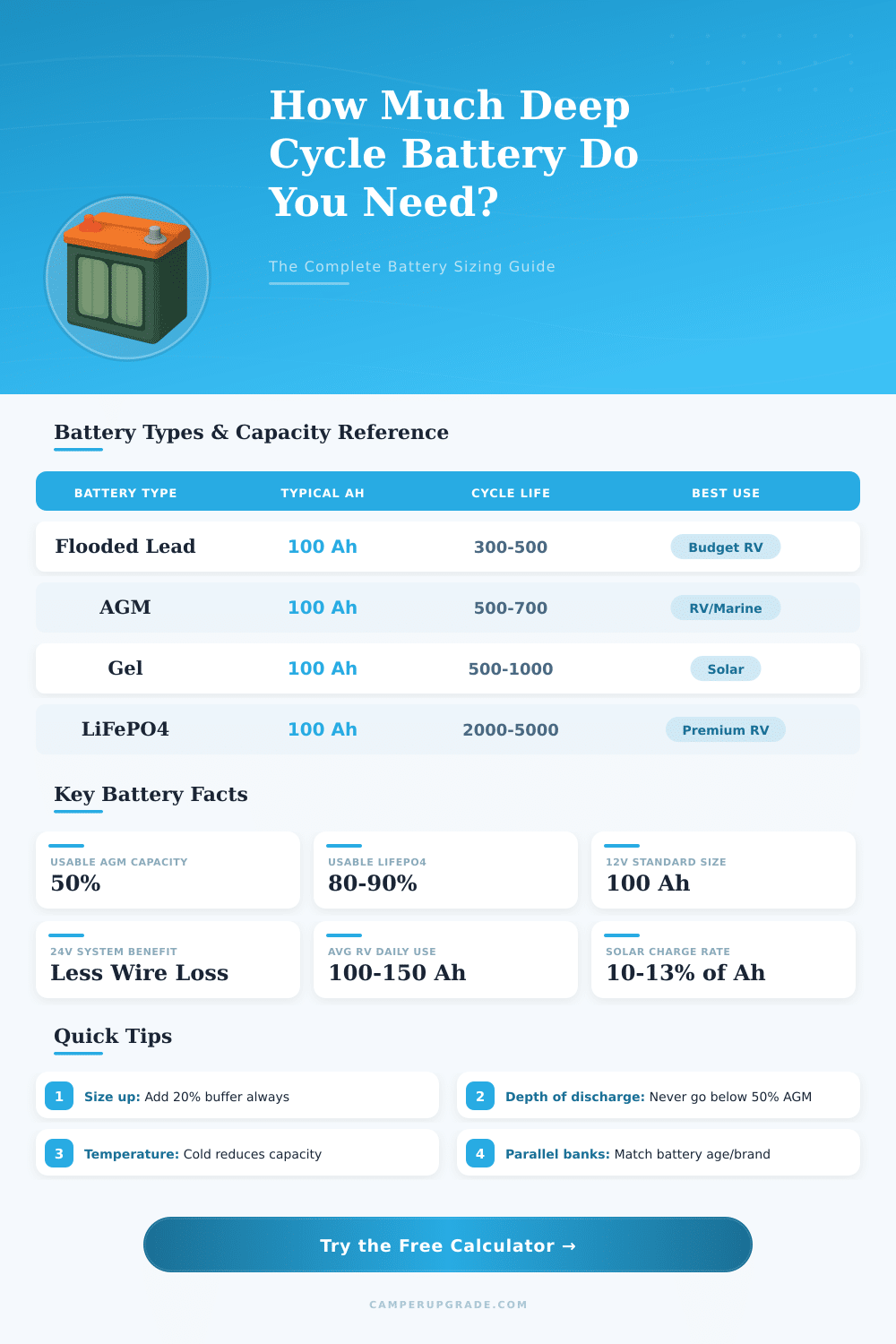
| Flooded Lead-Acid | 50% | 300–500 | 5–15% | 75–225 Ah | ~63 lbs / 29 kg |
| AGM Lead-Acid | 50% | 500–700 | 1–3% | 50–200 Ah | ~64 lbs / 29 kg |
| Gel Lead-Acid | 50% | 500–1,000 | 1–2% | 50–200 Ah | ~60 lbs / 27 kg |
| LiFePO4 (Lithium) | 80% | 2,000–5,000 | <2% | 50–300 Ah | ~26 lbs / 12 kg |
| Lithium-Ion (NMC) | 80% | 500–1,500 | 2–3% | 50–200 Ah | ~22 lbs / 10 kg |
| Carbon Foam | 60% | 1,000–3,000 | 1–2% | 100–200 Ah | ~58 lbs / 26 kg |
| Appliance | Typical Watts | Wh @ 4 hrs/day | Wh @ 8 hrs/day |
|---|---|---|---|
| LED Lighting (per bulb) | 10 W | 40 Wh | 80 Wh |
| 12V Fan | 25 W | 100 Wh | 200 Wh |
| Laptop / Tablet Charger | 65 W | 260 Wh | 520 Wh |
| TV (32 in LED) | 50 W | 200 Wh | 400 Wh |
| RV Refrigerator (12V) | 45 W | 180 Wh | 360 Wh |
| Residential Refrigerator | 150 W | 600 Wh | 1200 Wh |
| CPAP Machine | 30 W | 120 Wh | 240 Wh |
| Phone Charger | 10 W | 40 Wh | 80 Wh |
| Water Pump (12V) | 60 W | 10 Wh | 20 Wh |
| Roof Vent Fan | 35 W | 140 Wh | 280 Wh |
| Coffee Maker | 800 W | 67 Wh | 133 Wh |
| Microwave (1000W) | 1000 W | 83 Wh | 167 Wh |
| Inverter Air Conditioner | 600 W | 2400 Wh | 4800 Wh |
| Diesel Heater | 12 W | 48 Wh | 96 Wh |
| Daily Wh Load | Ah @ 12V | Ah @ 24V | Ah @ 48V |
|---|---|---|---|
| 100 Wh | 8.3 Ah | 4.2 Ah | 2.1 Ah |
| 200 Wh | 16.7 Ah | 8.3 Ah | 4.2 Ah |
| 500 Wh | 41.7 Ah | 20.8 Ah | 10.4 Ah |
| 1,000 Wh | 83.3 Ah | 41.7 Ah | 20.8 Ah |
| 2,000 Wh | 166.7 Ah | 83.3 Ah | 41.7 Ah |
| 3,000 Wh | 250.0 Ah | 125.0 Ah | 62.5 Ah |
| 5,000 Wh | 416.7 Ah | 208.3 Ah | 104.2 Ah |
Deep Cycle Battery is made to be regularly drained, using the biggest part of its capacity. It gives steady energy for a long time and can work well until it is around 80% drained or even more which means that you already should recharge it. That fully differs from a car starter battery, that is designed for short bursts of very high power to start the engine.
Starter batteries have many slim lead plates to deliver huge amounts of amps while Deep Cycle Battery types have thicker plates for similar size and are meant to be charged and drained over and over.
Deep Cycle Batteries: Uses, Types and Care
People rate Deep Cycle Battery types by amp hours at a set output rate, for instance 100 Ah over 10 hours. Starter batteries instead are most commonly described by cold cranking amps (CCA). A real Deep Cycle Battery will be marked as Ah (amp hours), and anything listed with CCA, CA or MCA is not a real Deep Cycle Battery.
Good to know that while shopping.
People use these batteries for boats, caravans (RV), golf carts, trolling motors, camping, home energy storage and for some wheelchair uses. During a hurricane, a Deep Cycle Battery with a small inverter can run a television for several hours. They also are very useful for “dry” camping, where some folks get two or thee nights from a full charge.
There are some common types. Lead-acid Deep Cycle Battery types are the oldest and most usual. AGM batteries use absorbed glass mat technology and handle high drain and recharge cycles better then lead-acid batteries.
AGM batteries can be charged much more quickly than flooded batteries, up to five times the charge speed, and they can be deeply cycled to around 80% drain depth. They also have very low self-drain and do not suffer much from buildup. Then come lithium iron phosphate (LiFePO4) batteries, that give twice the power, half the weight, five times faster charging, almost no care and come with Bluetooth monitoring and smart battery management systems.
For lead-acid Deep Cycle Battery types, the general advice is to drain only to about 50% to reach the biggest number of cycles. Draining past 50% on an average lead-acid battery strongly affects the lifetime of the cells. Some real deep cycle lead batteries are rated at more than 1000 cycles at 50% drain.
LiFePO4 batteries last much longer at much deeper drain, which makes them better for longer run times.
Six-volt golf cart batteries, wired in series, are a popular and cheap choice. They are real Deep Cycle Battery types and can last around six years. Deep Cycle Battery types are far more lasting, replaceable and cost-effective.
If reliable powermatters and the budget allows, LiFePO4 is the right way for regular cycling and daily use.