🪵 Cedar Firewood Drying Time Calculator
Estimate how long cedar takes to season based on log size, split type, climate, and storage method
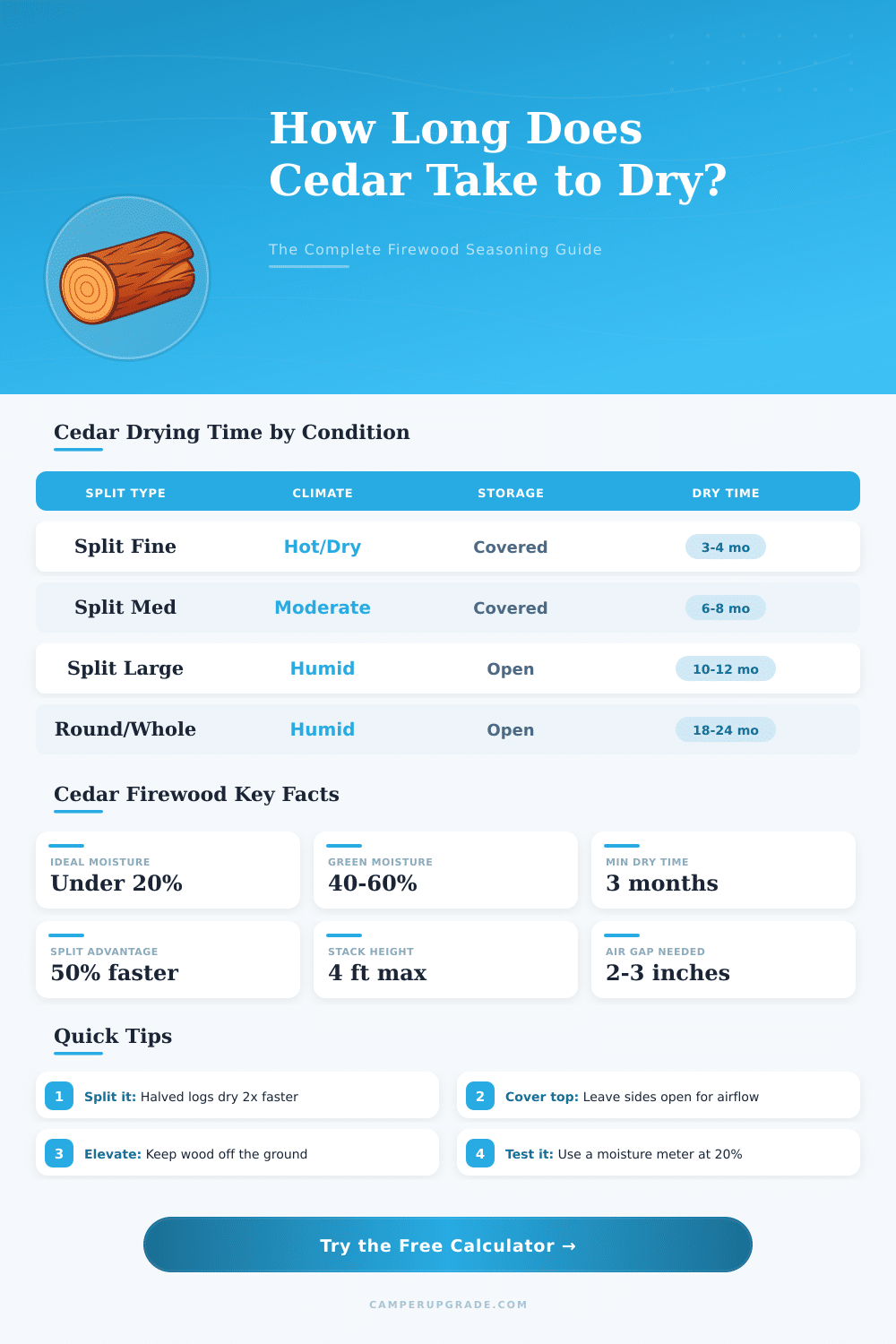
| Split Type | Climate | Storage | Est. Months to 20% | Est. Months to 15% |
|---|---|---|---|---|
| Small Split (2–4 in) | Hot & Dry | Covered Shed | 2–3 months | 3–4 months |
| Small Split (2–4 in) | Moderate | Covered Shed | 3–5 months | 5–7 months |
| Small Split (2–4 in) | Humid | Open Stack | 5–7 months | 8–10 months |
| Medium Split (4–6 in) | Hot & Dry | Covered Shed | 4–6 months | 6–8 months |
| Medium Split (4–6 in) | Moderate | Covered Shed | 6–9 months | 9–12 months |
| Medium Split (4–6 in) | Humid | Open Stack | 8–12 months | 12–16 months |
| Large Split (6–8 in) | Hot & Dry | Covered Shed | 6–8 months | 9–11 months |
| Large Split (6–8 in) | Moderate | Covered Tarp | 9–12 months | 13–16 months |
| Large Split (6–8 in) | Humid | Open Stack | 11–15 months | 16–20 months |
| Whole Round Log | Hot & Dry | Covered Shed | 10–14 months | 15–18 months |
| Whole Round Log | Moderate | Open Stack | 15–20 months | 20–26 months |
| Whole Round Log | Humid | Open Stack | 18–24 months | 24–30 months |
| Storage Method | Airflow | Rain Exposure | Speed Factor | Time Modifier |
|---|---|---|---|---|
| Covered Shed (open sides) | Excellent | None | Fastest | Baseline (1.0x) |
| Elevated Rack (open sides) | Very Good | Partial | Very Fast | +10% time |
| Covered with Tarp (top only) | Good | Minimal | Fast | +20% time |
| Open Ground Stack | Moderate | Full | Slow | +40–60% time |
| Diameter (inches) | Diameter (cm) | Surface Area Ratio | Moisture Loss / Month (Moderate) | Approx Extra Months vs 4 in |
|---|---|---|---|---|
| 2–4 in | 5–10 cm | High | 5–7% | Baseline |
| 4–6 in | 10–15 cm | Medium-High | 4–5% | +2–3 months |
| 6–8 in | 15–20 cm | Medium | 3–4% | +4–6 months |
| 8–12 in | 20–30 cm | Low-Medium | 2–3% | +7–10 months |
| 12+ in (round) | 30+ cm | Low | 1–2% | +12–18 months |
| Moisture Reading | Status | Burn Quality | Recommended Action |
|---|---|---|---|
| 40–60% | Green / Freshly Cut | Poor – Heavy Smoke | Do not burn – continue drying |
| 25–40% | Partially Seasoned | Fair – Some Smoke | Continue drying 2–6 more months |
| 20–25% | Nearly Seasoned | Good | Acceptable for outdoor burning |
| 15–20% | Well Seasoned | Very Good | Ready for indoor fireplace |
| Below 15% | Fully Dry / Kiln-Dry | Excellent | Ideal – maximum heat output |
cedar firewood fits quickly warms the upper part of house, what makes it reliable choice when one finds it. Even so it does not work for long steady burns. Are useful recall that if one wants to keep fire burning during whole night.
cedar is known because of its unique smell, that sets it among the most pleasant smelling woods. Especially red cedar enjoys fame as one of the most nice smelling woods. That wood has also attractive reddish shade, that makes nice sight beside the fire.
Cedar Firewood: Burns Fast, Smells Nice, Not Good for Indoor Fires
Some even compare its smell to that of Christmas.
cedar makes sparks and fires during burning. Hence do not suggest to burn it in home or chimney on wooden floor. The oils inside the wood can create fires, that risks inside, so it better works for use outside.
Because of taht same reason some folks avoid it as firewood for campfires.
West cedar delivers around 18 millions of BTU each cord year for warming. East cedar does give only 12 millions of BTU each cord year, so a bit less. Nice dense pine as lodgepole burn quite a lot well, and red west cedar beats white pine, but white pine match red east cedar.
Cedar burns quickly and strongly, hence some favour it for heating of ovens.
Split in little bits, cedar works better as starting wood than as basic firewood. Some pieces of cedar successfully light fire always. One can however cut cedar boards in short parts and split them more small.
Shaved the edges in slim hairs and light those hairs help to start fire easily, without need mess up with newspaper.
Burn cedar inside has less positive sides. Light wood as cedar burns rough and cause tar to build up in the chimney. That needs more common cleanings of the tubes and grows risk of fires their.
So some use cedar only for light and later switch to pine or hard wood for the main burning.
cedar trees bear needles instead of leaves and one commonly uses them for landscaping. They also serve as Christmas trees in houses. Around the world exist many kinds of cedars, but only some commonly appear in United States as firewood.
Info about burning of cedar commonly conflicts, with opinions of “do not burn it” until “it is among the purest woods for fire”. The truth probably restssomewhere also, whether depend of the amount and place of burning.