💧 Camping Water Calculator
Calculate exactly how much water you need for your camping trip
| Camping Style | Gal/Person/Day | L/Person/Day | Includes |
|---|---|---|---|
| Backpacking | 1.5 – 2.0 | 5.7 – 7.6 | Drinking, minimal cooking |
| Tent Camping | 2.0 – 3.0 | 7.6 – 11.4 | Drinking, cooking, basic hygiene |
| Car Camping | 3.0 – 4.0 | 11.4 – 15.1 | Drinking, cooking, dishes, hygiene |
| RV / Trailer | 3.5 – 5.0 | 13.2 – 18.9 | All above + short showers, toilet |
| Base Camp | 3.0 – 4.5 | 11.4 – 17.0 | Group cooking, shared cleanup |
| Glamping | 5.0 – 7.0 | 18.9 – 26.5 | Full showers, comfort, cooking |
| Climate | Adjustment | Reason | Drinking Water Add |
|---|---|---|---|
| Cold (below 50°F) | -10% | Less sweating, lower evaporation | +0 gal |
| Mild (50–75°F) | Baseline | Normal hydration needs | +0 gal |
| Summer (75–90°F) | +20% | Increased sweating | +0.25 gal |
| Hot & Dry (90°F+) | +50% | Heavy sweating, dehydration risk | +0.5 gal |
| Hot & Humid | +35% | Sweating less effective, more needed | +0.5 gal |
| High Altitude (5000 ft+) | +25% | Faster dehydration, dry air | +0.5 gal |
| Container Type | Capacity (Gal) | Capacity (L) | Weight Full (lbs) |
|---|---|---|---|
| Standard Water Bottle | 0.13 (16 oz) | 0.5 | 1.1 |
| Nalgene Bottle | 0.26 (32 oz) | 1.0 | 2.2 |
| 1-Gallon Jug | 1.0 | 3.8 | 8.3 |
| 5-Gallon Jerry Can | 5.0 | 18.9 | 41.7 |
| 7-Gallon Aqua-Tainer | 7.0 | 26.5 | 58.4 |
| RV Fresh Tank (Small) | 30 – 40 | 114 – 151 | 250 – 334 |
| RV Fresh Tank (Large) | 60 – 100 | 227 – 379 | 500 – 834 |
| Scenario | People × Days | Gallons Needed | Liters Needed |
|---|---|---|---|
| Solo Backpacker Weekend | 1 × 2 | 3.3 – 4.4 | 12.5 – 16.7 |
| Couple Car Camping 3 Days | 2 × 3 | 19.8 – 26.4 | 74.9 – 99.9 |
| Family of 4 Weekend | 4 × 2 | 17.6 – 26.4 | 66.6 – 99.9 |
| Family of 4 Week | 4 × 7 | 61.6 – 92.4 | 233.2 – 349.8 |
| Group of 6 Long Weekend | 6 × 4 | 52.8 – 79.2 | 199.9 – 299.8 |
| RV Couple 2 Weeks | 2 × 14 | 107.8 – 154 | 408.1 – 583 |
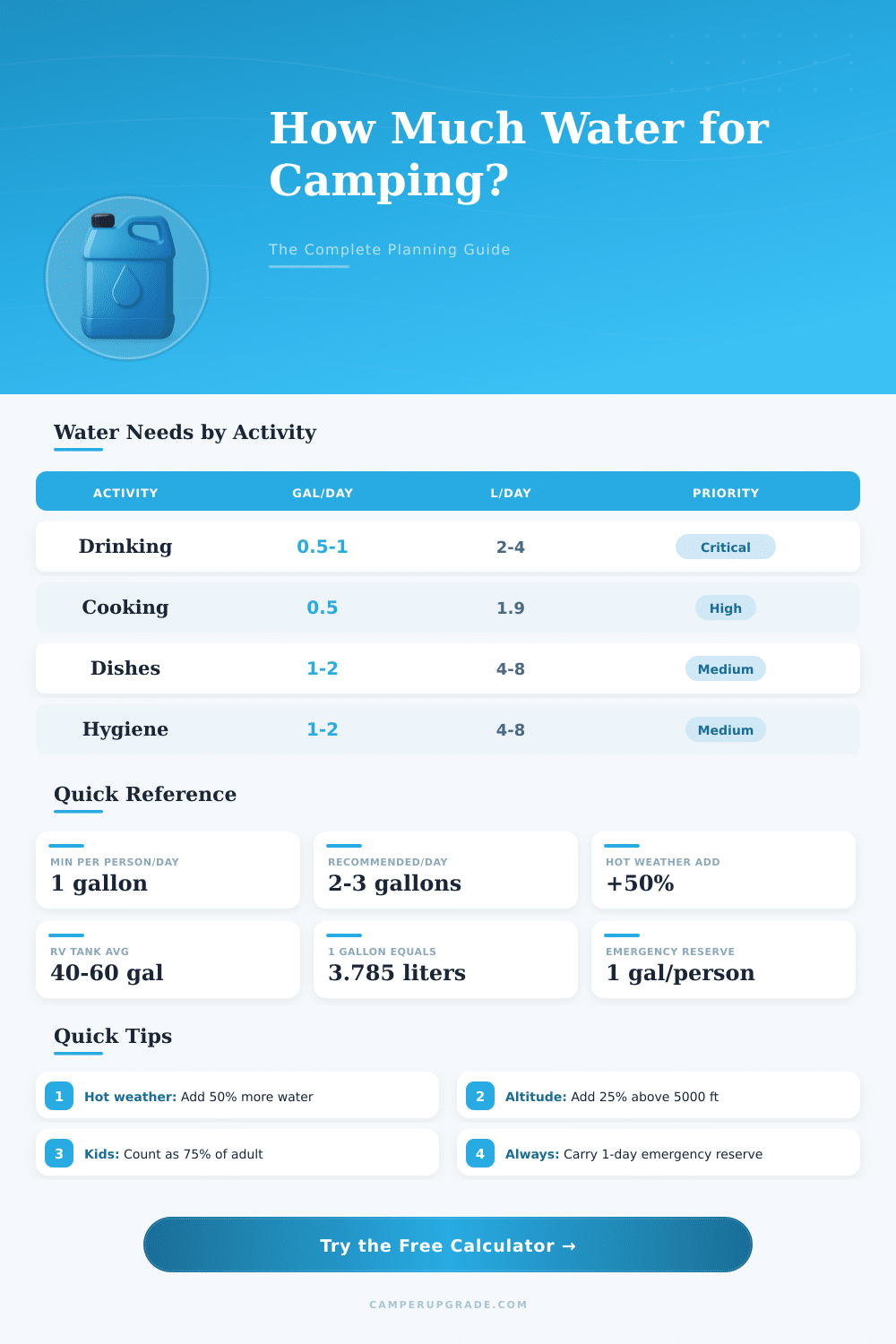
A single gallon of water weighs 8.34 pounds, and that adds up fast when youre hauling for a group. Ive found that tent camping runs about 2 to 3 gallons per person per day. Car camping bumps it closer to 4.
RV setups with short showers? Easily 5 gallons each day per person. Above 90 degrees Fahrenheit, I add 50% more across the board.
How Much Water You Need and Why Water Matters
High altitude above 5000 feet tacks on another 25%, which I didnt expect the first time.
The information below does not come from some computer or translation device. It is based on real explorations, discussions in forums and experiences of the community, that one finds everywhere on the net.
Water is made up of a substance with the chemical formula H2O. It is clear odorless plain and almost colourless. It forms the main part of the rivers on the Earth, of the lakes and of the oceans.
In all known living creatures it involves the biggest portion of the liquids, where it works as a solvent. The elements hydrogen and oxygen chemically combine to create Water. It appears in three forms: gaseous, liquid and solid.
Between its most remarkable traits is the skill to dissolve many other materials.
Almost 70 percent of the human body is made up of Water. People manage to last without food during seven days, but only during two days without Water. It works also as a cleanser, that helps to remove dirt from the blood and from the whole body.
Inside the body Water acts as a cushoin in the eyes, in the spinal area and in the sac, that protects the baby during the pregnancy.
One commonly believes, that every person requires eight glasses of Water daily. Even so not each truly must drink eight ounce glasses a day. Some need less, while others need much more.
Common advice is to consume one ounce of Water for every two pounds of weight. The everyday amount of all liquids, included from foods, is estimated at around 11,5 cups for females and 15,5 cups four men. That matches to about 2,7 liters for women and 3,7 liters for men each day.
People that exercise or live in very warm regions maybe require bigger amounts. Those with tiny bodies can manage with less.
Drinking liquids does not limit to pure Water. Low fat milk, without sugar drinks, tea and coffee all contribute to the daily need. The body receives around 20 percent of its Water demand from foods.
Even foods that seem dry, even so store Water. During the digestion one produces tiny amounts of Water, that the body uses.
Less thirst and urine that looks colourless or light yellow show, that the liquids suffice. Regular drinking of Water during meals, exercise and when thirst attacks, help to avoid drying out.
One cup of usual city tap Water stores zero calories, zero proteins, zero fat, zero carbohydrates, zero fibers and zero sugar. It is between the simplest drinks, that one can imagine.
For outdoor activity, one can carry 5 to 6 liters of Water during mountain climbing, what works well. While an 8-hour march one uses around 4 liters, what is typical.
Enough Water helps the body in ways, that not always show. It removes toxins, controls the body heat and helps feel well and work normally. Even so it does not work miracles regarding skin look, especially for serious skin-problems.
The main benefits happen inside, where one can not observe them.
Water matters also in the kitchen. The method of Water bath, known as bain-marie in French, lays a tin with food in a big shallow bit of warm Water. Like this the food receives gentle heat, not directly.
It works for tender sauces or sweets. When one cooks meat, adding oil to the Water is rare practice. Billions of folks around the globe live without safely delivered Water and hygiene.
The 6th Sustainable Development Goal intends to ensure, that Water and sanitation will be available for everyone until 2030. In New York one delivers more than one billion gallons of fresh pure Water daily from big reservoirs up in the state, some more than 125 miles away, to thetaps of nine millions of users through the whole region.
Water creates everything. It takes every form. It is soft, but in the end beats everything.
It always goes to the lowest spots. It is modest, but feeds every living thing.