🔥 Camping Stove Gas Canister Calculator
Find out exactly how long your gas canister will last based on stove output, canister size & cooking habits
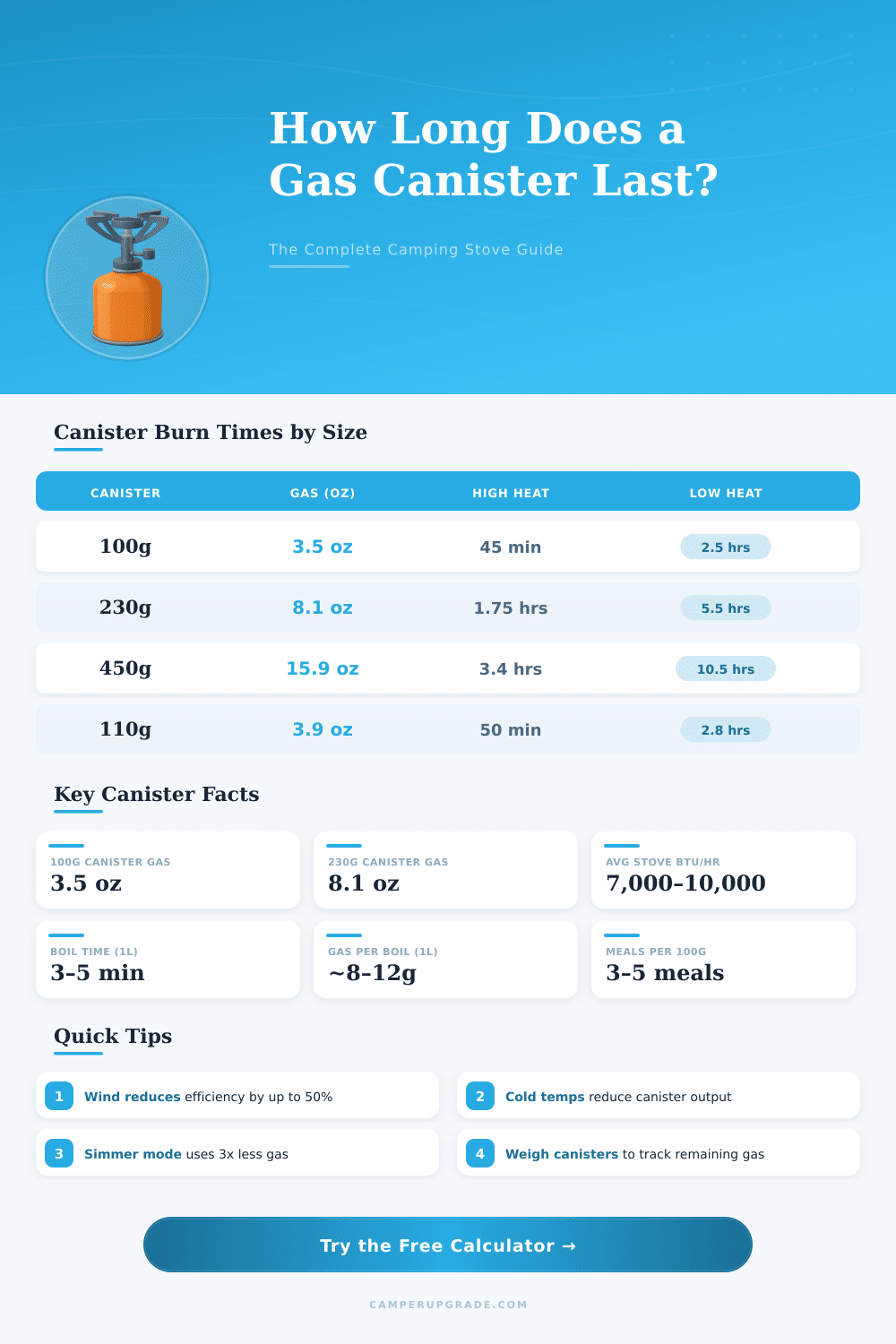
| Canister | Gas Content | Low Heat (~25%) | Medium (~55%) | High (~85%) | Full Blast |
|---|---|---|---|---|---|
| 100g | 3.5 oz / 100g | 2h 30m | 1h 08m | 44m | 37m |
| 110g | 3.9 oz / 110g | 2h 45m | 1h 15m | 49m | 41m |
| 230g | 8.1 oz / 230g | 5h 45m | 2h 37m | 1h 42m | 1h 26m |
| 250g | 8.8 oz / 250g | 6h 15m | 2h 50m | 1h 50m | 1h 33m |
| 450g | 15.9 oz / 450g | 11h 15m | 5h 07m | 3h 19m | 2h 48m |
| 500g | 17.6 oz / 500g | 12h 30m | 5h 41m | 3h 41m | 3h 07m |
* Based on a typical 8,500 BTU/hr (2.49 kW) backpacking stove at stated throttle setting, ideal conditions. Real times vary with wind, cold, altitude, and pot/stove efficiency.
| Stove Output | kW Equiv. | Gas/hr (g) | Gas/hr (oz) | 100g Lasts | 230g Lasts |
|---|---|---|---|---|---|
| 3,500 BTU/hr (simmer) | 1.03 kW | ~41g/hr | ~1.4 oz/hr | ~2h 26m | ~5h 36m |
| 6,000 BTU/hr (low) | 1.76 kW | ~70g/hr | ~2.5 oz/hr | ~1h 26m | ~3h 17m |
| 8,500 BTU/hr (medium) | 2.49 kW | ~99g/hr | ~3.5 oz/hr | ~1h 01m | ~2h 20m |
| 10,000 BTU/hr | 2.93 kW | ~116g/hr | ~4.1 oz/hr | ~52m | ~1h 59m |
| 14,000 BTU/hr (high) | 4.10 kW | ~163g/hr | ~5.7 oz/hr | ~37m | ~1h 25m |
| 20,000 BTU/hr (expedition) | 5.86 kW | ~233g/hr | ~8.2 oz/hr | ~26m | ~59m |
| Condition | Fuel Penalty | Effective Burn Time | Notes |
|---|---|---|---|
| Ideal (calm, >60°F) | +0% | Full rated time | Manufacturer spec conditions |
| Normal (light wind, 40–60°F) | +10% | ~91% of rated | Typical 3-season camping |
| Windy (>15 mph) | +30% | ~77% of rated | Use a windscreen if possible |
| Cold (below 32°F / 0°C) | +40% | ~71% of rated | Isobutane performs better in cold |
| Extreme (wind + cold) | +65% | ~61% of rated | Warm canister in pocket first |
| High altitude (>10,000 ft) | +15% | ~87% of rated | Lower O2, longer cook times |
| Canister | 1 Person | 2 People | 4 People | Stove Assumed |
|---|---|---|---|---|
| 100g canister | ~3 days | ~2 days | ~1 day | 8,500 BTU medium heat |
| 230g canister | ~7 days | ~4 days | ~2 days | 8,500 BTU medium heat |
| 450g canister | ~14 days | ~7 days | ~4 days | 8,500 BTU medium heat |
| 500g canister | ~16 days | ~8 days | ~4 days | 8,500 BTU medium heat |
Stove boilers for Gas Canister is a liked choice for those that go on backpack trips or nature adventures. Those Gas Canister units show themselves compact and fit well with most of the gear for backpacks. The boilers set by means of screw to the screwed upper part of self-closing Gas Canister units that store two pressed gases: isobutane and propane.
They weigh little, require little effort and last for two until three days of backpack travel.
Gas Canister Stoves for Backpacking
Two kinds of modern Gas Canister units are common for backpacks. One of them is the type of Camping Stove without threading, while the others use the 7/16-inch UNEF-screwed connection. In North America almost all tins with threading, that are sold for backpack boilers, are of that kind.
Between the common brands of those boilers find themselves MSR, Primus, Snow Peak and Optimus. All those screwed tins work together according to the mechanical link.
Although the tins seem alike visually, the inner mix of gases differs a lot between different brands. For instance, some carry 85 percent isobutane and 15 percent propane. It is important to know what is inside the tins, especially on cold nights, when the flame of the boiler can weaken.
One good trick is to lay the roll in a jar with warm water, so that it stays at least at 32 degrees, which helps teh flow of the gas. In the United States one finds isobutane tins almost everywhere in the land.
Those boilers connect directly to the Gas Canister for fast and good cooking of foods. They are lightweight, quite strong and give reliable times to boil water four lunches of day hikers or fast meals in a tent. Some models have a tube that runs from the boiler to the tin, so that one can swap the tin without waiting for the boiler to cool.
Compact stove boilers work well when the space is tight and one avoids big jars or pots.
A butane tin will burn around two hours on high flame and four hours on low heat. Also it is possible to buy tins of different sizes. Some boilers are made sturdy, without moving parts and with a broad flame, that heats jars for one until three people.
The fixed four-pint support for jars boosts the stability and resistance against wind. Some versions work for both kinds of tins, with or without threading.
Stove boilers are preferred because of safety in hills. At high heights liquid fuel boilers often have trouble to burn cleanly. Those Gas Canister models are much more easily usable in such cases.
Even so one can not carry Gas Canister units on a plane, so best buy them in a local store near the start of the way. Also one needs care about storage in a warm car, and during fire bans the boilers must have a valve to turn. Gas Canister fuels are bright and fast toinstall, while liquid fuels work more well in cool weather.