☀️ Camping Solar Power Calculator
Calculate exactly how many solar panels and batteries you need for off-grid camping
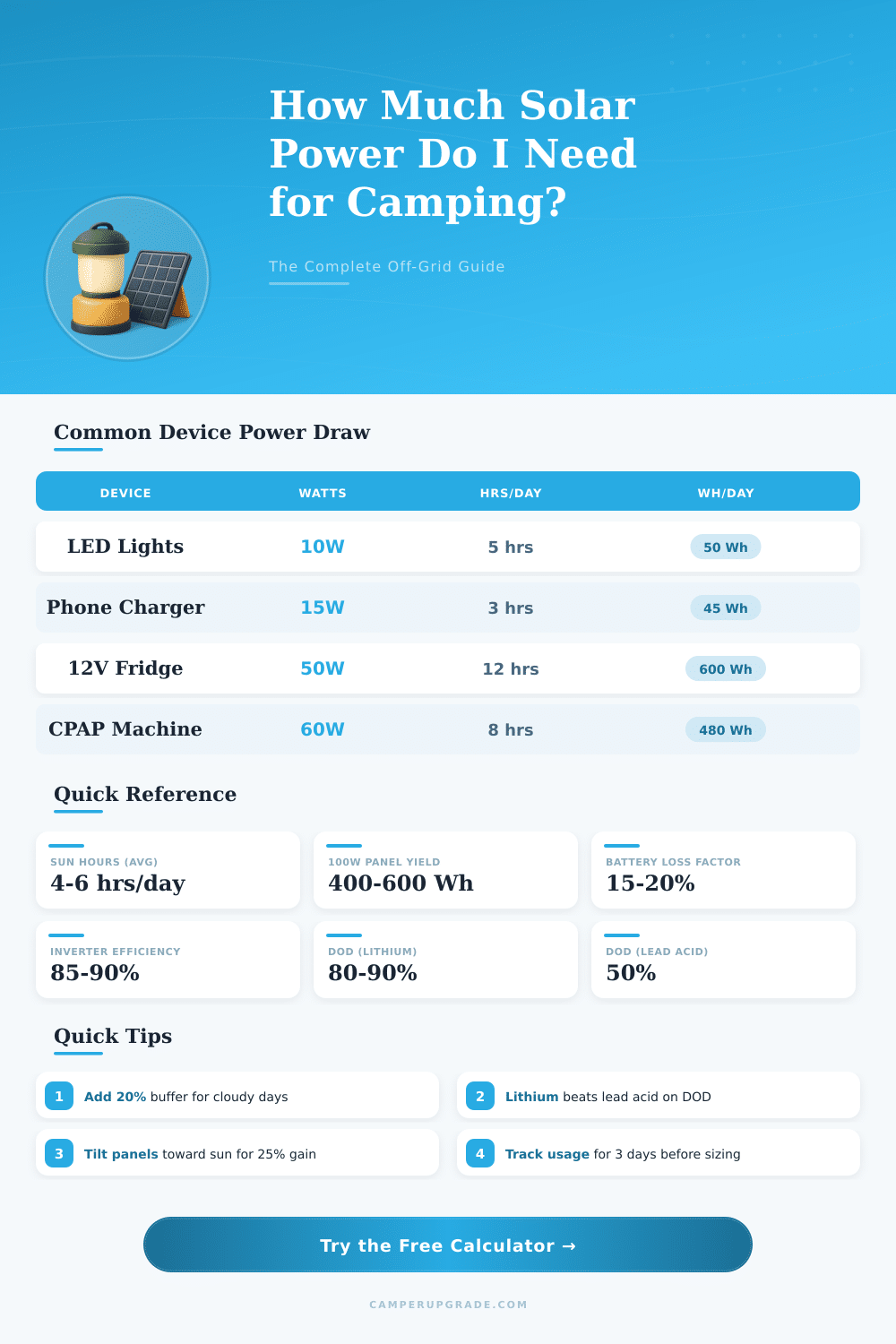
| Device | Watts (Typical) | Hours/Day | Wh/Day |
|---|---|---|---|
| LED Camp Lights | 5–15 W | 5 | 25–75 |
| Phone Charger | 10–18 W | 2–3 | 20–54 |
| Tablet Charger | 15–25 W | 2 | 30–50 |
| Laptop | 45–65 W | 3–5 | 135–325 |
| 12V Fridge (Small) | 30–45 W | 12–16 | 360–720 |
| 12V Fridge (Large) | 50–80 W | 12–16 | 600–1280 |
| CPAP Machine | 30–60 W | 7–8 | 210–480 |
| Starlink Mini | 25–40 W | 6–10 | 150–400 |
| Fan (12V) | 15–30 W | 8 | 120–240 |
| Water Pump | 40–60 W | 0.5–1 | 20–60 |
| Portable Speaker | 5–10 W | 3 | 15–30 |
| Drone Charger | 60–90 W | 1–2 | 60–180 |
| Electric Kettle (12V) | 120–200 W | 0.3 | 36–60 |
| TV / Monitor | 30–60 W | 2–4 | 60–240 |
| Panel Size | 3 Sun Hrs | 5 Sun Hrs | 7 Sun Hrs |
|---|---|---|---|
| 50W | 150 Wh | 250 Wh | 350 Wh |
| 100W | 300 Wh | 500 Wh | 700 Wh |
| 160W | 480 Wh | 800 Wh | 1,120 Wh |
| 200W | 600 Wh | 1,000 Wh | 1,400 Wh |
| 300W | 900 Wh | 1,500 Wh | 2,100 Wh |
| 400W | 1,200 Wh | 2,000 Wh | 2,800 Wh |
| Battery (12V) | Amp-Hours | Watt-Hours | Usable (LiFePO4 80%) |
|---|---|---|---|
| Small Portable | 50 Ah | 600 Wh | 480 Wh |
| Medium | 100 Ah | 1,200 Wh | 960 Wh |
| Large | 200 Ah | 2,400 Wh | 1,920 Wh |
| Dual 100 Ah | 200 Ah | 2,400 Wh | 1,920 Wh |
| Large Bank | 300 Ah | 3,600 Wh | 2,880 Wh |
| XL Bank | 400 Ah | 4,800 Wh | 3,840 Wh |
| Region / Climate | Summer (hrs) | Winter (hrs) | Annual Avg (hrs) |
|---|---|---|---|
| Desert Southwest (AZ, NV, NM) | 7–8 | 5–6 | 6–7 |
| Southern US (TX, FL, CA coast) | 6–7 | 4–5 | 5–6 |
| Midwest US (CO, KS, MO) | 5–6 | 3–4 | 4–5 |
| Pacific Northwest (OR, WA) | 5–6 | 1.5–2.5 | 3–4 |
| Northern US / Canada | 4–5.5 | 1.5–3 | 3–4 |
| Australia (outback) | 7–8 | 5–6 | 6–7 |
| UK / Northern Europe | 4–5 | 1–2 | 2.5–3.5 |
Solar panels rarely produce their full rated output. Heat, angle, partial shade, and wiring losses reduce actual yield by 15–25%. An MPPT charge controller recovers 10–15% more than a PWM controller. This calculator accounts for about 15% system loss by using peak sun hours (which are already adjusted below raw sunlight hours).
For lead acid batteries, never discharge below 50% to protect lifespan. LiFePO4 batteries safely discharge to 80–90%. This means a 100 Ah lead acid battery only provides 50 Ah usable, while a 100 Ah lithium gives you 80–90 Ah. Always size batteries based on usable capacity, not total rated capacity.
A 100W panel in 5 peak sun hours only generates about 500 watt-hours, which blew my mind because a 12V camping fridge alone can pull 600 to 720 Wh daily running 14 hours at 45 watts. Thats already more than one panel covers. Bump to 2 panels and youre at 1000 Wh, which handles most van life setups with a fridge, lights, and phone charging.
CPAP users need around 400 Wh nightly so that eats a full panels output alone. Lithium batteries give you 80% usable capacity versus 50% for lead acid, meaning a 100 Ah lithium at 12V delivers 960 usable watt-hours while AGM gives just 600.
Simple Guide to Solar Panels and Batteries
The information in this article does not come from computer or automatic translator. It is based on real searches, discussions in forums and experiences of communities that one finds everywhere on the net.
solar power is made up of the change of sun energy into electricity. One can do that directly by means of photovoltaics, usually called PV, or indirectly by means of focused sun power, known as CSP. Here are the two main kinds of solar power technology that are available currently.
Solar panels work thanks to the photoelectric effect that changes light into electrical energy.
solar power ranks between the cleanest and most plentiful renewable resources. The United States has between the richest sun resources globally. Between its main benefits are that it generates itself and it is possible to use it everywhere.
Also it is silent technology, which does please many.
Little photovoltaic cells feed calculators, garden clocks and other tiny electronics. One ties bigger solar cells into panels, and those panels form sets, that deliver electricity for bigger uses. The production of solar PV reached record level of 320 TWh in 2023, what marks a 25 percent increase over 2022.
That is remrakable progress.
Solar panels work at full power only for around 6 hours in a day, and at less power during the other 6 hours. Like this solar power becomes an unreliable resource. Without batteries solar panels either poorly produce energy, or can not work alone from the net always.
To have energy when the net fails does rank between the main arguments four solar installations.
Widely one kilowatt of solar setup involves around 100 square feet and generates roughly 1,100 kWh yearly. Installations between 5 and 10 kW usually suffice for the energy needs of many houses. For a typical home one needs between 16 and 23 solar panels to cover whole electricity use.
A standard home solar panel measures around 17.5 square feet. More panels and bigger install space means more energy surplus.
With solar power there does not exist cost for fuel. However the devices to seize energy, transport it and store it for nights, when the sun does not shine, do cost money. Systems at 10 kilowatts or less commonly receive grants from particular foundations, hence many home PV installations stay under 10 kW.
Adding around 20 percent reserve to the size of your solar setup is wise to make up for absences.
Shade and angle of panels matters a lot. If panels turn north or suffer heavy shading, the output will be much more low than planned. One rates solar panels according to their rating of watts in peak, but that value measures DC electricity under standard test conditions, that does not always match with actual life.
Cooking by means of solar power truly is possible. One already cooked food by means of only 10 watts of sun power, using an insulating container together with solid state warm element. A 100 watt solar panel cooks for a whole family, if one ties it with good insulation.
By means of 1000 watts of solar power one boils a liter of water in around 6 minutes. Insulating the kitchen, even slow systems boil water in one hour. New designs of solar kitchens, that use absorbers like black chrome surface, black jars and curved reflectors with Mylar tape, reach efficiency above 41.2 percent.
New ideas for solar cooking systems help farmers cook more steadily and escape firewood. Thermal containers work together with solar driven thermal kitchens, allowing to cook at high temperatures even during cloudy days or evenings. Direct solar thermal cooking answers for many uses, but safety for eyes is an important problem atstronger devices.
Solar technology continuously improves. Farmers even graze livestock under solar panels, and rooftop solar panels can replace shade covers to protect against direct sunshine. The benefits of solar power expect only more increase in the coming years.