🔥 Camping Propane Calculator
Calculate exactly how much propane you need for your camping trip based on appliances, usage, and trip length
| Tank Size | Propane Weight | Camp Stove Runtime | Heater Runtime |
|---|---|---|---|
| 1 lb Canister | 1 lb (0.45 kg) | ~1 hr | ~4.5 hrs |
| 16.4 oz Canister | 1.02 lb (0.46 kg) | ~1 hr | ~4.6 hrs |
| 5 lb Tank | 5 lb (2.3 kg) | ~5.5 hrs | ~23 hrs |
| 11 lb Tank | 11 lb (5 kg) | ~12 hrs | ~50 hrs |
| 20 lb Tank | 20 lb (9.1 kg) | ~22 hrs | ~91 hrs |
| 30 lb Tank | 30 lb (13.6 kg) | ~33 hrs | ~136 hrs |
| Activity Level | Per Person/Day (lbs) | Per Person/Day (kg) | Description |
|---|---|---|---|
| Minimal | 0.25 – 0.5 | 0.11 – 0.23 | Boiling water only, 1 meal |
| Light | 0.5 – 0.75 | 0.23 – 0.34 | 2 simple meals, coffee |
| Moderate | 0.75 – 1.25 | 0.34 – 0.57 | 3 meals, some grilling |
| Heavy | 1.25 – 2.0 | 0.57 – 0.91 | Full cooking + heating |
| RV Full Hookup | 1.5 – 3.0 | 0.68 – 1.36 | Stove, oven, fridge, heater, water heater |
| Trip Scenario | Propane (lbs) | Propane (kg) | Suggested Tank |
|---|---|---|---|
| Solo Overnighter | 0.5 – 1 | 0.2 – 0.5 | 1 lb canister |
| Couple Weekend (2 days) | 2 – 4 | 0.9 – 1.8 | 2–4 x 1 lb canisters |
| Family Weekend (4 ppl) | 4 – 8 | 1.8 – 3.6 | 5 lb or 11 lb tank |
| Solo Week Trip | 4 – 7 | 1.8 – 3.2 | 5 lb tank |
| Family Week (4 ppl) | 12 – 25 | 5.4 – 11.3 | 20 lb tank |
| RV Weekend | 8 – 15 | 3.6 – 6.8 | 20 lb tank |
| RV Full Week | 20 – 40 | 9.1 – 18.1 | 20–30 lb tank |
| 2‑Week Extended | 15 – 35 | 6.8 – 15.9 | 20 lb tank (or 2x) |
| Tank | Propane Capacity | Gallons (Liters) | Total Tank Weight |
|---|---|---|---|
| 1 lb Canister | 1 lb (0.45 kg) | 0.24 gal (0.9 L) | ~1.8 lbs (0.8 kg) |
| 5 lb Tank | 5 lb (2.3 kg) | 1.2 gal (4.5 L) | ~13 lbs (5.9 kg) |
| 11 lb Tank | 11 lb (5 kg) | 2.6 gal (9.8 L) | ~24 lbs (10.9 kg) |
| 20 lb Tank | 20 lb (9.1 kg) | 4.7 gal (17.8 L) | ~38 lbs (17.2 kg) |
| 30 lb Tank | 30 lb (13.6 kg) | 7.1 gal (26.9 L) | ~55 lbs (24.9 kg) |
| 40 lb Tank | 40 lb (18.1 kg) | 9.4 gal (35.6 L) | ~72 lbs (32.7 kg) |
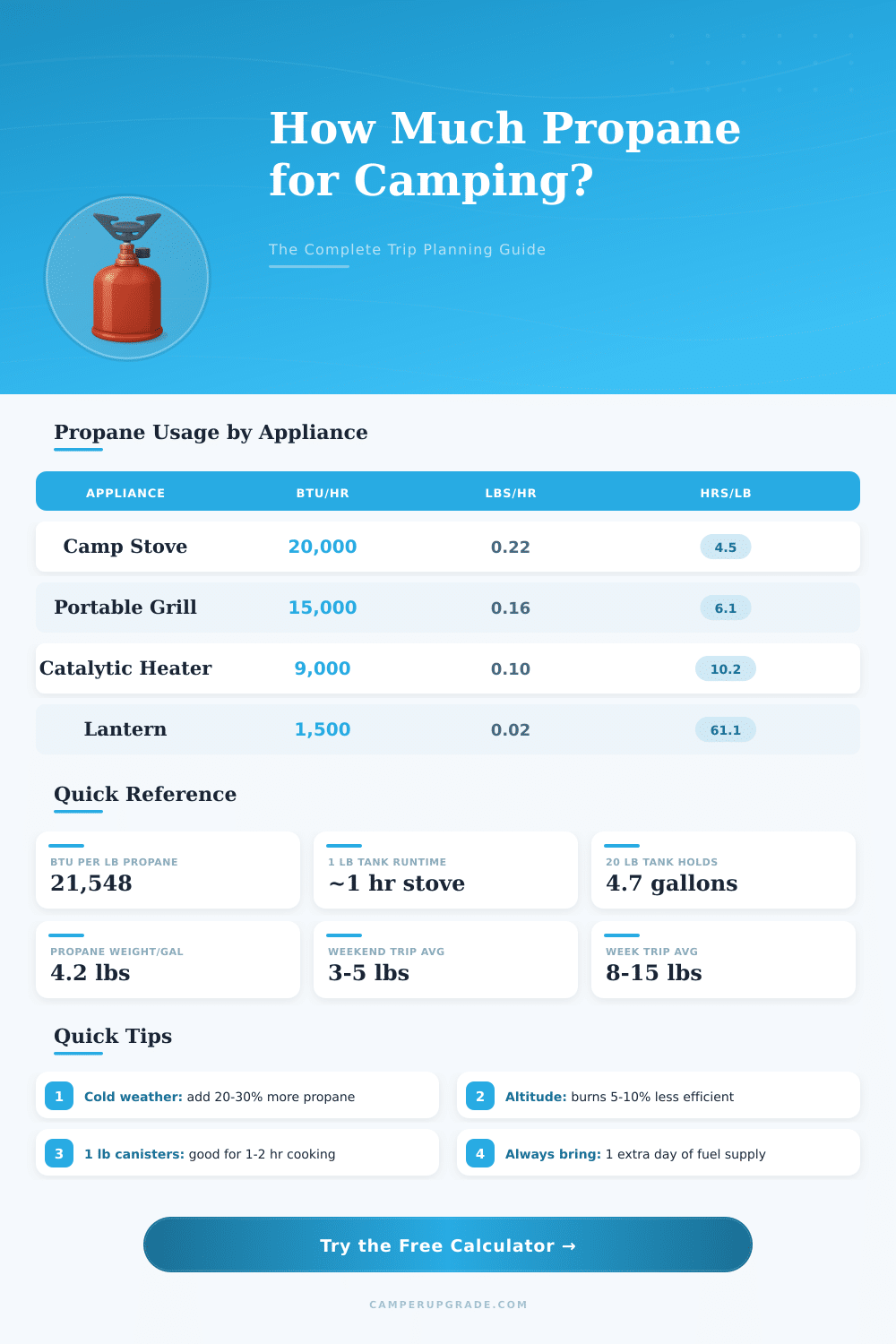
A standard 16.4 oz canister holds roughly 1 lb of propane and delivers about 21,548 BTU total. Ive burned through one in under an hour on a two burner camp stove running at 20,000 BTU. Thats way faster than most people expect.
A portable grill at 15,000 BTU stretches that same canister to maybe 90 minutes, and a catalytic heater at 9,000 BTU can squeeze out around 2.4 hours from it. For a weekend with two people I kept landing on 3 to 5 pounds total. Cold weather bumps that 25 to 30 percent higher easily.
Propane Basics, Uses and Tank Sizes
The information below does not come from some computer calculator or automatic translator. It bases on actual user experiences, discussions in forums and community knowledge from the whole net.
Propane is a gas with three carbons in a chain, whose chemical formula is C3H8. It stays gaseous in normal temperature and pressure, but turns into liquid during compression. Like this one can preserve and move it.
In a tank Propane exists as clear and odorless liquid under high pressure. If one opens the pressure, the liquid turns into steam, and that steam one burns as fuel.
Propane itself has no smell. So that one can detect possible leaks, one adds smelling material called ethyl mercaptan. It is not toxic.
Sometimes one calls it liquefied petroleum gas or simply LPG. It is received as a by-product during the preparation of natural gas or the refining of crude.
Technically Propane works as gas and as liqiud at the same time. In a roll, in a truck or in a big tank, it stays liquid. Through underground tubes it arrives to a home in liquid state, but later turns into steam before devices use it.
Like this it adapts to the circumstances in both states.
Chemically Propane belongs to the group of alkanes. They are made up of simple chains of carbon atoms, that hydrogen atoms surround. During combustion with enough oxygen, Propane gives water steam, carbon dioxide and much heat.
Compared to coal, natural gas, diesel or gasoline, it less pollutes the surroundings. Unlike natural gas, that chiefly is methane with one carbon and four hydrogens, Propane stores three carbons and eight hydrogens for every molecule.
A big plus of Propane is, that it does not go bad quickly like gasoline. It can stay a long time in storage without any damage. So it works four generators, that can wait in a possible electrical pause.
The sizes of tanks a lot range. The portable tins of 20 pounds are most used and standard for grills, fryers for turkeys, devices against flies and little heaters. From here one finds up to tanks more than 2,000 gallons.
A tank of 200 gallons is 94 inches long and has 30 inches of diameter. One uses it for extra heating or for running two home machines, for instance generators, heaters for pools or for water. A tank of 320 gallons stands between that of 250 and 500 gallons, so it well suits for folks, that want to bury their tank underground, but do not want one as big as 500 gallons.
A tank of 1,000 gallons works for big commercial properties, while a 100-pound tin helps a little business or a vacation cottage. Most tanks, including those of 500 and 1,000 gallons, can be buried. The biggest, that stores up to 24,000 gallons, is 70 feet long and 10 feet tall, and one uses them for vast commercial areas, big factories or stations for filling.
For security, Propane tanks obey the rule of 80 percent filling. A tank of 500 gallons, when “full”, truly stores only 400 gallons. Bigger units give better steam during cold weather and need fewer deliveries.
On Propane tanks one stamps a date of expiration beside the valve. If your tank soon will end, it is good to exchange it for a new full one at a store. Refilling the old instead of changing also saves money.
Filling costs around 7 dollars, while changing comes to 20 dollars.
Propane monthly costs more than natural gas. For instance, natural gas can be 30 to 60 dollars a month, while Propane reaches 90 to 200 dollars. But the first expense to install a natural gas line to a distant place commonly is very high.
So Propane makes sense for houses far from such lines. Propane burns hotter than butane, but for cooking like caramelizing sugar, butane works well. Propane reaches the needed temperatures for sauteing and other tasks with high heat.
In Propane kitchens one can have burners with high BTU value, from 15,000 BTU upward, for frying.
Oil for heating risks pollution and is a much more dirty fuel. Propane is much more pure in comparison. Switching a home from oil to onewith Propane commonly results in lower cost in the end.